Latest News
-
 Skydiving as a Confidence Booster: How One Jump Can Change Your Life September 20, 2026
 -
 How to Convince Your Parents to Let You Skydive September 19, 2026
 -
 How to Land a Parachute Safely: A Beginner’s Guide September 18, 2026
 -
 Static Line vs AFF: Choosing Your Path to Solo Skydiving in 2026 September 17, 2026
 -
 Skydiving A License: Your Passport to the Skies September 16, 2026
What to Wear Skydiving: The Ultimate Outfit Guide for Your Big Jump
August 2, 2026 12:00 amThe morning of your skydive, you’re not thinking about your outfit. You’re thinking about hurling yourself out of a plane at 13,000 feet. But here’s the thing: what you wear skydiving genuinely matters, and getting it wrong can turn the most exhilarating moment of your life into a very cold, very uncomfortable one.
You’re not alone if you’ve pictured your jacket billowing up around your face at 120mph, or wondered whether you’ll be shivering before you even reach the door of the aircraft. Those concerns are completely valid. Altitude brings a serious chill, and loose clothing and high-speed freefall are not a happy combination.
The good news? Dressing for a skydive is far simpler than you think. This guide covers exactly what to wear from head to toe, what to leave at home, and how to make sure your outfit works with your harness rather than against it. And if you’re jumping with us at our Cambridgeshire dropzone, you’ll be pleased to know a jumpsuit is provided, so your own clothes stay protected throughout the whole incredible experience.
Key Takeaways
- Knowing what to wear skydiving is simpler than you think, and getting it right means you can focus entirely on the thrill rather than the chill.
- Layering thin, flexible clothing is the smartest approach to handling the significant temperature drop you will experience at 13,000 feet.
- Your footwear is a genuine safety consideration, not just a style choice, so the right shoes are non-negotiable on jump day.
- A jumpsuit is provided for you at our Cambridgeshire dropzone, protecting your own clothes and keeping you looking great for your photo and video package.
- A few simple final checks, like emptying your pockets and leaving jewellery behind, can make the difference between a seamless experience and an avoidable headache.
Comfort is King: The Basics of Skydiving Attire
Before you think about anything else, think about movement. Your body goes through a lot during a tandem skydive. You’ll arch your back in freefall, lift your legs for landing, and twist and adjust throughout the whole experience. Your clothing needs to move with you, not fight you. Figuring out what to wear skydiving really comes down to one core principle: if it restricts you, leave it at home.
Athleisure and sportswear are your best friends here. Think gym gear, running tights, or a soft tracksuit. These fabrics are designed for a full range of motion, they’re lightweight, and they sit comfortably beneath a safety harness without bunching, pinching, or digging in. That last point matters more than most people expect. A tandem harness fits snugly across your chest, hips, and thighs, so anything stiff or bulky underneath is going to make for an uncomfortable ride.
Stiff denim and heavy leather jackets are a firm no. They restrict movement, they don’t compress well under a harness, and they add unnecessary bulk. Save them for the celebration afterwards.
Prioritising Mobility and Flex
Your instructor will guide you through a landing position that requires you to lift your legs out in front of you. It sounds simple, but if you’re wearing rigid jeans or stiff trousers, that movement becomes genuinely difficult. Leggings, joggers, or tracksuit bottoms give you the flexibility to nail that position without a second thought. A good rule of thumb: if you can comfortably do a squat in it, you can jump in it.
Avoiding the Flap Factor
Freefall speed reaches around 120mph. At that velocity, loose fabric doesn’t just flap, it snaps against your skin with real force. It’s distracting at best and genuinely painful at worst.
- Hoodies: Only wear one if the hood can be tucked away completely. A loose hood at 120mph becomes a problem fast.
- Baggy tops: Opt for fitted or semi-fitted tops that stay in place during freefall. A close-fitting long-sleeved top is ideal.
- Oversized layers: These can ride up and obscure your instructor’s access to the harness. Keep it streamlined.
The good news is that when you jump with us at our Cambridgeshire dropzone, you’ll be kitted out in a provided jumpsuit that goes over your own clothes. So your outfit underneath doesn’t need to be perfect, it just needs to be practical and comfortable enough to wear for a full day out.
Mastering the Layers: Dressing for the British Weather
Britain doesn’t do predictable. You can set off from home in sunshine and arrive at the dropzone to find grey skies rolling in from the fens. But whatever the ground-level forecast says, one thing never changes: it gets significantly colder as the aircraft climbs toward 13,000 feet. We’re talking a temperature drop that can genuinely catch you off guard if you haven’t dressed for it.
The smartest approach to figuring out what to wear skydiving in the UK is to think in layers rather than single bulky items. Multiple thin layers trap warm air between them far more effectively than one thick garment, and they give you the flexibility to peel one off if Cambridgeshire decides to deliver an unexpectedly gorgeous afternoon. That adaptability is everything when you’re dealing with British weather.
Summer Skydiving Essentials
On a warm summer’s day, a fitted t-shirt and light, flexible trousers will cover the basics on the ground. But don’t let the sunshine fool you. The air at altitude is noticeably cooler, and at 120mph it hits your skin hard. Adding a thin long-sleeved layer over your t-shirt protects your arms from windburn during freefall and gives you something to tie around your waist the moment you land and the heat kicks back in. Light, breathable fabrics work best here. Think base-layer tops rather than heavy cotton.
Winter Warmth at 13,000 Feet
Winter jumps are a different beast entirely. A thermal base layer is genuinely non-negotiable when temperatures on the ground are already low, because what feels cold at ground level feels brutal at altitude. Layer a fleece jumper over the top and you’ve got a combination that delivers serious warmth without the bulk that causes problems with your harness fit.
That last point is worth emphasising. Enormous puffer jackets might feel tempting on a cold January morning, but they compress awkwardly under a tandem harness and can interfere with the fit around your chest and hips. Stick to streamlined, close-fitting warmth rather than volume.
- Thermal base layer: Your first line of defence against the cold at altitude.
- Fleece mid-layer: Warm, compressible, and harness-friendly.
- Thin outer layer: A fitted softshell or close-cut jacket adds wind protection without the bulk.
Remember, a jumpsuit goes over everything you wear at our Cambridgeshire dropzone, so your layers stay protected throughout. Plan your clothing around comfort and warmth, and let the jumpsuit handle the rest. If you’re ready to start planning your jump day, book your tandem skydive experience and we’ll walk you through everything you need to know before you arrive.
Stepping Up: Why Your Choice of Shoes Matters
Most people spend a lot of time thinking about what to wear skydiving from the waist up and almost no time thinking about their feet. That’s a mistake. Your footwear is a genuine safety consideration, not a style preference, and it’s one of the first things your instructor will check before you go anywhere near the aircraft.
Think about the physics of it. You’re moving at around 120mph during freefall. Your feet are exposed to that same wind force, and a shoe that fits loosely on the ground can behave very differently at altitude. Then there’s the landing itself. Your feet are the first point of contact with the ground, and the position you land in puts real demand on your ankles and soles. The wrong footwear makes a smooth, controlled landing significantly harder than it needs to be.
The Case for Trainers
Standard running shoes or lace-up trainers are the ideal choice for jump day. They’re lightweight, they flex with your foot during the landing position your instructor will teach you, and a flat sole gives you a stable, even surface to touch down on. Crucially, they stay on your feet. Before you board the aircraft, tie your laces tightly and double-knot them. It sounds obvious, but it’s worth doing deliberately rather than assuming they’ll hold.
Why Boots are a No-Go
Hiking boots might feel like a sensible, sturdy option. They’re not. The real danger isn’t the weight or the stiffness, though both cause problems. It’s the lace hooks. Many hiking and walking boots use open metal hooks rather than eyelets to thread the laces through. Those hooks can catch on parachute lines during deployment, and that’s a risk no instructor will accept. Beyond the hook hazard, heavy boots restrict the ankle movement your instructor needs from you during the landing sequence. Flexible ankles help absorb impact and allow you to adjust your position in the final seconds before touchdown. Rigid boots work against all of that.
- Do wear: Lace-up trainers or running shoes, tied tightly with double-knotted laces.
- Do wear: Shoes with a flat, even sole for a stable landing surface.
- Don’t wear: Hiking boots with open lace hooks.
- Don’t wear: Sandals, slip-ons, flip-flops, or any footwear that doesn’t fasten securely.
- Don’t wear: High heels or platform soles of any kind.
Getting your footwear right is one of those small decisions that makes a big difference. Solid trainers, tied properly, and you’re good to go. It really is that straightforward.

Professional Gear: What We Provide on the Day
Here’s something that surprises a lot of first-timers: you don’t need to buy a single piece of specialist equipment for your tandem skydive. Not one item. Everything you need on jump day is provided for you at our Cambridgeshire dropzone, fully inspected, properly fitted, and ready to go. So when you’re thinking about what to wear skydiving, the honest answer is that the most important gear is already sorted.
The Iconic Skydiving Jumpsuit
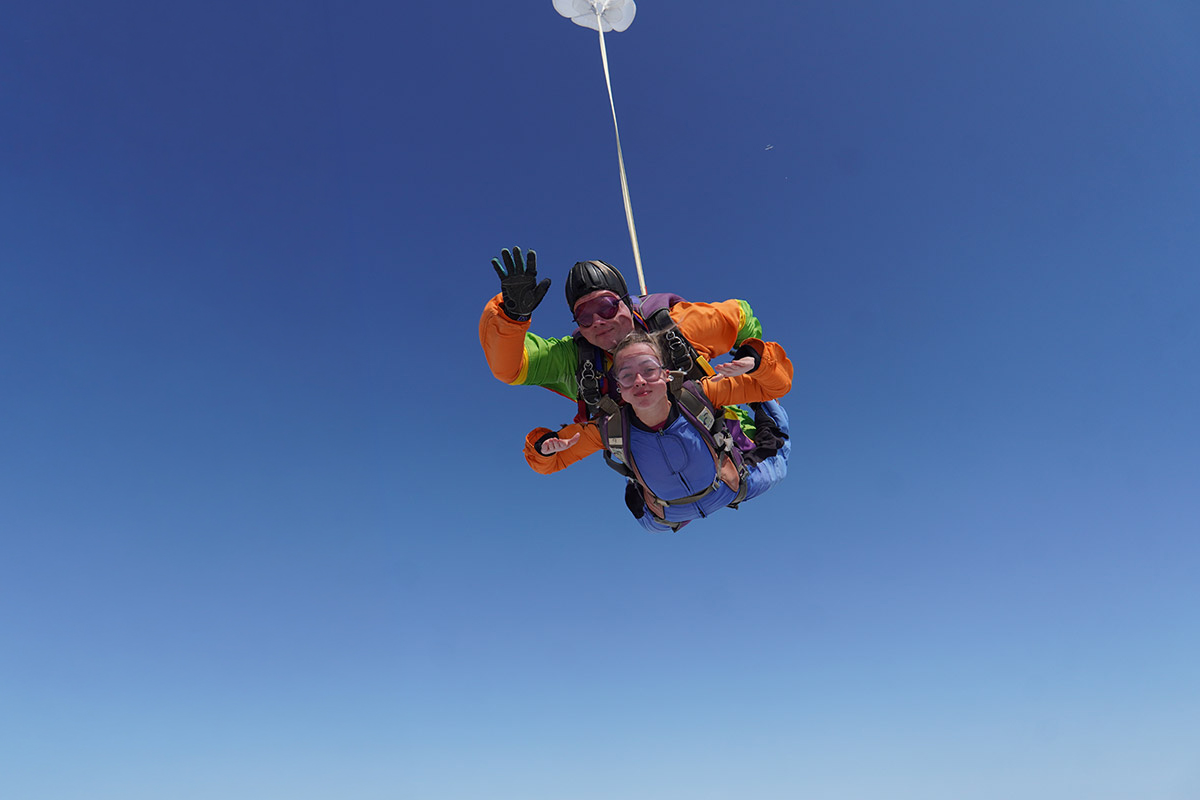
The moment you arrive, you’ll be kitted out in a proper skydiving jumpsuit that goes straight over your own clothes. This isn’t just for show. The jumpsuit does two genuinely useful jobs. First, it shields your outfit from the grass stains and mud that are an unavoidable part of landing in a Cambridgeshire field. Second, it adds a meaningful layer of wind protection during freefall, where the air hits you at around 120mph and every extra barrier counts.
There’s a third benefit worth mentioning. The jumpsuit looks brilliant on camera. If you’re adding a video and photo package to your experience, and most people do once they realise how incredible the footage looks, the jumpsuit means you’ll look the part from the moment you step onto the dropzone. No wardrobe regrets. Just a great shot.
Goggles and Headgear
Without goggles, freefall at altitude would be genuinely eye-watering. The wind force is intense enough to make it impossible to keep your eyes open, which would be a shame given you’re about to see Cambridgeshire from 13,000 feet. We provide goggles for every jumper, so that view is yours to enjoy without squinting through it.
We also provide soft caps and head liners to keep hair out of your face during the jump. They’re comfortable, they sit neatly under your helmet, and they make a real difference to how the experience feels.
One thing that catches people off guard: you can absolutely wear goggles over prescription glasses. Contact lens wearers are equally well catered for. Our team will fit everything around whatever you need, so vision is never a barrier to the full experience.
Every single piece of safety equipment is regularly inspected to meet strict UK standards, and our instructors will check the fit of your gear personally before you go anywhere near the aircraft. Nothing is left to chance. Ready to experience it for yourself? Book your tandem skydive today and we’ll take care of the rest.
Ready for Takeoff: Final Tips for Your Tandem Experience
You’ve sorted your layers, you’ve laced up your trainers, and you know exactly what to wear skydiving. But before you head to the flight line, there are a few final checks that take less than two minutes and can save you a genuine headache on the day.
Start with your pockets. Empty them completely. Coins, keys, phones, lip balm, anything loose becomes a serious projectile at 120mph. Your instructor will check this before you board the aircraft, but doing it yourself beforehand means there are no last-minute delays while you hunt for somewhere to leave your belongings.
Jewellery and watches need to come off too. Rings, necklaces, and bracelets can catch on equipment or cause discomfort under a harness that fits tightly against your body. Leave them locked safely in your car or with someone on the ground. They’ll be there when you land, buzzing with a story to tell.
Long hair is another thing worth sorting before you arrive. Tie it back securely and keep it low, so it sits comfortably beneath your helmet rather than whipping across your face during freefall. A tight bun or low ponytail works perfectly. Loose hair at altitude is uncomfortable at best and distracting at worst.
And then, once all of that is done, there’s only one thing left to do. Prepare yourself for the unforgettable sensations of freefall. The rush of air. The impossible view. The moment your stomach catches up with the rest of you. Nothing quite prepares you for it, and that’s exactly the point.
Charity T-Shirts and Costumes
Jumping for a cause? You’re absolutely not alone. Many charity jumpers choose to wear their branded t-shirt over their jumpsuit for photos, and it works brilliantly. Just make sure the t-shirt is large enough to pull comfortably over the jumpsuit without pulling or restricting your movement. A size up from your usual is usually the safest bet. If you’re planning something more elaborate, like a fancy dress costume, get in touch with us before your jump day. Some costumes work well and some create problems with harness fit or safety equipment, so a quick check beforehand means no surprises on the day.
Booking Your Adventure in Cambridgeshire
Tandem skydiving is the simplest, most accessible way to experience freefall for the first time. You don’t need any prior experience, any specialist kit, or any particular level of fitness. You just need to show up. Our dropzone is based in March, Cambridgeshire, making it an ideal location whether you’re travelling from London or further north. The fenland skies are wide, the views are extraordinary, and our instructors are with you every single step of the way. Now you know what to wear skydiving, there’s only one thing left to do. Take the leap. Book your tandem skydive today and make a memory that genuinely lasts a lifetime.
Your Jump Day Starts Here
Knowing what to wear skydiving really does come down to a handful of simple decisions. Flexible, close-fitting layers to handle the altitude chill. Lace-up trainers tied tight. Pockets emptied and jewellery left behind. Get those things right and you’re genuinely ready for everything jump day throws at you.
The rest is taken care of. At our Cambridgeshire dropzone, our highly experienced British Skydiving instructors guide you through every step, all your safety equipment is provided, and the stunning fenland views stretching out beneath you at 13,000 feet are unlike anything you’ve seen from the ground. Whether you’re jumping for a charity close to your heart or simply chasing the most extraordinary experience of your life, this is the moment you’ll talk about for years.
Don’t let another day pass wondering what it feels like. Book your life-changing tandem skydive in Cambridgeshire today! Your adventure is waiting.
Frequently Asked Questions About What to Wear Skydiving
Can I wear my glasses or contact lenses while skydiving?
Yes, absolutely. You can wear both glasses and contact lenses during your tandem skydive. Goggles are provided at our Cambridgeshire dropzone and are designed to fit comfortably over prescription glasses, so your vision is fully protected throughout freefall. Contact lens wearers don’t need to do anything differently. The goggles seal well enough to prevent wind from drying your lenses out during the jump.
Should I wear a specific type of bra for skydiving?
A standard, well-fitted sports bra is the most comfortable option. The tandem harness fits snugly across your chest, so anything with underwiring, thick padding, or rigid structure can dig in uncomfortably under that pressure. A soft, supportive sports bra sits flat against your body and stays comfortable throughout the entire experience, from the aircraft climb to landing. Underwired bras aren’t banned, but most people who’ve jumped in one wish they hadn’t.
Is it okay to wear shorts if the weather is very hot on the ground?
Shorts are technically allowed, but they’re genuinely not recommended. Even on the hottest summer day, the temperature at 13,000 feet is significantly colder than at ground level, and bare legs at 120mph will feel the full force of that wind chill. A pair of lightweight, flexible leggings or thin joggers will keep you comfortable at altitude without making you overheat on the ground. The jumpsuit provided over your clothes adds some protection, but your legs from the knees down will still be exposed.
What happens if I wear the wrong shoes on the day?
Your instructor will flag the issue before you board the aircraft, and in some cases you may be asked not to jump until suitable footwear is found. This isn’t about being difficult. It’s a genuine safety call, particularly if you’re wearing boots with open lace hooks that can catch on parachute lines. It’s worth sorting your footwear well in advance rather than risking a delay or disappointment on jump day. Lace-up trainers are the simple, reliable answer.
Do I need to bring my own gloves for a winter jump?
Bringing a pair of thin gloves for a winter jump is a smart idea and something we’d actively encourage. Your hands are exposed during freefall and the cold at altitude hits them fast. Thin thermal or running gloves work well. Avoid thick, bulky gloves that reduce your grip and dexterity. Check with the dropzone team before your jump day if you’re unsure whether the gloves you have are suitable, as they’ll be able to advise based on conditions.
Can I wear a GoPro or my own camera on my head?
No. Personal cameras, GoPros, and any head-mounted recording devices are not permitted for first-time tandem jumpers. This is a strict British Skydiving safety rule, not a dropzone preference. Inexperienced skydivers aren’t trained to manage a camera safely at altitude, and a device catching the wind or a parachute line creates a serious risk. If you want incredible footage of your jump, our video and photo packages capture the whole experience professionally, and the results are genuinely spectacular.
What should I do with my long hair during the jump?
Tie it back low and secure it tightly before you arrive at the dropzone. A tight bun or low ponytail sits comfortably beneath your helmet without pulling or shifting during freefall. Avoid high ponytails, which can interfere with helmet fit. We provide soft head liners that help keep everything in place, but they work best when your hair is already neatly contained. Loose hair at 120mph is uncomfortable and distracting, so this one small prep step makes a real difference.
Is there a place to change into my skydiving clothes at the dropzone?
Yes, changing facilities are available at our Cambridgeshire dropzone. That said, most people find it easiest to simply arrive wearing what they plan to jump in. Your own clothes go straight under the provided jumpsuit, so there’s no need to bring a separate outfit specifically for the jump. Wearing your layers from home saves time and means you’re ready to get straight into the briefing when you arrive. Just pack a change of clothes for afterwards if you’re heading somewhere afterwards to celebrate.
Categorised in: Blog