Latest News
-
 4 ways to make your first skydive feel more manageable November 10, 2026
-
 What’s the Scariest Part of Skydiving? How Freefall Feels November 9, 2026
-
 Parental Consent for Skydiving and Young Jumpers November 8, 2026
-
 How to Position Your Body and Breathe During Freefall November 7, 2026
-
 Pressure Changes During Skydiving: Why Your Ears Hurt November 6, 2026
Pressure Changes During Skydiving: Why Your Ears Hurt
November 6, 2026 12:00 amAs you climb, outside air pressure falls, so trapped gas expands. That’s why pressure changes during skydiving can affect your ears and expand gas in your digestive tract. The Eustachian tubes help equalise pressure in the middle ear, but if they don’t open easily, you may feel pain, fullness or muffled hearing.
If your ears often hurt during a jump, the discomfort can take the edge off an otherwise incredible experience. Understanding what’s happening can help you recognise factors that may raise the risk of barotrauma, an injury caused by pressure differences, and what to discuss before jumping again. This article explains how gas responds to changing pressure, why you may feel the effects in your ears and abdomen, and how congestion or recent dental treatment may matter. You’ll have a clearer picture of how your body responds as you ascend and descend, so you can approach your next skydive with more confidence.
Key Takeaways
- As altitude increases, outside pressure falls and gas expands. Boyle’s Law helps explain why pressure changes can affect air spaces in your body.
- Intestinal gas can expand during ascent, which may cause bloating or discomfort. Learn what can influence how noticeable it feels.
- Congestion, recent dental treatment and other factors may raise the risk of barotrauma. Understanding these risks can help you make a more informed decision about jumping.
- Pressure doesn’t change at the same rate throughout a skydive. The altitude profile and whether you’re in freefall or under canopy both matter.
Ambient pressure and gas volume
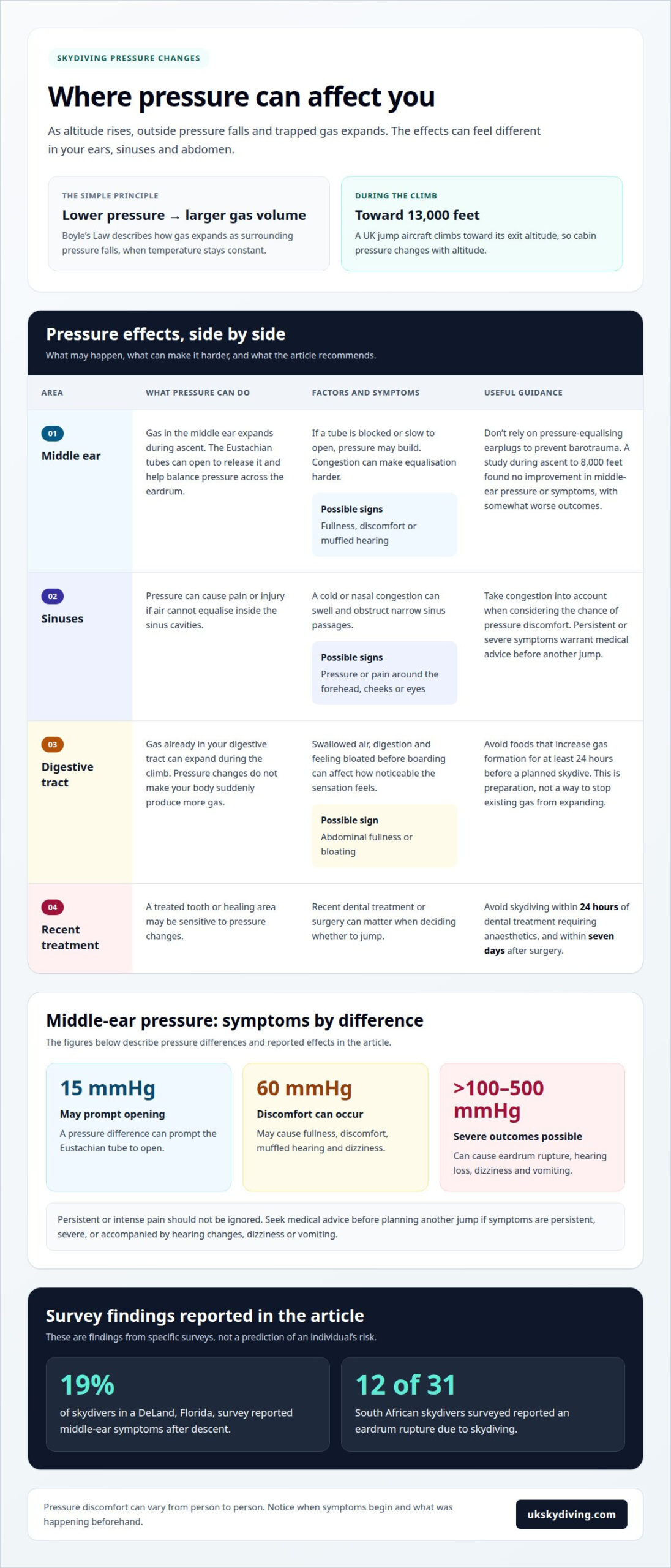
Air pressure falls as altitude increases. Boyle’s Law describes the effect: at constant temperature, gas expands as the surrounding pressure decreases. This applies to air trapped in body spaces, including the middle ear and digestive tract. Pressure changes during skydiving refers to this shift in surrounding pressure as the aircraft climbs and later descends.
In the standard atmosphere, pressure decreases by about 1 inHg per 1000 ft of elevation, according to St. Olaf College. Sea-level pressure is 29.92 mmHg, equivalent to 1 atm. These reference points help explain why a change in altitude affects enclosed gas volume. If surrounding pressure halves while temperature stays constant, the gas volume doubles.
For a UK jump, consider an aircraft climbing towards the client-provided exit altitude of 13,000 feet. Ambient pressure falls as the aircraft gains height, so air in enclosed spaces expands. The exact pressure at a particular point depends on the atmospheric conditions, but the direction of the change remains clear: higher altitude means lower ambient pressure.
Your Eustachian tubes connect the middle ear with the back of the nose and throat. During ascent, the Eustachian tubes can open to release expanding middle-ear air. If a tube is blocked or doesn’t open readily, pressure can build against the eardrum. That may cause fullness, discomfort or muffled hearing during the climb.
Cabin pressurisation affects how much the surrounding pressure changes inside an aircraft. Commercial airliners are pressurised to the equivalent of roughly 8,000 feet. A skydiving aircraft climbs towards its exit altitude, so the pressure in its cabin changes with altitude rather than staying at that airline-cabin equivalent.
Understanding pressure changes during skydiving means distinguishing outside pressure from pressure inside your middle ear. When the Eustachian tubes equalise the pressure, the eardrum can move more comfortably. If equalisation is delayed, you may feel the difference as the aircraft gains altitude.
Intestinal gas during ascent
As an aircraft climbs, lower outside pressure allows gas already in your digestive tract to expand. This follows Boyle’s Law: when pressure falls, gas occupies more volume if its temperature remains constant. That can cause abdominal fullness or bloating. Pressure changes during skydiving don’t make your body suddenly produce more gas, but they can change the volume of gas already present.
Digestive gas comes from different sources. You may swallow air while eating or drinking, and digestion can produce gas as food moves through your gut. If you’re already feeling bloated before boarding, for example, changing pressure may make the sensation more noticeable during the climb. How you feel depends partly on how much gas is present and how readily it moves through your digestive system.
Food choices can affect gas formation before a jump. Avoid foods that increase gas formation for at least 24 hours before a planned skydive. This is a preparation measure, not a way to stop existing gas from expanding. Familiar foods that tend to leave you bloated are a useful starting point when deciding what to avoid during that period.
Pressure changes during skydiving can make abdominal discomfort more noticeable, but the sensation varies from person to person. Pay attention to when it begins and whether it follows a particular meal. For instance, noting that you felt bloated before boarding gives a clearer account of the timing than simply remembering discomfort after landing.
If recurring abdominal symptoms concern you, describe their timing and pattern to a healthcare professional before your next jump. For a first jump, you can also explore planning your skydive and consider how your usual food choices affect your comfort. A little preparation can help you focus on the experience rather than an avoidable distraction.
Risk factors for barotrauma
Barotrauma is an injury caused by a pressure difference that an air space cannot equalise. Symptoms can include ear fullness, discomfort, muffled hearing, dizziness or pain around the face.
Middle-Ear Barotrauma
Middle-ear barotrauma occurs when pressure on either side of the eardrum fails to balance. A 15 mmHg difference can prompt the Eustachian tube to open, while a 60 mmHg difference can cause fullness, discomfort, muffled hearing and dizziness. Congestion can make equalisation harder, increasing the chance that pressure discomfort will interrupt the jump.
More severe pressure differences, above 100-500 mmHg, can cause eardrum rupture, hearing loss, dizziness and vomiting. These outcomes show why persistent or intense pain shouldn’t be ignored. A study of pressure-equalising earplugs during ascent to 8,000 feet found no improvement in middle-ear pressure or symptoms, with somewhat worse outcomes. Earplugs shouldn’t be relied on to prevent barotrauma.
Sinus Barotrauma
Sinus barotrauma is pain or injury caused when pressure cannot equalise inside the sinus cavities. A cold or nasal congestion can cause swelling that obstructs the narrow passages through which air moves. You may feel pressure or pain around your forehead, cheeks or eyes, particularly if a sinus passage is blocked during a pressure shift.
Recent treatment or surgery can also affect your decision to jump. Avoid skydiving within 24 hours of dental treatment requiring anaesthetics, and within seven days after surgery. A treated tooth or healing area may be sensitive to pressure changes. If symptoms are persistent, severe or accompanied by hearing changes, dizziness or vomiting, seek medical advice before planning another jump.
In a DeLand, Florida, survey, 19% of skydivers reported middle-ear symptoms after descent. Of 31 South African skydivers surveyed, 12 reported an eardrum rupture due to skydiving.
How quickly does pressure change during freefall and parachute descent?
Pressure changes follow altitude, not the sensation of speed alone. During a climb towards 13,000 feet, outside pressure falls as the aircraft gains height. Once you leave the aircraft, freefall carries you down rapidly, so pressure rises as altitude drops. Boyle’s Law describes how this rising pressure compresses gas in enclosed spaces.
Freefall and canopy descent feel very different, but both involve changing altitude. In freefall, you cover altitude quickly, so the surrounding pressure changes quickly too. Under an open parachute, descent is slower, spreading the change over more time. Your ears may respond differently during these phases, depending on how well they equalise.
There isn’t one pressure-change rate that applies to every skydive. The aircraft’s climb profile, exit altitude and descent path all affect how quickly altitude changes. For example, a jump from a lower exit altitude involves less vertical distance than one from 13,000 feet. Wind can alter the route, but altitude remains the key factor for ambient pressure.
Your body responds in different ways in different areas. The middle ear equalises through the Eustachian tubes, while the sinuses rely on open passages. If congestion makes those routes harder to clear, a pressure shift may feel more uncomfortable. For example, you might notice ear fullness during the climb, followed by a different sensation as the parachute descent begins.
Pay attention to when discomfort starts: during the aircraft climb, freefall or canopy descent. That timing helps distinguish a response to a particular phase from general discomfort. If you’re learning to skydive solo, explore Accelerated Freefall training and build your understanding of each stage before taking to the sky.
UK Skydiving
UK Skydiving offers experiences for people considering a first jump or working towards solo skydiving. If pressure-related discomfort has made you hesitant, use what you’ve learned here to think through your concerns and the kind of experience you want.
The Tandem Skydive Experience is designed for beginners, who are securely harnessed to a professional instructor for a jump from up to 13,000 feet. If your goal is to learn to skydive solo, the Accelerated Freefall (AFF) Course offers a different route. Charity Jumps and Video and Photo Packages are also available for readers with those aims.
Contact UK Skydiving to discuss your skydiving plans.
Make your next jump an informed choice
Understanding pressure changes during skydiving can help you approach your next jump with greater awareness, but recurring pain deserves attention. Note when the discomfort begins and how it feels. That detail can help you explain your concern and decide what support you need before planning another jump.
Skydiving should be an exciting challenge, not a test of how much discomfort you can tolerate. If ear pain or pressure symptoms have made you hesitate, you don’t have to set your questions aside. Contact UK Skydiving to discuss your plans and the experience that may suit your goals. For persistent or severe symptoms, seek appropriate medical advice before jumping.
Contact UK Skydiving with your questions and take your next step with confidence.
Frequently Asked Questions
I seem to have ear pain frequently when skydiving, what can I do to minimise effects and continue jumping?
Don’t push through recurring ear pain. Note whether it starts during the aircraft climb, freefall or descent, and whether congestion or a recent cold is involved. Share that pattern with a healthcare professional before planning another jump. If you’re considering skydiving again, you can also discuss your concerns with UK Skydiving to make an informed plan.
How does air pressure change with altitude during a skydive?
Air pressure decreases as the aircraft climbs and increases again as you descend. To compare pressure at different stages, focus on altitude rather than how fast the ground appears to move. The same altitude change can feel different in the aircraft, freefall and under canopy, but the surrounding pressure responds to altitude throughout.
How do pressure changes affect the ears and sinuses when skydiving?
Your ears and sinuses contain air spaces, so a pressure difference can cause discomfort when air cannot move freely. Ear symptoms can include fullness, muffled hearing or dizziness. Sinus pressure may feel like pain around your forehead, cheeks or eyes. For example, congestion can make pressure-related discomfort more noticeable during a jump.
How can skydivers equalise ear pressure during ascent and descent?
Try swallowing, yawning or gently moving your jaw as the aircraft changes altitude. These actions may help the Eustachian tubes open and let pressure equalise. Keep any manoeuvre gentle, and don’t blow forcefully against a blocked nose. If you’re congested or equalising is painful, tell the instructor rather than ignoring the sensation.
What should you do if your ears will not equalise after a skydive?
If your ears remain blocked or painful after landing, avoid another jump until the symptoms have settled and you’ve considered medical advice. Persistent muffled hearing, dizziness or worsening pain are reasons to seek assessment. Note when the symptoms began and whether one or both ears are affected. That information can help a healthcare professional understand what happened.
Categorised in: Blog