Latest News
-
 4 ways to make your first skydive feel more manageable November 10, 2026
-
 What’s the Scariest Part of Skydiving? How Freefall Feels November 9, 2026
-
 Parental Consent for Skydiving and Young Jumpers November 8, 2026
-
 How to Position Your Body and Breathe During Freefall November 7, 2026
-
 Pressure Changes During Skydiving: Why Your Ears Hurt November 6, 2026
Parental Consent for Skydiving and Young Jumpers
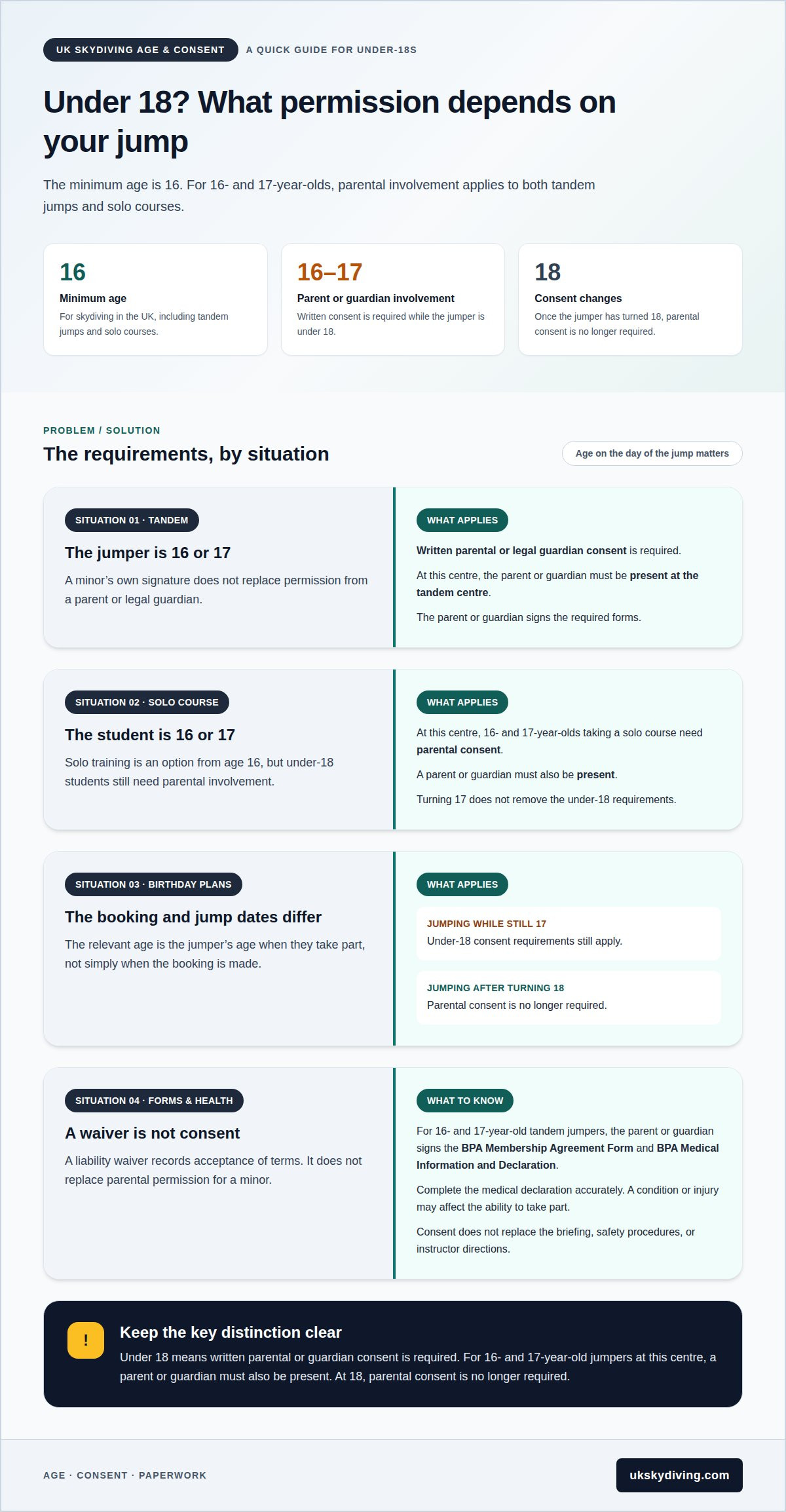
November 8, 2026 12:00 amA solo skydiving course isn’t reserved for adults. In the UK, the minimum age for skydiving is 16, and parental consent for skydiving is required for jumpers aged 16 or 17. At this centre, 16- and 17-year-olds taking a solo course also need a parent or guardian to be present. Once a jumper turns 18, parental consent is no longer required.
It’s understandable to want the age and permission rules clear before a young person takes on a first jump. Tandem and solo skydiving are different experiences, but both have consent requirements for under-18s. This guide explains how the rules apply to under-18 tandem jumpers, what a 17-year-old needs for a solo course, and what changes at 18. You’ll also learn how parental involvement fits into the paperwork, so you can understand the requirements before deciding which kind of jump is right.
Key Takeaways
- Understand how written consent, a parent or guardian’s presence and required paperwork apply to under-18 tandem jumpers.
- See which consent requirements change when a young jumper turns 18.
- Learn how parental involvement differs for a 17-year-old taking a solo skydiving course.
- Get a clearer sense of whether a tandem jump or solo training is the right experience for a young jumper.
Parental or legal guardian consent for under-18 tandem jumpers
In the UK, the minimum age for a tandem skydive is 16. Jumpers aged 16 or 17 need written parental or legal guardian consent, and the parent or guardian must be present.
Consent and Minor Waivers
Parental consent gives permission for a minor to take part, while a liability waiver records acceptance of the activity’s terms. For under-18 jumpers, parental consent for skydiving is required, but signing a waiver does not replace that permission. This distinction matters because a minor’s own signature may not provide the same legal authority as an adult’s. A parent or legal guardian must be involved in the consent process.
Accepted Consent Forms
Written consent is required for a UK parachute jump by anyone under 18. For jumpers aged 16 or 17, the BPA Membership Agreement Form and BPA Medical Information and Declaration must be signed by a parent or legal guardian. A parent or guardian must also be present at the tandem centre. Having the required forms completed helps establish consent before the jump, rather than relying only on a minor’s signature.
Required Identification and Documents
The key documents are the signed BPA Membership Agreement Form and BPA Medical Information and Declaration. A parent or guardian should attend with the minor to provide consent in person. The UK requirements described here specify these forms, not a separate type of identification for the parent or young jumper. Keep the paperwork together and ready for the centre’s registration process.
Medical fitness matters too. Jumpers complete a medical declaration, and a condition or injury may affect their ability to take part. Conditions such as epilepsy or heart and lung disease are cited as possible barriers for some charity jumps, but this does not establish a blanket rule for every UK tandem jump.
A tandem skydive involves being securely harnessed to an instructor, but it still requires following the centre’s safety procedures. Under-18 jumpers should understand the instructions, disclose relevant medical information, and take part only with the required consent and guardian present.
18Th birthday skydiving
Turning 18 changes the consent requirement for a UK skydive. Under-18s need written consent from a parent or guardian, while an adult jumper no longer needs parental permission. For someone planning a birthday jump, the key distinction is whether they are still under 18 or have reached adulthood when they take part. The birthday itself doesn’t change how tandem skydiving works. The jumper remains securely harnessed to an instructor during the experience.
Before turning 18, a young person cannot rely on their own permission alone for the jump. Their parent or legal guardian must provide consent, and the parent or guardian must be present for a 16- or 17-year-old tandem jumper at this centre. After turning 18, the new adult can make decisions about taking part without parental consent. That shift is about consent, not a change to the skydive’s physical requirements or instructions.
A birthday booking can involve two different situations. If the jumper takes part while still 17, the under-18 consent requirements apply. If they take part after turning 18, parental consent is no longer required. A booking date and a jump date may differ, so plan around the person’s age when the jump takes place. Don’t assume that celebrating a birthday near the booking date changes the age requirement for an earlier jump.
Turning 18 also doesn’t remove the need to complete the relevant participation paperwork or follow the instructor’s directions. Age affects who provides consent, not the need to take the activity seriously. For a birthday tandem jump, the adult jumper can take responsibility for their own participation and prepare for the briefing like any other adult. The result is a milestone with a real sense of occasion, and a clear change in who gives permission.
Parental consent for 17-year-olds
A 17-year-old is still under 18, so written consent from a parent or legal guardian is required for a UK parachute jump. At this centre, a 17-year-old tandem jumper must also have their parent or guardian present. Turning 17 does not remove these requirements, even if the young person is close to their 18th birthday.
The age that matters is the jumper’s age when taking part. For example, a person who books at 17 but jumps while still 17 needs consent and a parent or guardian present for a tandem jump. Consent is about permission to participate. It does not replace the briefing, medical declaration or other participation paperwork.
For a 17-year-old, the BPA Membership Agreement Form and BPA Medical Information and Declaration must be signed by a parent or legal guardian. These documents cover membership and medical information, so complete them with accurate details. The adult’s signature is essential. A 17-year-old’s own signature does not replace the required parental or guardian consent.
Solo training has a separate practical point. At this UK centre, 16- and 17-year-olds taking a solo course need parental consent, and the parent must be present. That means a 17-year-old considering a parachute course should account for the adult’s attendance, not just a signed form. Tandem and solo participation have different formats, but both require parental involvement for under-18s here.
Parental consent for skydiving is not a promise that every young person can take part. A medical condition or injury can affect participation, so the medical declaration must be completed honestly. The paperwork helps the centre understand relevant health information before the jump. A parent or guardian should be ready to provide consent and attend, while the 17-year-old listens to instructions and follows the centre’s safety procedures.
There is no separate maximum-age rule that changes a 17-year-old’s consent requirements. The deciding point is being under 18 on the day of the jump. For a 17-year-old, plan around the signed forms and the required adult presence.
Parental consent for solo skydiving courses
The minimum age for skydiving in the UK is 16, and solo courses are an option from that age. At this centre, 16- and 17-year-old students need parental consent, and a parent must be present. Solo training differs from a tandem jump: students learn to make a parachute jump independently, with instruction and training before taking part.
For a 17-year-old, parental permission is part of joining a course, not a substitute for training. The parent’s presence is also required at this centre. This matters when planning dates and attendance, especially if the student is approaching 18. If they take part while still 17, the under-18 consent requirements apply. Turning 18 removes the need for parental consent, as explained in the previous section.
The British Parachute Association (BPA) Solo Student Fitness Form 115C is a separate requirement. Solo students complete this form on arrival from age 16. It concerns fitness for solo training, while parental consent addresses permission for an under-18 to participate. Keeping those purposes distinct helps families understand why consent alone doesn’t complete the course requirements.
In practical terms, a 16- or 17-year-old considering an Accelerated Freefall (AFF) course should plan around two things: parental consent with a parent present, and the solo student fitness form completed on arrival. These are separate parts of preparing for training. They don’t mean the student skips instruction or takes a jump without the course process.
The clear takeaway is that solo skydiving is not automatically restricted to adults in the UK. The minimum age is 16, but under-18 students need parental consent and a parent present at this centre. If you’re ready to explore the training route, find out about the Accelerated Freefall course and the pathway towards solo jumping.
UK Skydiving
UK Skydiving helps young jumpers and their families understand which skydiving experience suits their age and goals. If a young person is under 18, the consent requirements can affect whether a tandem jump or solo course is the right next step. The Tandem Skydive Experience offers a first jump alongside an instructor, while the Accelerated Freefall (AFF) Course is for those learning to skydive solo.
Families can also consider charity jumps, and video and photo packages can capture the experience. The first decision is whether the young jumper wants a tandem experience or structured solo training. Once you know their age on the jump date, you can consider the relevant consent and attendance requirements described above.
For guidance on choosing an experience and understanding the next steps, contact UK Skydiving.
Make the next step feel clear
A young person’s first skydive can be an exciting shared decision, not just a date on the calendar. Talk together about what they hope to experience, what questions they still have, and who needs to be involved before making plans. A clear conversation helps the young jumper feel prepared and gives their parent or guardian space to understand how parental consent for skydiving fits into the decision.
There’s no need to rush the choice. Whether the interest is a first jump, learning to jump solo, or taking part for charity, the right next step starts with understanding the experience and its requirements. UK Skydiving offers tandem jumps, charity jumps, and Accelerated Freefall courses to suit different plans.
Contact UK Skydiving with your questions, and take the next step towards an adventure you can look forward to together.
Frequently Asked Questions
Can Kids Go Skydiving?
Yes. In the UK, the minimum skydiving age is 16, so children under 16 cannot take part. Jumpers aged 16 or 17 need consent from a parent or legal guardian. They can choose a tandem jump with an instructor or consider a solo course, which involves structured training. The right option depends on the young person’s age and whether they want a first experience or training.
Can You Skydive at 17 with Parental Consent?
Yes, a young person may be able to skydive with parental or legal guardian consent. For a tandem jump or solo course at this centre, a parent must also be present. For example, if the jump takes place before the jumper’s 18th birthday, the under-18 requirements still apply, even if they booked earlier. Consent allows them to take part, but it doesn’t replace the required forms or instructions.
What are the age requirements for sky diving?
In the UK, skydiving starts at age 16. Jumpers aged 16 or 17 need parental or legal guardian consent, while adults aged 18 or over can decide for themselves. Age requirements may depend on the type of jump and the centre’s rules. These age rules answer who may take part, while the type of jump determines whether the experience is with an instructor or part of a course.
What is the minimum age to skydive in the UK?
The minimum age to skydive in the UK is 16. A 16- or 17-year-old needs parental or legal guardian consent. At this centre, the parent or guardian must also be present for an under-18 tandem jump. Once a jumper turns 18, parental consent is no longer required. Age determines the consent process, but does not replace the other participation requirements.
What is the minimum age for solo or accelerated freefall skydiving in the UK?
The minimum age for solo skydiving in the UK is 16, including Accelerated Freefall training. At this centre, students aged 16 or 17 need parental consent, and a parent must be present. Solo students complete BPA Solo Student Fitness Form 115C on arrival from age 16. This form concerns fitness for training, while parental consent is the separate permission needed for under-18s.
What are the risks and safety rules for under-18 skydiving in the UK?
Under-18s need written consent from a parent or legal guardian; at this centre, 16- and 17-year-old tandem jumpers also need the parent or guardian present and the required forms signed. They must complete the medical declaration honestly, disclose relevant health information, and follow the centre’s safety instructions. A condition or injury may affect participation.
Categorised in: Blog