Latest News
-
 Skydiving as a Confidence Booster: How One Jump Can Change Your Life September 20, 2026
 -
 How to Convince Your Parents to Let You Skydive September 19, 2026
 -
 How to Land a Parachute Safely: A Beginner’s Guide September 18, 2026
 -
 Static Line vs AFF: Choosing Your Path to Solo Skydiving in 2026 September 17, 2026
 -
 Skydiving A License: Your Passport to the Skies September 16, 2026
What to Expect on Your First AFF Jump: The 2026 Solo Skydiving Guide
August 23, 2026 12:00 amWhat if your very first solo flight didn’t involve a cockpit, but instead started with a leap into the open air from the edge of a moving aircraft? Moving from being a tandem passenger to a solo student is a massive leap, and you’re likely wondering exactly what to expect on your first AFF jump. It’s natural to feel a mix of pure adrenaline and “can I really do this?” nerves. You might worry about forgetting your training the moment the door opens or feel anxious about sticking the landing. We’ve seen it all before, and we know that with the right mentors, those fears quickly turn into the most empowering moment of your life.
This guide gives you a clear mental roadmap from the second you arrive at our Cambridgeshire base to your first solo touchdown. You’ll discover the secrets of our intensive ground school, the high-tech safety of modern equipment like Automatic Activation Devices, and the incredible support of instructors who stay by your side in freefall. Get ready to stop being a passenger and start being the pilot of your own destiny. We’ll cover everything from the initial briefing to the path toward your full skydiving licence.
Key Takeaways
- Learn how to shift your mindset from being a passive passenger to a student pilot in command of your own destiny.
- Discover why a full day of intensive ground school and “dirt dives” are essential for building muscle memory before you board the plane.
- Get a step by step breakdown of the exit sequence and exactly what to expect on your first AFF jump as you leave the aircraft at 13,000 feet.
- Understand the high-tech safety systems like Automatic Activation Devices that provide total peace of mind during your freefall.
- Find out how post-jump video debriefs with your expert mentors help you refine your skills and fast-track your journey to becoming a licensed skydiver.
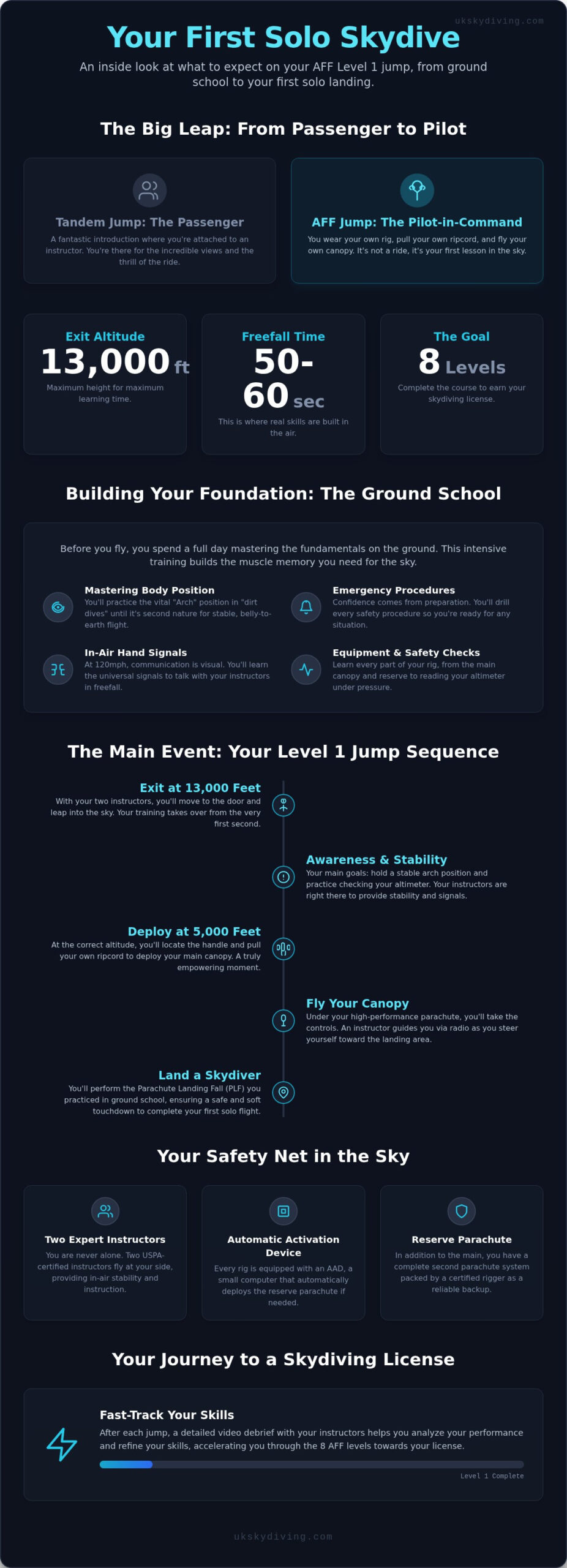
The Transition to Solo: What is an AFF Level 1 Jump?
Accelerated Freefall (AFF) is the world’s most efficient and exhilarating way to transform from a ground-dweller into a solo skydiver. It’s not just a jump, it’s a comprehensive training programme designed for those who want to skip the passenger seat and go straight to the pilot’s chair. This is a peak life event where you aren’t just falling, you’re flying. On your Level 1 jump, you aren’t strapped to someone else. You are wearing your own rig, managing your own altimeter, and pulling your own ripcord. This shift in mindset is massive. You’re no longer just along for the ride, you are the pilot in command of your own destiny from the moment you leave the plane.
Knowing what to expect on your first AFF jump helps settle the nerves and prepares you for this transformative process. The primary goal of Level 1 is simple but vital: maintain a stable body position and stay aware of your altitude. You’ll have two expert mentors holding onto you in the air to keep you steady, but the controls are in your hands. It’s an intense, focused experience that demands your full attention, yet provides a level of satisfaction that a tandem simply can’t match.
Tandem vs AFF: Choosing Your First Solo Path
A tandem jump is a fantastic introduction to the sky, but it’s essentially a passenger experience. You’re there for the view and the sensation. AFF is different because it turns the sky into your classroom. Many of our students decide to learn to skydive after a tandem because they want more control. They want to feel the weight of the parachute on their own shoulders and the thrill of steering themselves back to earth. The sense of accomplishment when you land your own canopy for the first time is absolutely life-changing. It’s the moment you stop being a spectator and start being an athlete in one of the world’s most demanding environments.
Why the Accelerated Method Works
The Accelerated Freefall (AFF) method is called “accelerated” for a reason. Unlike older methods that required dozens of short jumps, AFF puts you straight into 50 to 60 seconds of freefall from 13,000 feet. This extra time in the air is where the real learning happens. Having two instructors by your side ensures you stay stable while you practice your moves. This hands-on guidance allows you to blast through the eight levels of the course much faster than you’d expect. It’s a high-energy, high-reward path that builds your skills and confidence at an incredible pace.
Ground School: Building the Foundation of Your Flight
Before you ever set foot on the plane, you’ll spend a full day in our intensive ground school. This isn’t just a boring lecture. It’s a high-energy, hands-on deep dive into the world of flight. You’ll spend hours on the “dirt dive,” which is where we practice every movement on the ground until it’s second nature. We drill the exit, the freefall count, and the deployment until your body knows exactly what to do without you having to think. This preparation is a huge part of what to expect on your first AFF jump training.
You’ll also master the universal hand signals instructors use to communicate in the air. Since you can’t hear anything over the 120mph wind, these visual cues are your lifeline. Your mentors will use them to tell you to arch more, relax, or check your altitude. You’ll also learn the fascinating mechanics of how a modern parachute works. It isn’t just a piece of fabric, it’s a high-performance wing designed to glide and flare for a soft touchdown. It’s incredible how much science goes into every single jump.
The Arch is the most vital body position because it uses your centre of gravity to ensure a stable, belly-to-earth flight.
Mastering the Equipment and Safety Checks
Your rig is a marvel of engineering. You’ll learn every inch of it, from the main canopy to the reserve parachute system that acts as your ultimate backup. We’ll teach you how to read your Altimeter under pressure, ensuring you always know your height with a quick glance at your wrist. These procedures are all based on the USPA Skydiver’s Information Manual, which sets the gold standard for safety. By the time you’re ready to board, these pre-flight checks will feel like second nature. If you’re ready to take the leap, you can book your AFF course and start your journey today.
The Parachute Landing Fall (PLF)
Landing is a skill we teach with absolute precision. You’ll spend time mastering the Parachute Landing Fall (PLF), a specific technique designed to distribute the impact of landing safely across your body. We practice this drill on the grass repeatedly to build muscle memory. It’s a simple, effective way to ensure you stay safe even if the wind catches you off guard. Reaching the ground is a controlled and taught skill, giving you the total confidence you need for your first solo touchdown. You’ll feel like a total pro by the time the plane wheels leave the tarmac.
The Jump Experience: From Aircraft Exit to Landing
The ride up to 13,000 feet is an experience in itself. As the aircraft climbs, you’ll feel the temperature drop and the excitement build to a fever pitch. This is the time to breathe, run through your drills, and soak in the incredible view of the Cambridgeshire countryside. When the door rolls open, the roar of the wind hits you like a physical force. It is a sensory explosion that tells your brain the adventure has truly begun. You’ve spent all morning preparing for this moment, and now it is finally here.
You’ll move to the door with your two expert instructors. The ‘Ready, Set, Go’ sequence is crisp, professional, and designed to ensure you leave the plane in a stable position. You aren’t being pushed. You are choosing to fly. The moment your feet leave the aircraft, the world changes. You’ll immediately start your ‘Circle of Awareness’ to stay focused. This involves checking your altimeter, looking at your primary instructor, and then your secondary instructor. This structured routine is a huge part of what to expect on your first AFF jump because it keeps you calm and in control during the rush.
The Freefall Phase: Your First 50 Seconds of Solo Flight
This is where you truly understand what skydiving feels like when you are the one in command. You’ll feel the air supporting your body like a solid, rushing cushion. Your instructors hold your harness to keep you level, but you are the one flying your body through the sky. You’ll perform three practice ripcord pulls to ensure you can find your handle when the time comes. This builds the vital muscle memory you need to deploy your own parachute at 6,000 feet. It is a fast-paced, high-octane lesson in the world’s most exciting classroom.
Under Canopy: Navigating Back to Earth
Pulling the handle brings a sudden and incredible change. The roar of the wind vanishes instantly. It is replaced by a profound, beautiful silence that feels almost magical. You are now under a high-performance wing, following safety standards that align with global benchmarks like the FAA Parachute Operations Regulations. You’ll use your toggles to steer, feeling the canopy respond to your every move as you glide toward the earth. Most students receive clear radio assistance from the ground to help them navigate back to the landing area. This ensures a safe, smooth, and triumphant touchdown on the grass.
Managing the Sensory Rush: Safety and Mental Prep
The first time you leave a plane solo, your brain might try to process everything at once. This “sensory overload” is a completely normal part of the experience. The roar of the wind, the incredible speed, and the vast horizon can feel overwhelming for a few seconds. It is exactly why our ground school is so intensive. We build your muscle memory so that even when your mind is racing, your body knows exactly how to respond. Understanding that this rush is coming is a key part of what to expect on your first AFF jump. It is a wild, beautiful, and temporary sensation that quickly clears as you focus on your tasks.
Safety is the bedrock of everything we do. Modern skydiving equipment is a marvel of reliability and engineering. Every student rig is equipped with an Automatic Activation Device (AAD). This is a sophisticated micro-computer that monitors your altitude and speed. If you don’t deploy your parachute by a certain height, the AAD does it for you automatically. This creates a powerful safety net that lets you focus on the thrill of the flight. When you follow professional training, you’ll find that skydiving is safe and incredibly well-regulated. You aren’t just falling, you are participating in a highly technical and controlled sport.
Overcoming Performance Anxiety
It is natural to feel a bit of performance anxiety before your first solo exit. You might worry about forgetting your drills or losing stability. Take a breath. Use box breathing and visualisation to see yourself performing a perfect arch and a clean deployment. Remember that your expert mentors are right there beside you. If you wobble, they will use hand signals or physical grips to steady you instantly. Every world-class skydiver started as a nervous beginner. Embrace the nerves as part of the adventure. They are just a sign that you’re about to do something truly extraordinary.
The Reliability of Modern Parachutes
We hold our equipment to the highest possible standards. Every student parachute is packed with extreme precision by certified professionals. You also carry a “two-parachute” system. If the main canopy doesn’t perform perfectly, you have a reserve parachute that is checked and repacked with even more rigorous oversight. Modern parachutes are not just round bags of air. They are high-performance wings that allow you to glide through the sky with incredible control. You can trust your gear completely while you focus on the horizon. If you’re ready to master the skies, sign up for your AFF course and join the ranks of solo flyers.
The Debrief and Your Future in the Sky
The moment your feet touch the grass, you’ll feel a surge of euphoria that is hard to put into words. You’ve done it. You’ve completed your first solo skydive. But the learning doesn’t stop at the landing area. One of the most important parts of what to expect on your first AFF jump is the professional debrief that follows. You’ll head back to the hangar with your mentors to relive the experience through the lens of a high-definition camera. It’s a chance to catch your breath and realise the magnitude of what you just accomplished.
Reviewing your video footage is an exhilarating and eye-opening process. It allows you to see your body position from an outside perspective, which is far more effective than just trying to remember how it felt in the rush of the wind. Your instructors will point out your successes and show you exactly where to tweak your arch or your leg position for next time. This feedback is what makes the Accelerated Freefall course so effective. It turns every jump into a massive leap forward in your skills and builds the confidence you need for the levels ahead.
After the video review, you’ll receive your very first official entry in your skydiving logbook. This is a significant milestone. It’s the physical proof that you are no longer a passenger, but a student skydiver. Seeing that first signature from your instructor is a proud moment that you’ll remember for the rest of your life. It marks the formal beginning of your journey through the remaining seven levels of the AFF programme. Each level will introduce new challenges, but you’ve already conquered the biggest one by making that first solo exit.
Joining the Skydiving Community
The dropzone in March, Cambridgeshire, is more than just a training centre. It is a vibrant, welcoming community of adrenaline seekers. After your jump, the atmosphere on the ground is electric. You’ll find yourself swapping stories with other students and seasoned jumpers who have thousands of flights under their belts. The bond formed over a shared leap from 13,000 feet is unique and powerful. Many of our students find that the lifelong friendships they make on day one are just as rewarding as the flying itself. Stay for a while, soak in the atmosphere, and celebrate your achievement with your new tribe.
Booking Your Next Adventure
The best time to schedule your Level 2 jump is while the sensations and skills are still fresh in your mind. Momentum is your best friend when you’re learning to fly. Your ultimate goal is the ‘A Licence,’ which is your passport to solo jumping at dropzones all over the world. Each level of the course builds on the last, adding new skills like turns, backloops, and tracking. You’ve already proven you have the courage to step out of the door. Now it’s time to refine those skills. Join us at UK Skydiving and take the next step toward becoming a fully licensed skydiver today.
Take Command of the Skies
Stepping out of an aircraft solo is a transformative milestone that changes your perspective forever. You’ve discovered how our intensive ground school builds the muscle memory you need and how modern safety technology provides a reliable safety net in the air. By moving from a tandem passenger to a student pilot, you are choosing a path of incredible personal accomplishment and joining a vibrant global community of flyers.
Now that you have a clear roadmap of what to expect on your first AFF jump, the sky is no longer a mystery. It is your new playground. Our expert British Skydiving certified instructors are ready to guide you at our professional base in Cambridgeshire, which offers easy access for students from London and the North. We include a comprehensive ground school with every jump to ensure you feel confident and capable before your feet even leave the tarmac.
Book your AFF Level 1 course today and start your solo journey! we can’t wait to see you in the air and help you earn your place among the clouds. The adventure of a lifetime is just one click away.
Frequently Asked Questions
How long does the AFF Level 1 ground school take?
The AFF Level 1 ground school typically takes a full day of intensive training, usually lasting around six hours. You’ll spend this time mastering the “dirt dive” and learning essential safety procedures. It’s a high-energy day that ensures you understand exactly what to expect on your first AFF jump before the plane leaves the ground. Our expert mentors will guide you through every detail until your muscle memory is rock solid and you feel ready to fly.
Do I need to have done a tandem jump before starting AFF?
No, you can start your Accelerated Freefall course without any prior experience. While many people choose to try a tandem jump first to get a taste of the air, it isn’t a requirement for the course. You’ll receive all the training you need during your ground school to go straight to your Level 1 solo flight. It’s an incredible way to fast-track your journey to becoming a licensed skydiver and taking command of your own destiny in the sky.
What happens if I cannot find the pull handle for my parachute?
If you struggle to find your handle, your two instructors are right there to assist you immediately. They’ll use hand signals or physically guide your hand to the toggle to ensure a safe deployment. Even in the highly unlikely event that nobody pulls the ripcord, every student rig is fitted with an Automatic Activation Device. This clever computer automatically deploys your reserve parachute at a safe altitude, providing a massive layer of redundancy and peace of mind.
Will I be jumping completely alone on my first AFF jump?
You won’t be alone in the air for your first level. You’ll jump with two British Skydiving certified instructors who will hold onto your harness from the moment you leave the plane until your parachute is open. They are there to keep you stable and provide real-time guidance through hand signals. You’re the pilot in command, but your expert mentors are by your side every second of the freefall to ensure you feel secure and supported.
What is the weight limit for an AFF course in the UK?
Weight limits can vary between dropzones, but the typical limit for a student skydiver in the UK is around 15 stone or 95kg. This limit is in place to ensure the equipment operates at peak performance and that your landing is as soft as possible. It’s always best to check with our team in March before booking if you’re near this limit. We want to ensure every student is safe, comfortable, and ready to fly with total confidence.
What should I wear for my first solo skydiving lesson?
You should wear comfortable, athletic clothing that allows for a full range of movement during your flight. Think layers like leggings, joggers, or a sweatshirt, depending on the season. Flat-soled trainers that lace up securely are essential for a safe landing on the grass. We’ll provide you with a specialised jumpsuit to wear over your clothes. This protects your gear and helps you maintain the perfect arch while you are rushing through the air at 120mph.
What happens if the weather is too bad to jump after my training?
If the British weather doesn’t cooperate, we’ll simply reschedule your jump for the next available clear day. Your ground school training remains valid, though you might need a quick refresher if there’s a long gap between your training and your first flight. Safety is our absolute priority, so we only fly when conditions are perfect for a student. We’ll work with you to find a new slot that fits your schedule perfectly and gets you airborne.
Can I get a video of my first AFF Level 1 jump?
Yes, you can absolutely get a high-definition video of your first solo experience. We offer professional video and photo packages that capture everything from the aircraft exit to your triumphant landing. Watching your footage is a huge part of what to expect on your first AFF jump debrief. It’s a brilliant way to review your technique with your instructors and provides a permanent, exhilarating memory of your achievement that you can share with everyone you know.
Categorised in: Blog