Latest News
-
 Skydiving as a Confidence Booster: How One Jump Can Change Your Life September 20, 2026
 -
 How to Convince Your Parents to Let You Skydive September 19, 2026
 -
 How to Land a Parachute Safely: A Beginner’s Guide September 18, 2026
 -
 Static Line vs AFF: Choosing Your Path to Solo Skydiving in 2026 September 17, 2026
 -
 Skydiving A License: Your Passport to the Skies September 16, 2026
What to Do After Your First Skydive: Your Guide to the Ultimate Afterglow
April 16, 2026 10:00 amThe moment your feet touch the grass after plunging toward earth at 120 mph from 13,000 feet, you aren’t just a person anymore. You are an explorer of the extraordinary. It’s completely normal to feel a massive wave of exhaustion within 4 hours of landing once that breathtaking adrenaline rush starts to fade. You’ve just conquered the ultimate high, and your body is finally catching up with your adventurous spirit. Knowing exactly what to do after your first skydive is the secret to turning a one-time thrill into a life-altering passion.
We’ve all been there, and we understand that the post-jump “adrenaline hangover” can feel just as intense as the leap itself. This guide promises to help you manage your recovery, share your epic story with friends, and start your journey toward becoming a solo skydiver. We’ll walk you through the precise steps to get your British Skydiving licence and introduce you to a community of like-minded adventurers who live for the sky. Get ready to turn that temporary afterglow into a permanent lifestyle as we explore the path from your first landing to your second jump.
Key Takeaways
- Learn how to ride the massive dopamine wave and manage the inevitable adrenaline crash that follows your ultimate high.
- Discover the best ways to share your breathtaking adventure and why capturing the moment on video is essential for a lifetime of memories.
- Get expert advice on what to do after your first skydive, whether you want to experience the thrill of a second tandem or take the leap into solo flight.
- Explore the fastest route to earning your British Skydiving A-Licence through the Accelerated Freefall course and start your journey as a student skydiver.
- Find out why life at our Cambridgeshire base is about more than just jumping and how to become part of the UK skydiving family.
Riding the Adrenaline High and Managing the Post-Jump Crash
You’ve just stepped out of a plane at 13,000 feet and plummeted toward the earth at speeds exceeding 120 mph. It’s the ultimate high. Right now, your brain is swimming in a massive cocktail of dopamine and adrenaline. This is your body’s fight or flight response working in overdrive to keep you sharp and focused during the jump. It’s a breathtaking and intoxicating feeling that makes you feel absolutely invincible. You’ll likely find yourself buzzing with energy, wanting to call every friend in your contact list to shout about the news. This emotional surge is a vital part of the adventure. To understand how we reached this level of modern thrill-seeking, you can Learn more about the history of skydiving and how the sport evolved into the safe, exhilarating journey it is today.
Why You Feel ‘Tuckered Out’ After the Ultimate High
The adrenaline crash is the body’s natural process of returning to its baseline state after a period of extreme physiological and emotional intensity. While the freefall lasts less than a minute, the mental focus required is staggering. You’ve been processing a huge amount of new sensory input at high speeds, which leads to a unique type of mental fatigue once the initial excitement wears off. Many first-timers report a sense of let down about 24 hours later. After such an extraordinary event, sitting at a desk or doing the weekly shop in the UK can feel incredibly mundane. It’s a common psychological shift that happens when your brain craves that next big hit of excitement.
Expert Tips for a Smooth Post-Jump Recovery
Knowing what to do after your first skydive is essential for making sure you enjoy the memories without feeling like a zombie the next day. Your body has just been through a lot of physical stress. Follow these steps to bounce back quickly:
- Eat a high-protein meal: Consume something like a chicken breast or a three-egg omelette within two hours of your jump to help repair muscles and stabilise your blood sugar.
- Get a full eight hours of sleep: Your brain needs this time to process the intense sensory data and memories from the freefall.
- Engage in light movement: A 20-minute walk through a local park keeps the blood flowing and prevents your muscles from feeling stiff after the tension of the jump.
- Hydrate properly: Drink at least two litres of water to combat the dehydration that often comes with high-altitude breathing and nervous energy.
Managing these physical needs ensures you can reflect on your achievement with total clarity. You’ve joined an elite group of adventurers, and taking care of yourself is the best way to prepare for your next big thrill. When you are deciding what to do after your first skydive, remember that a professional recovery is just as important as the jump itself. Our highly skilled staff always recommend taking it easy so you can fully savour the experience for years to come.
Reliving the Moment: How to Share Your Epic Adventure
You just touched down on solid ground and your heart is still racing at 120 mph. The very first thing you should think about regarding what to do after your first skydive is to capture the feeling before it even begins to fade. Grab your phone or a notebook and write down exactly how that first step into the empty sky felt. Those raw, intoxicating emotions are at their peak in the first 10 minutes after landing. Writing it down preserves the “ultimate high” in a way that photos alone cannot. It turns a fleeting rush into a permanent memory you can revisit whenever you need a boost of confidence.
Speaking of photos, never skip the media package. It is an essential part of the adventure. Our highly skilled staff use professional equipment to record your entire journey from the aircraft exit to the parachute deployment. This isn’t just a video. It is a permanent record of an extraordinary life-altering milestone. You will want to watch it again and again to see the exact moment your nervous anticipation transformed into pure, unadulterated joy. It is the best way to prove to yourself and the world that you conquered the challenge.
Creating Your Skydiving Social Media Strategy
Your first post should be as bold as the jump itself. Forget about looking perfect in the wind. Pick the photo with the most dramatic “freefall face” to show your friends the true intensity of the experience. Use specific hashtags like #UKSkydiving and #FirstJump to find other adrenaline junkies in the British community. Don’t forget to tag your instructor in your stories. It is a fantastic way to say thank you for the expert guidance and the safe landing. Sharing your success online is a vital part of what to do after your first skydive to inspire others to take the leap.
Hosting the Ultimate Skydive Video Party
Watching your jump on a small phone screen simply doesn’t do it justice. Invite your friends over for a proper viewing session on the big screen. Show the raw footage first because the chaotic energy of the aircraft exit is always a crowd-pleaser. Be ready to answer questions about the “stomach drop” sensation. You can explain that it feels more like being supported by a powerful cushion of air than actually falling. Use this excitement to recruit your mates for a return trip. Most UK dropzones provide group discounts for bookings of 10 people or more. If the skydiving bug has truly bitten, you might even find yourself researching a British Skydiving A-Licence to start your path toward solo flight. You can check our availability to see when you can bring the whole crew along for your next breathtaking adventure.
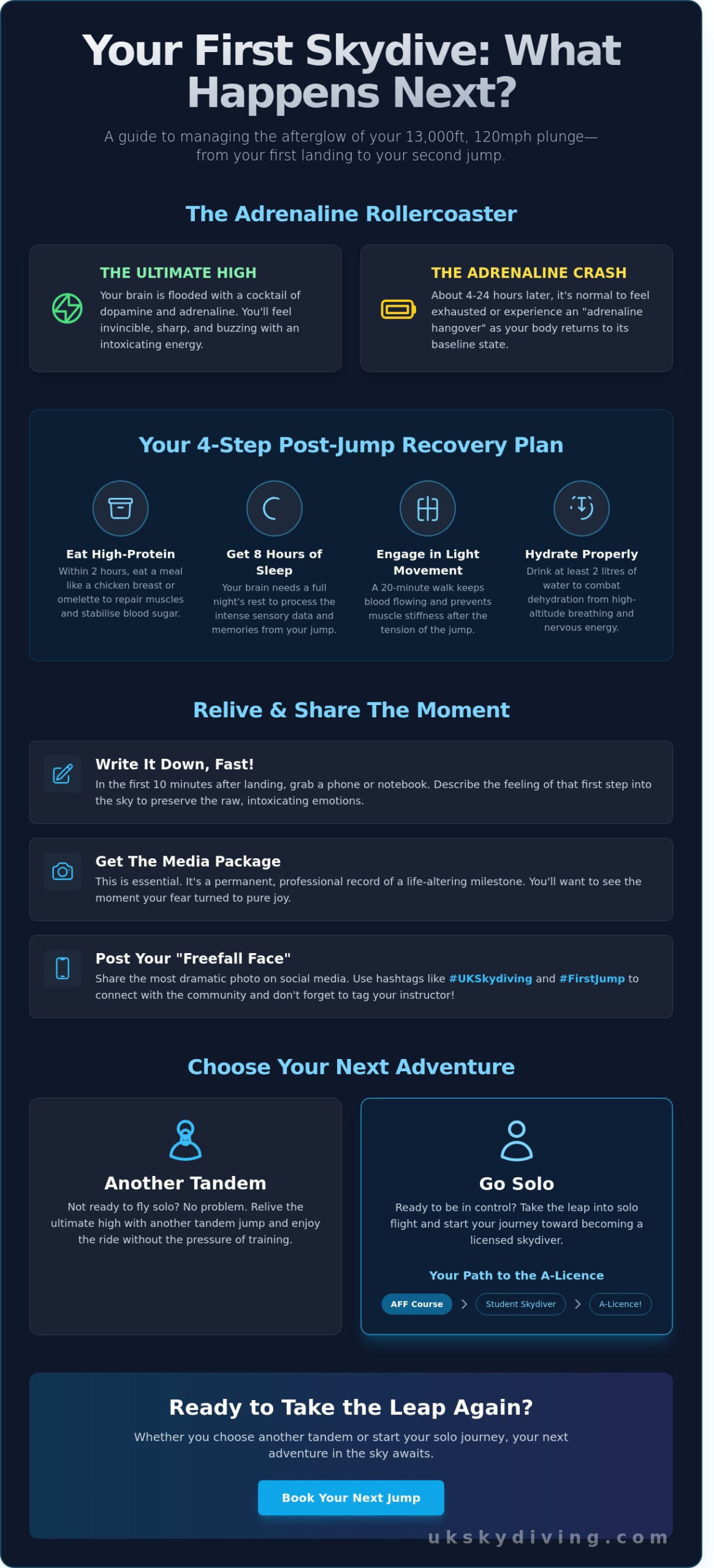
Choosing Your Next Adventure: Another Tandem or Going Solo?
The buzz from that first landing is like nothing else on earth. You have conquered the clouds and now you are likely wondering what to do after your first skydive to keep that fire burning. For most adventurers, the choice boils down to two paths. You can book another tandem to refine your skills or dive headfirst into a solo training course. Both options offer a breathtaking and intoxicating experience, but they serve very different goals on your journey to becoming a skydiver.
Why the Second Tandem is Often Better Than the First
Have you heard of “Second Jump Syndrome”? It is a well known phenomenon in the skydiving world. During your first jump, your brain is often in survival mode. It is busy processing a massive sensory overload that can make the freefall feel like a blur. On the second go, your mind is far more relaxed. This shift allows for incredible situational awareness. Instead of just reacting to the wind, you can actually look around and soak in the stunning Cambridgeshire views from 13,000 feet.
A second tandem also gives you the chance to be an active participant. Your highly skilled instructor will guide you through more than just the ride. You can practice these specific skills:
- Controlled 360-degree turns in freefall
- Monitoring the altimeter to track your altitude
- Assisting with the parachute steering once the canopy opens
It is the ultimate high without the pressure of being entirely responsible for your own safety just yet. You get to focus on the thrill while our experts handle the technicalities.
Is It Time to Ditch the Instructor? Signs You Are Ready for Solo
If you find yourself constantly dreaming about being in total control of the parachute, it is a clear sign you are ready to ditch the instructor. Taking a solo course like Accelerated Freefall (AFF) is a massive personal accomplishment. While the initial training involves a higher upfront cost, it is a brilliant financial move for the long run. Once you are a qualified solo jumper, the cost per jump drops significantly. In the UK, experienced jumpers often pay between £30 and £45 per “lift” to altitude.
If you feel the “itch” to take charge, you should review the basics first. Check out this Tandem Skydiving: The Ultimate Guide to Your First Jump for a refresher on the mechanics of flight. Moving to solo status means you are no longer just a passenger. You become a pilot of your own body and canopy. It is a bold step that transforms a one-time thrill into a lifelong passion.
Another incredible way to plan what to do after your first skydive is to look into charity skydiving. This allows you to experience the adrenaline rush of a lifetime while raising vital funds for a cause you care about. Many of our jumpers find that jumping for a purpose adds an extra layer of emotional reward to the adventure. Whether you choose to go solo or stick with a pro, the sky is waiting for you. Prepare to fly!
Taking the Leap: Earning Your British Skydiving A-Licence
You have already tasted the adrenaline. Now it is time to take total control. If you are wondering what to do after your first skydive, the answer is to stop being a passenger and start being the pilot. Moving from a tandem jump to a student skydiver is the ultimate high. It turns a one-off thrill into a lifelong passion. This journey is about more than just falling, it is about mastering the air and joining a global community of adventurers.
The path to your British Skydiving A-Licence is structured to build your confidence and skill. You won’t be doing it alone. Our highly experienced instructors guide you through every second of the process. You start with the most intensive training available to ensure every jump is as safe as it is exhilarating. This is your chance to earn your wings and experience the breathtaking freedom of solo flight.
What is an AFF Course and How Does It Work?
The Accelerated Freefall (AFF) course is the fastest way to fly solo. It is an intensive eight-level program designed to turn beginners into competent skydivers quickly. During levels one to three, two instructors stay by your side in freefall to maintain your stability. By levels four to seven, you transition to a single instructor as you learn turns, fast falls, and backloops. Level eight is your final solo graduation jump.
Before you ever board the aircraft, you must complete a full day of ground school. This training is vital. You will spend at least six hours learning canopy control, flight patterns, and emergency drills. We make sure these skills are second nature before you exit the door at 13,000 feet. For a complete breakdown of the journey, read our Learn to Skydive: Your Ultimate Guide to Becoming a Licensed Skydiver.
The Perks of Being a Licensed Skydiver in the UK
Earning your A-Licence changes everything. Once you have that qualification, the entire world opens up. You aren’t restricted to your home dropzone. You can take your logbook to any skydiving centre on the planet and jump. It is a universal passport to adventure. You also gain the ability to jump with others. You can start learning formation skydiving, where you and your friends link up in mid-air to create incredible patterns.
The financial benefits are just as exciting. While the initial training is an investment, the cost per jump plummets once you are licensed. Instead of paying for an instructor’s expertise, you simply pay for your “slot” on the plane. In the UK, this usually costs between £30 and £45 per jump. When you decide what to do after your first skydive, choosing the licensed route is the best way to make the sport sustainable and fun. You get more airtime, more freedom, and more memories for the rest of your life.
Are you ready to stop dreaming and start flying? Book your AFF ground school today and join the ranks of the world’s elite adventurers!
Welcome to the Family: Life at the UK Skydiving Dropzone
You’ve felt the ultimate high. Your feet are back on solid ground, but the adrenaline is still surging through your veins. This is the moment you transition from a visitor to a member of the family. At our Cambridgeshire base in March, the experience doesn’t end when the canopy collapses. We are more than just a service provider. We are a lifelong club of adrenaline junkies and sky-high explorers. You didn’t just tick an item off a bucket list. You opened a door to a completely different way of living.
The atmosphere at our dropzone is electric. It’s a place where novices rub shoulders with veterans who have logged over 5,000 descents. We encourage you to stick around after your flight. Grab a seat, relax, and look up. Observing the landing patterns and exit timings is a vital part of your education. You’ll see different disciplines in action, from high-speed tracking to graceful canopy work. This is where you start to understand the true scale of the sport.
The Cambridgeshire Skydiving Community
Our facilities in March are designed for more than just logistics. They are the heart of the action where jumpers gather to swap stories and share tips. If you’re wondering what to do after your first skydive, the best advice is to talk to the “fun jumpers.” These are the regulars who live for the weekend. They love sharing their passion and can tell you everything about the different paths you can take, whether it’s formation skydiving or freeflying. Learning by immersion is the fastest way to progress.
When the planes stop flying and the sun begins to set, the real magic happens. Our bunkhouse culture is the backbone of the UK skydiving scene. It’s where the “apres-dive” social events take place. We host regular BBQs and gatherings where the day’s highlights are replayed in vivid detail. You’ll find that the bonds formed at 13,000 feet are stronger than anything you’ll find on the ground. You aren’t just a customer here. You’re a part of the crew.
Your Journey Starts Here
That first leap was an intoxicating introduction to a brand-new world. It was the beginning of an extraordinary journey that can take you across the globe. Don’t let that momentum fade away. Most of our regular jumpers booked their second flight or signed up for an Accelerated Freefall (AFF) course before the adrenaline from their first jump had even subsided. The sky is no longer the limit. It’s your new playground.
Every expert you see at the dropzone started exactly where you are today. They felt the same nerves and the same incredible rush. Now, they’ve mastered the air. You can do the same. This is your invitation to step up and join the ranks of those who truly know what it means to fly.
Keep the High Alive and Join the Family
Your first jump is just the beginning of an extraordinary journey that changes how you see the world forever. Once the initial adrenaline rush settles, you’ll find that the best way to beat the post-jump crash is to start planning your next move immediately. Figuring out what to do after your first skydive often leads right back to the airfield, whether you’re reliving the video with friends or looking into earning your British Skydiving A-Licence. It’s about more than just a single jump. It’s about joining a community of passionate adventurers who live for the ultimate high.
You can step up to a full range of AFF solo training courses at our state-of-the-art facilities in Cambridgeshire. These facilities are built to support your progression from a tandem passenger to a qualified solo skydiver. You’re always in safe hands with our highly experienced British Skydiving instructors who guarantee a breathtaking and professional experience every time you visit. Don’t let the excitement fade. Book your next adrenaline rush at UK Skydiving today! Prepare to fly and take your place in the skies.
Frequently Asked Questions
How long should I wait before my second skydive?
You can jump again as soon as there is an available slot on the next plane. Many adventure seekers choose to go back up within 60 minutes to keep the momentum of that initial high. If you are deciding what to do after your first skydive, try to book your next jump within 30 days to ensure your confidence and muscle memory stay sharp.
Is the second skydive scarier than the first one?
The second jump often feels more intense because your brain actually knows what is coming. During the first jump, sensory overload makes everything a blur, but the second time allows you to consciously experience the 120 mph freefall. It is a breathtaking and intoxicating experience that many enthusiasts find even more exhilarating than their debut.
What is an adrenaline crash and how do I fix it?
An adrenaline crash is the natural dip in energy your body feels after the massive hormonal surge of a jump. You might feel sudden fatigue or a slight “brain fog” about 45 minutes after landing. You can fix this easily by drinking 500ml of water and eating a snack high in complex carbohydrates to stabilize your blood sugar levels.
Can I start learning to skydive solo immediately after a tandem?
Yes, you can begin your journey to becoming a solo skydiver the very same day you finish your tandem. Most UK dropzones encourage students to move straight into the Ground School for the Accelerated Freefall course. Planning what to do after your first skydive often leads directly to the classroom where you’ll learn the mechanics of flight and safety.
How many jumps does it take to get a skydiving licence in the UK?
You need a minimum of 18 successful jumps to qualify for your British Skydiving “A” Licence. This total includes the 8 levels of the Accelerated Freefall program followed by 10 consolidation jumps where you practice your skills solo. It is a structured and extraordinary journey that turns you into a fully qualified pilot of your own parachute.
What happens if I feel sick or dizzy after my first jump?
Feeling a bit dizzy is usually a result of the canopy turns or the pressure changes in your inner ear. If you feel unwell, tell your highly skilled instructor immediately so they can lead you to a quiet spot to rest. Most people feel completely back to normal after 20 minutes of fresh air and a few sips of water.
Are there discounts for booking my second tandem jump on the same day?
Many UK dropzones offer a significant “jump again” discount if you book your second tandem before you leave the centre. You can often save £50 or more by committing to a second flight while you are still at the airfield. It is the ultimate way to experience the thrill again while keeping your costs down.
Can I use my tandem jump as credit toward an AFF course?
Some centres allow you to apply a portion of your tandem payment toward the cost of an AFF Level 1 training day. This credit is usually valid for 30 to 60 days depending on the specific dropzone’s policy. Always ask the manifest office for a training voucher before you head home so you can start your solo adventure for less.
Categorised in: Blog