
Latest News
-
 Skydiving as a Confidence Booster: How One Jump Can Change Your Life September 20, 2026
 -
 How to Convince Your Parents to Let You Skydive September 19, 2026
 -
 How to Land a Parachute Safely: A Beginner’s Guide September 18, 2026
 -
 Static Line vs AFF: Choosing Your Path to Solo Skydiving in 2026 September 17, 2026
 -
 Skydiving A License: Your Passport to the Skies September 16, 2026
Failing an AFF Level: Why Repeating a Jump is Part of the Journey
May 14, 2026 12:00 amThe most legendary skydivers in the sky today didn’t start as perfect pilots! They started as dedicated students who weren’t afraid to master a skill before moving on to the next challenge. If you’re feeling the sting of failing an AFF level, take a deep breath and look at the horizon. You aren’t falling behind. You’re actually building the rock-solid foundation required for a lifetime of adrenaline-fueled adventures. It’s completely natural to feel a bit of a gut punch when you don’t get the pass on your first go. We understand the pressure of wanting to progress and the worry about your training budget.
This journey is about more than just checking boxes. It’s about your safety and your ultimate success as a solo flyer. We promise to show you why repeating a level is a standard part of training that even the most talented athletes experience. You will get practical tips to help you nail your next jump and understand why these safety adjustments are the best thing for your skydiving career. Get ready to bounce back with more confidence than ever before. Your path to the British Skydiving ‘A’ license is still wide open and more exciting than you ever imagined!
Key Takeaways
- Understand why failing an AFF level is actually a strategic safety pause designed to turn you into a more competent and confident pilot.
- Discover how brain lock and sensory overload work so you can stay focused during the intense adrenaline rush of freefall.
- Master the art of the Dirt Dive and use mental visualization to lock in your skills before you even leave the plane.
- Get a clear picture of the financial journey and see why repeating jumps is a normal part of the process for most skydivers.
- Learn how our world-class instructors in Cambridgeshire create the ultimate supportive environment for your skydiving success.
What Does Failing an AFF Level Actually Mean?
That moment on the landing area can feel incredibly heavy. You just put your heart and soul into a jump, but the debrief doesn’t end with a “pass” stamp. It is okay to feel a sting of frustration. We have all been there! But here is the truth: failing an AFF level is actually a badge of dedication. It means you are part of a sport that refuses to compromise on your safety. Your instructor is not failing you. They are investing more time in you. They want to ensure that your muscle memory is 100% reliable before you take the next big step toward solo flight.
Skydiving is a brand-new language for your body. You are teaching your limbs to move and react while falling through a literal hurricane at 120mph. That is intense! Nobody expects you to be a master of the air on day one. Even the most legendary flyers and national champions in our community had to repeat a jump or two during their training. They understood that the Accelerated Freefall program is designed to be a challenge. It pushes you because the reward is a lifetime of incredible freedom. A repeat is just a pivot toward a more successful future.
Reframing the Repeat: Learning at Your Own Pace
Think of a repeat as a private, high-altitude coaching session. The sky is a high-speed classroom with a very steep learning curve. There is no “one size fits all” rule for human flight. You need to master the fundamentals like your stable arch and altitude awareness before you move on to complex turns or docks. Mastering these basics now prevents dangerous habits from forming later. It is about learning at your own pace and making sure every single jump is a victory for your skill set. You aren’t falling behind. You are getting extra practice that will make you a much better pilot in the long run.
The Role of British Skydiving Standards
We operate under the strict safety criteria set by British Skydiving. These rules are the gold standard for training. They aren’t here to hold you back or make things difficult. They exist to keep you and everyone else in the sky safe. Our instructors are highly qualified professionals who know exactly what a student needs to demonstrate before moving up. If they ask you to repeat a level, it is because they want you to be a confident, capable flyer. For more on how we prioritize your well-being, check out our Is Skydiving Safe? guide. Trust the process and trust the standards!
Common Reasons for Repeating a Skydiving Level
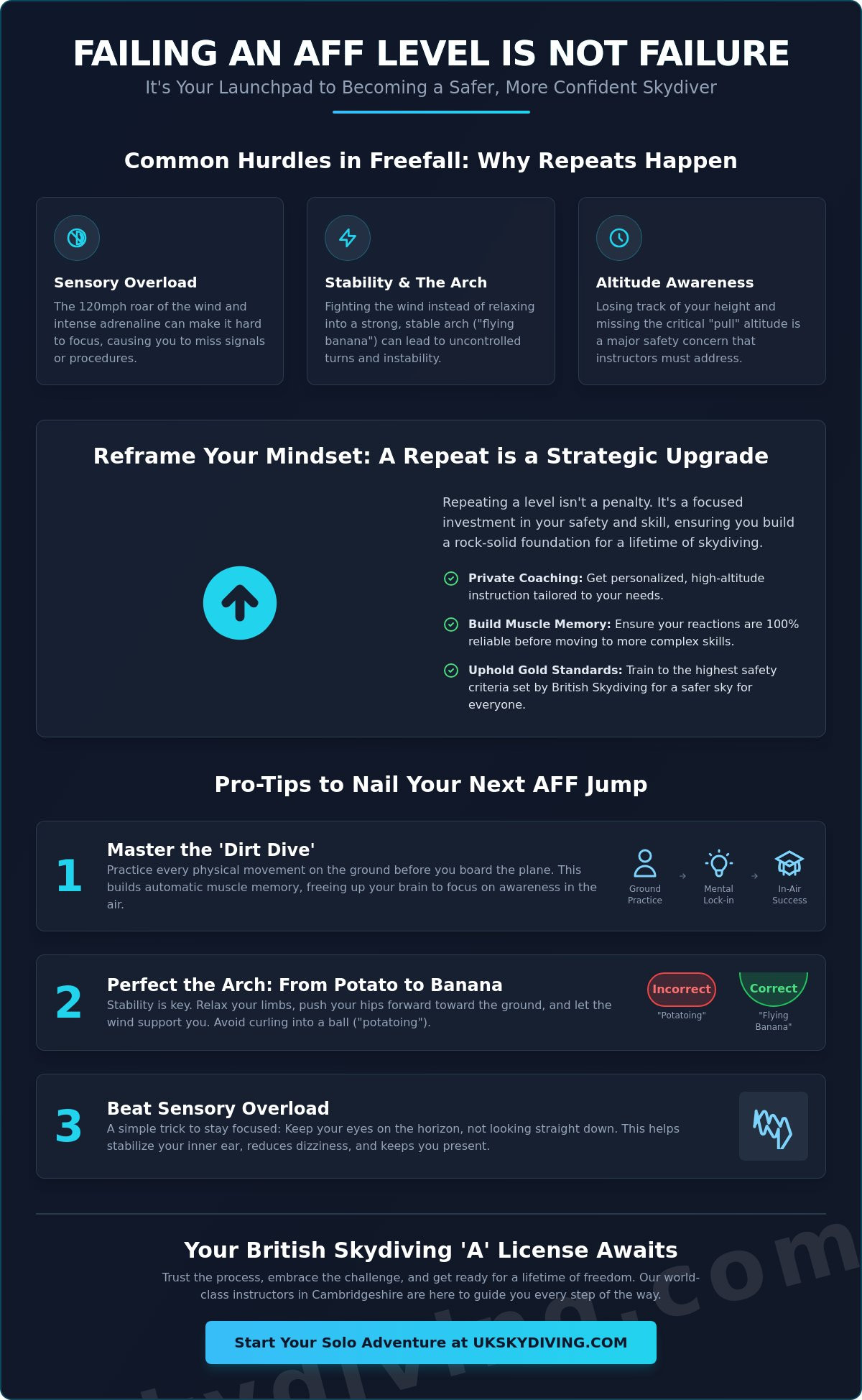
The rush of the wind is unlike anything else on earth! It’s a sensory explosion that can leave even the bravest souls a bit dazed. While failing an AFF level might feel like a setback, it’s usually caused by very specific, fixable technical hurdles. Understanding these common “brain locks” is the first step to conquering them. Instructors aren’t looking for perfection. They’re looking for consistent, safe reactions in a high-speed environment. They want to see that you can handle the intensity before you move to the next stage of your journey.
There are a few key reasons why a student might need another go at a jump. These include missing a signal, losing stability, or landing a bit too far from the target. According to the Skydiver’s Information Manual, safety protocols require students to demonstrate clear competency in specific skills before progressing. This ensures that every jump you make is as safe as it is thrilling. It’s all about building a foundation that lasts a lifetime.
Sensory Overload and Altitude Awareness
Your first few jumps are a massive shock to the system. The roar of the wind at 120mph can make it surprisingly hard to focus on your altimeter. This is what we call sensory overload. If you miss your “pull” signal or forget to check your height, your instructor will likely call for a repeat. It’s not about punishment. It’s about making sure you can stay aware when the adrenaline is pumping! Try to keep your eyes fixed on the horizon rather than looking straight down at the ground. This simple trick helps stabilize your inner ear and reduces that dizzy, overwhelmed feeling. It keeps your world from spinning and lets you focus on the task at hand.
The Perfect Arch: Why Stability Matters
Stability is everything in freefall. We want you to look like a flying banana! A strong, deep arch is the foundation of every successful solo flight. Many students struggle with “potatoing” where they accidentally curl into a ball because of leg tension. If your legs are too stiff or you’re fighting the wind, you might start to turn or drift unexpectedly. Relax! The air is your friend. Instead of fighting the pressure, lean into it. Pushing your hips toward the ground and keeping your chin up will lock you into a rock-solid position. If you’re feeling nervous about your next jump, why not check out our Accelerated Freefall (AFF) Course details to remind yourself of the progression steps?
Finally, canopy control is just as vital as the freefall itself. If you manage a perfect exit and a stable flight but end up landing in a different county, you might need to repeat the level. Learning to navigate your parachute back to the designated landing area is a critical skill for any solo pilot. It takes practice to judge the wind and time your flares perfectly. Every repeat is just another chance to get that landing exactly right and build your confidence for the future.
The AFF Journey: Managing Costs and Expectations
Let’s talk about the elephant in the room: the cost. We know that skydiving is a premium sport, and the financial reality of failing an AFF level can feel like an unwanted weight on your shoulders. It is completely normal to feel a bit of budget-related stress when you realize you need to pay for a repeat jump. But here is an epic perspective shift for you! That repeat jump is not a wasted expense. It is a high-value investment in your future as a safe, competent solo pilot. You are paying for expert, one-on-one coaching in the most exhilarating classroom on the planet. That extra time in the air builds the rock-solid skills you will use for the rest of your life.
It is a common myth that everyone breezes through the course without a single repeat. In reality, the “average” student does not pass every level on the first attempt. Some people struggle with the exit, while others need an extra try to nail their 360-degree turns. This is all part of the process! The USPA Integrated Student Program and similar British Skydiving standards are designed to be rigorous for a reason. They ensure you have the muscle memory to handle high-stakes situations with total confidence. When you finally earn that license, you will know you earned it through grit and genuine mastery.
Budgeting for Your Skydiving License
The best way to take the pressure off yourself is to plan ahead. We always suggest setting aside a “buffer” fund for at least two or three repeat jumps. Having this financial safety net means you won’t be panicking about your bank balance while you’re trying to focus on your arch at 12,000 feet! Rushing the course just to save a few pounds usually backfires. It creates unnecessary tension that makes learning harder. If you want a clear picture of the road ahead, our Learn to Skydive guide covers everything you need to know about course expectations and the path to your license.
Comparing Your Progress to Others
Beware of “dropzone envy”! It is so easy to watch another student progress faster and feel like you’re falling behind. Stop right there. Everyone comes to this sport with a different background. Some might have hundreds of hours in other extreme sports, while others are starting from zero. Your journey is yours alone. The sky doesn’t care how many tries it took you to pass Level 4. It only cares that you are safe and stable when you get there. Focus on your personal wins and the incredible achievement of becoming a licensed skydiver. That first solo jump after your license will feel just as sweet, regardless of how many repeats it took to get there!
Pro Tips to Pass Your Next AFF Level
Ready to crush your next jump? We know you are! While failing an AFF level can feel like a brief pause in the action, it’s actually the perfect time to sharpen your tools. You have the heart of a lion, and now we just need to fine-tune the technique. The best way to move forward is to look back with total clarity. Ask your instructor for a detailed video debrief of your previous attempt. Seeing your body position from an outside perspective is a total game-changer! You might realize your legs weren’t as symmetrical as they felt or that you missed a hand signal by just a fraction of a second. This visual proof turns “I think I did this” into “I know exactly how to fix this” for your next exit.
Visualisation and Mental Preparation
Your brain is a powerful flight simulator. Take 60 seconds to sit quietly and close your eyes. Imagine the door opening and the blast of cold air hitting your face. In your mind, walk through every single second of the dive from the exit to the parachute deployment. Focus on your “eyes-on-altimeter” cues. Visualise the needle moving and yourself reacting with a calm, steady check. This mental rehearsal builds the neural pathways you need to stay cool under pressure. Don’t forget to back this up with a physical “dirt dive” before you board the plane. Dirt diving is the practice of your jump sequence on the ground to build muscle memory until your movements become automatic.
How the Wind Tunnel Can Fix Your Arch
If you’re struggling with stability, the wind tunnel is your ultimate secret weapon. Think of it as a high-speed laboratory for your body position! Just 15 minutes of flight time in a tunnel is roughly equivalent to the freefall time of dozens of actual skydives. It’s a controlled, safe environment where you can find your stable “neutral” position without the pressure of a ticking altimeter. Tunnel instructors are experts at helping you isolate specific movements. They can show you exactly how to adjust your hips or legs to stop an unwanted turn. Once you feel that rock-solid stability in the tunnel, you can translate that success back to the dropzone. You’ll head to the plane knowing exactly how the wind feels against your arch. It’s the fastest way to turn a repeat into a spectacular pass!
The sky is waiting for you to claim your victory. Every pro was once a student who refused to quit. Use these tools to build your confidence and get back to the flight line with a smile. We are here to support every step of your journey to the clouds. Book your next AFF jump today and show the world what you’re made of!
Starting Your Solo Adventure at UK Skydiving
Welcome to the family! At UK Skydiving, we don’t just teach you how to fall. We teach you how to fly. If you have been feeling discouraged about failing an AFF level, you have come to the right place for a legendary comeback. Our Cambridgeshire dropzone is more than just an airfield. It is a high-energy hub of support where every student is treated like a future pro. We are totally committed to your journey from that first nervous exit to the incredible moment you hold your A-License in your hands. Our team knows exactly how to turn those “not quite” moments into “nailed it” victories!
The road to becoming a licensed skydiver is a massive personal accomplishment. It requires grit, focus, and a passion for the extreme. Remember that a British Skydiving A-License requires a minimum of 25 jumps. This includes your 8 AFF levels and at least 17 consolidation jumps. If you need to repeat a level, look at it as a bonus! You are simply gaining more of the 25 jumps you need while receiving expert, one-on-one attention from the best in the business. Every extra second in freefall is a chance to perfect your form and build the confidence required for a lifetime of solo adventure.
Expert Coaching in Cambridgeshire
Our base in March is designed for your ultimate success. We have world-class facilities and a community that is completely free of judgment. Every instructor here specialises in student progression. They have seen every mistake in the book and they know exactly how to fix them! They understand the intense adrenaline and the technical glitches that can happen at 12,000 feet. After every single jump, you get personalised, detailed feedback. We use professional video debriefs to show you exactly what happened in the air. This isn’t just about passing a level. It is about making sure you are a safe, reliable pilot who can handle any situation with a cool head.
Ready to Get Back in the Air?
Momentum is your best friend in this sport. The best time to fix a mistake is while the feeling of the wind is still fresh in your mind! Don’t let a small technicality slow you down. Think about that breathtaking feeling of your first true solo flight. Imagine the pride of landing your parachute perfectly in the target area. That dream is just one jump away! Our team is standing by to help you reset, refocus, and reach the clouds again. You have the passion and we have the expertise to get you there. Let’s make your next jump the one you remember forever.
The sky is calling and your seat on the plane is waiting. Take the leap and join the ranks of the world’s most adventurous people. Book your next AFF jump or speak to our team today and let’s get you back where you belong!
Claim Your Future in the Clouds
Your journey to the clouds is just beginning! Remember that failing an AFF level isn’t a stop sign. It is a launchpad. You now have the mental tools and the technical knowledge to return to the airfield stronger than ever. By mastering your dirt dive and trusting the expert feedback from your instructors, you are transforming into a truly elite pilot. The thrill of your first solo landing is waiting for you. It will be one of the most legendary moments of your life!
Our professional British Skydiving instructors are ready to guide you every step of the way. We provide state-of-the-art training facilities in Cambridgeshire and a highly supportive student community that celebrates every win. Don’t let a small technicality keep you on the ground. The wind is calling and the view from 12,000 feet is absolutely unbeatable. You have the heart of an adventurer and the sky is your playground. Let’s get back to the flight line and make history together!
Take the next step toward your solo license with UK Skydiving
Frequently Asked Questions
Is it common to fail an AFF level on the first try?
It is incredibly common to repeat at least one jump during your training! Most students find that they need an extra go at a specific skill to ensure they are 100% safe and stable. Don’t feel discouraged because even the most natural flyers often face a repeat. It’s just a standard part of the learning process in such an intense environment. You are building a foundation for a lifetime of flight!
How much does it cost to repeat an AFF jump?
A single repeat jump typically costs between £140 and £180 at most UK dropzones. This fee covers your specialized gear hire, the aircraft slot to full altitude, and the dedicated time of your professional instructors. Think of it as a high-value investment in your safety and skill set. It ensures you have the expert coaching needed to master the air with total confidence before moving forward!
What happens if I fail the same AFF level multiple times?
If you find yourself failing an AFF level more than once, don’t panic! Our instructors will sit down with you for a deep-dive video debrief to identify exactly what is holding you back. We might suggest a specific focus on ground training or a session in a wind tunnel to build that vital muscle memory. We are totally committed to your success and will adjust our coaching to help you smash through that plateau.
Can I switch instructors if I am struggling with a certain level?
You can certainly request a different perspective if you feel you aren’t clicking with a specific teaching style. Every instructor at our Cambridgeshire base is highly qualified, but sometimes a new voice can make a difficult concept finally click. We want you to feel comfortable and empowered throughout your journey! Just speak to our training coordinator and we will find the perfect match for your specific learning needs.
Do I have to do the ground school again if I take a break?
You might need to attend a refresher if you take a break longer than three months between your jumps. British Skydiving regulations ensure your knowledge is fresh and your safety procedures are sharp before you head back up. If it’s been a very long time, you might need to sit the full ground school again. Staying current is the best way to keep your skills high and your training on track!
How many levels are there in the AFF course?
There are eight core levels in the Accelerated Freefall course. Each level introduces new skills, starting with basic stability and moving toward advanced maneuvers like turns and backloops. Once you pass Level 8, you’ll move on to your 10 required consolidation jumps. This path is the most efficient way to earn your solo skydiving license in the UK and join the community of solo flyers!
Can I use indoor skydiving to help pass my AFF levels?
Using a wind tunnel is a fantastic way to accelerate your progress! While we don’t sell indoor skydiving ourselves, we highly recommend it for students who are failing an AFF level due to stability or turn issues. Just fifteen minutes in the tunnel can give you the equivalent freefall time of dozens of jumps. It’s a brilliant tool to fix technical issues and boost your confidence before your next attempt.
What is the most difficult AFF level to pass?
Many students find Level 3 or Level 4 to be the most challenging milestones in the course! Level 3 is often the first time your instructors let go of you completely in freefall, which can be a massive adrenaline rush. Level 4 introduces starting and stopping turns, which requires very precise leg and arm movements. Every student is different, so your toughest level might be totally different from someone else’s!
Categorised in: Blog