Latest News
-
 Skydiving as a Confidence Booster: How One Jump Can Change Your Life September 20, 2026
 -
 How to Convince Your Parents to Let You Skydive September 19, 2026
 -
 How to Land a Parachute Safely: A Beginner’s Guide September 18, 2026
 -
 Static Line vs AFF: Choosing Your Path to Solo Skydiving in 2026 September 17, 2026
 -
 Skydiving A License: Your Passport to the Skies September 16, 2026
Hard Landing Skydiving Injuries: Risks, Prevention, and Reality
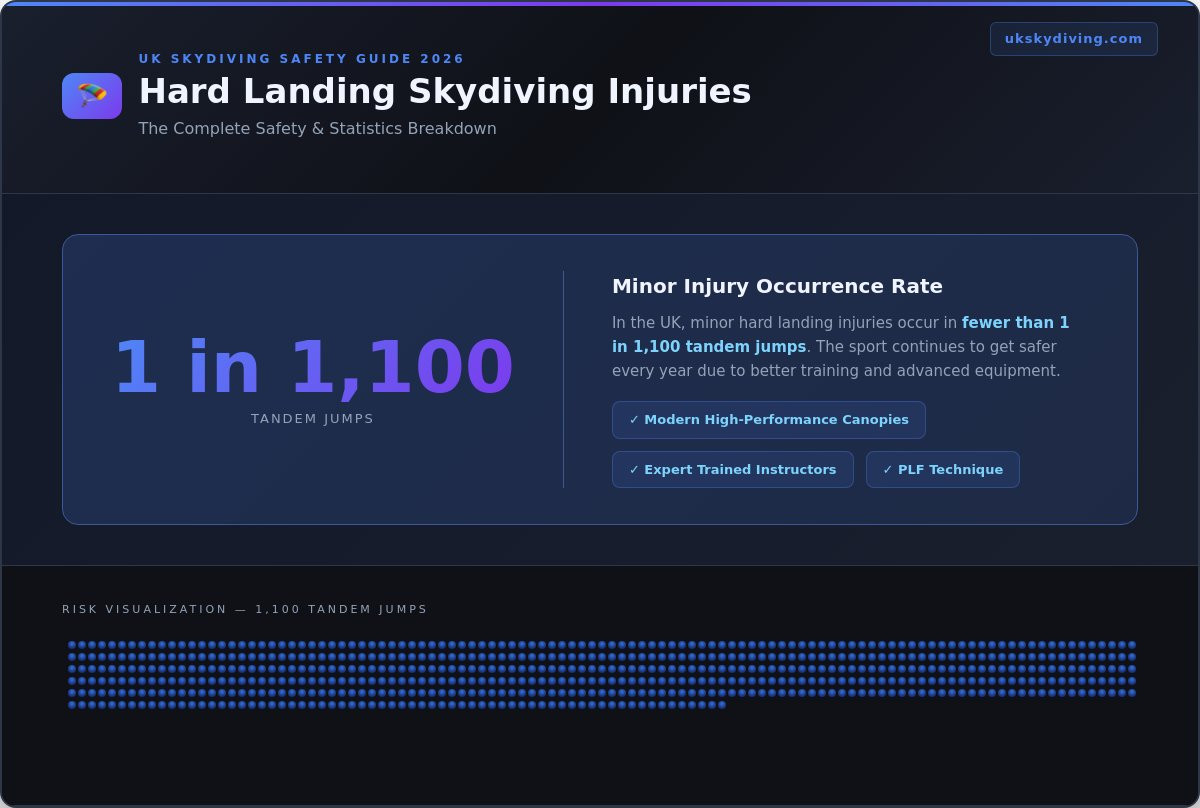
May 12, 2026 12:00 amDid you know that minor hard landing skydiving injuries occur in fewer than 1 in 1,100 tandem jumps across the UK? It’s completely natural to feel a rush of anxiety about the moment your feet touch the grass after an intoxicating freefall at 120 mph. You’re chasing the ultimate high, but you want to know you’re in safe hands when it’s time to come back to earth. We understand those nerves, and we’re here to show you why skydiving is one of the most exhilarating and well-regulated adventures you can choose.
In this guide, you’ll learn the truth about landing risks and how professional training keeps you secure throughout your entire journey. We’ll break down the latest 2026 safety statistics, explain why tandem jumps are significantly safer than solo flight, and reveal how our highly skilled staff use their expertise to ensure a smooth finish. You’ll walk away with a realistic understanding of the sport and the confidence to trust your instructor. Get ready to replace your fear with pure excitement and prepare to fly!
Key Takeaways
- Modern square parachutes act like wings to provide a flared landing, which ensures your descent is controlled and smooth.
- Discover the facts behind hard landing skydiving injuries and why minor incidents happen in fewer than 1 in 1,100 UK tandem jumps.
- Learn about the Parachute Landing Fall (PLF) technique and how distributing impact across five body points keeps you safe.
- Understand why tandem skydiving is the ultimate way to start your journey since your instructor handles every technical detail of the landing.
- Gain the confidence to embrace this breathtaking adventure with expert staff who prioritize both your safety and your adrenaline rush.
What is a Hard Landing in Skydiving?
Think of your landing as the final, triumphant act of your breathtaking adventure. While some media reports use dramatic language to describe any landing that isn’t perfect, a hard landing is actually a technical term. It describes a descent where your vertical or horizontal speed isn’t fully arrested before you touch the ground. In the world of modern skydiving, these events are the exception rather than the rule. Understanding the mechanics of your flight helps you see that hard landing skydiving injuries are rare and highly preventable.
Modern parachute gear has transformed the sport over the last few decades. We no longer use the round, non-steerable canopies you might see in old war movies. Today, we fly high-performance square parachutes that function exactly like an airplane wing. These canopies allow for incredible control and precision. They are designed to glide forward and generate lift. This technology has made soft, stand-up landings the standard for both tandem students and experienced solo jumpers. A minor bump or a sliding finish is often mistaken for a hard landing, but these are usually just part of the thrill and result in nothing more than a grass stain on your jumpsuit.
The Role of the Flare
The “flare” is the magic move that ensures a gentle touchdown. As you approach the landing area, your instructor will pull down on the steering toggles. This action changes the shape of the parachute wing, converting your downward speed into a momentary, gentle hover. It’s a breathtaking sensation that feels like stepping off a curb. Timing is everything here. A perfect flare requires a highly experienced instructor who knows exactly when to transition from flight to landing. While wind conditions can occasionally increase your ground speed, our highly skilled staff are experts at reading the environment to keep your journey safe and smooth.
Why Hard Landings Occur
When a landing is harder than expected, it’s usually down to human error or environmental factors. If a jumper flares too high, they might lose lift before reaching the ground. If they flare too low, they won’t slow down enough in time. This is why tandem students are in such a great position. You have a professional with at least 1,000 jumps handling the controls for you.
Environmental factors like sudden turbulence can also play a role. A key factor is wind shear. Wind shear is a sudden change in wind speed or direction near the ground. Even if the air is bumpy, jumpers are trained to use the Parachute Landing Fall to protect themselves. This technique ensures that any impact is distributed safely across the body, turning a potential hard landing into a controlled roll. You can feel confident knowing that every precaution is taken to ensure your ultimate high ends with a smile on the ground.
Common Hard Landing Skydiving Injuries
Let’s get real about what happens when you touch down. While the thrill of freefall is the main event, the landing is where the skill of our instructors really shines. Occasionally, things don’t go perfectly, and that’s when hard landing skydiving injuries can occur. However, these are far less dramatic than internet rumors suggest. Most incidents involve minor scrapes or bruises that you’ll wear as a badge of honor from your epic adventure.
Serious injuries to the head or spine are incredibly rare in the modern era. This is thanks to high-tech helmets and advanced harness systems that distribute force across your strongest muscle groups. Even when a descent is faster than planned, the risk of significant hard landing skydiving injuries is mitigated by how the gear protects your vital areas. Your body is built to absorb energy, and modern equipment ensures that force is directed away from your back and neck. This turns a potentially jarring moment into a manageable event.
Ankle and Lower Leg Risks
Your ankles are the most likely spot to feel the impact if you don’t lift your legs as instructed. Because they are often the first point of contact during a stand-up landing, they take the brunt of any leftover speed. Wearing sturdy, lace-up trainers is essential because they provide the lateral support your joints need. We always tell our jumpers that age is just a number, but maintaining good bone health helps your body handle the physical nature of any extreme sport. Our instructors are experts at guiding you through the leg-lift technique to keep your lower limbs clear of the ground until the very last second.
The Importance of a Reality Check
It’s vital to put the risks into perspective. You might be surprised to learn that tandem skydiving has a stellar safety record compared to other popular hobbies. In the UK, minor injuries happen in fewer than 1 in 1,100 tandem jumps. According to the USPA skydiving safety statistics, the sport continues to get safer every year due to better training and equipment. You are statistically more likely to get injured while cycling to the shop or skiing down a mountain than during your jump.
We want you to feel empowered by the facts. If you want to see how these numbers stack up against everyday activities, check out our guide on is skydiving safe for a deep dive into the data. Our goal is to make the extraordinary feel accessible and safe for everyone. When you book a Tandem Skydive Experience, you’re choosing a team that prioritizes your safety so you can focus on the adrenaline rush of a lifetime.
How to Prevent Injuries with the Parachute Landing Fall
You have just experienced the breathtaking rush of freefall and the intoxicating peace of the canopy ride. Now, it’s time to return to earth. While our highly experienced instructors handle the technical side of the landing during a tandem jump, every solo student learns a legendary safety move. It is called the Parachute Landing Fall, or PLF. This technique is the gold standard for landing safety across the globe. It is a simple but brilliant way to ensure that any extra energy from your descent is handled safely by your body.
The beauty of the PLF is how it turns a vertical impact into a smooth, horizontal roll. Instead of your joints absorbing the shock, the move distributes the force across five specific points of your body. This sequence is designed to protect your spine and head. By rolling through the impact, you significantly reduce the chance of sustaining hard landing skydiving injuries. You move from your feet to your calf, then through your thigh, your hip, and finally your shoulder. It is a fluid motion that feels like a controlled tumble on a gym mat.
Step-by-Step PLF Technique
Mastering the PLF starts with your body position. You must keep your feet and knees pressed firmly together. This creates a single, strong unit that is much more stable than two separate legs. As you approach the ground, you should resist the urge to look down at your boots. Instead, keep your eyes fixed on the horizon. Looking at the ground can cause you to reach out with your arms, which is something we always avoid. When you touch down, you simply collapse your knees and roll onto the side of your leg, flowing up through your back in one continuous motion.
Training for Success
We don’t just tell you how to do it. We make sure you feel it. Before your first solo jump, you will spend time on our training mats practicing these landings until they become second nature. Our instructors are with you every step of the way to provide encouragement and expert feedback. For those in our learn to skydive program, landing drills are a top priority. We even use ground-to-air radios to talk you through your first few landings from the safety of the flight line. This intensive training is a major reason why the UK has seen a 15% improvement in overall skydiving safety outcomes over the last ten years. You can jump with total confidence knowing you have the skills to land like a pro!
Tandem vs. Solo: Why Your First Jump is Extra Safe
If you are feeling a mix of adrenaline and nerves about your first jump, here is some incredible news. Tandem skydiving is designed to be the safest and most accessible way to experience the ultimate high. Unlike solo students who must master the flare and landing roll themselves, tandem passengers have a highly experienced professional literally attached to their back. Your instructor handles 100 percent of the parachute control from the moment the canopy opens until your feet touch the grass. This professional oversight is a massive factor in why hard landing skydiving injuries are so rare for first-time jumpers.
In a tandem setup, your responsibility is minimal. You get to enjoy the breathtaking views of the British countryside while your instructor does the heavy lifting. They are the ones calculating the wind speed and timing the flare to perfection. Because they are in total control, they can adjust the landing approach in real-time to ensure the softest possible touchdown. This level of expert management makes the experience feel safe, secure, and purely exhilarating. Even in the unlikely event of a firm touchdown, the instructor is positioned to take the primary impact. This ensures that the risk of hard landing skydiving injuries for the student is kept to an absolute minimum.
The “Lift Your Legs” Rule
Your main job during the landing sequence is simple. Lift your legs! By tucking your knees toward your chest, you allow the instructor to use their legs as the primary landing gear. This prevents you from accidentally tripping or catching a foot on the ground as you arrive. Whether the instructor lands on their feet or performs a smooth slide-in on their backside, your legs remain safely out of the way. This technique is a key part of our safety culture and helps guarantee a smooth finish to your adventure. For a full breakdown of what to expect during your journey, take a look at our tandem skydiving guide.
Instructor Expertise
The professionals at our Cambridgeshire base are among the best in the business. To even begin training as a tandem instructor in the UK, a skydiver must have a minimum of 1,000 jumps. This is a strict requirement set by British Skydiving and the Civil Aviation Authority. These highly skilled staff members have seen every type of weather condition and landing scenario imaginable. We also use top-tier dual-parachute systems to guarantee your safety. When you jump with us, you are benefiting from decades of experience and a passion for the sport. Are you ready to take the plunge? Book your Tandem Skydive Experience today and prepare for the thrill of a lifetime!
Preparing for Your Ultimate Adventure at UK Skydiving
Ready to experience the adrenaline rush of a lifetime? Now that you understand how our expert training and modern gear mitigate the risks of hard landing skydiving injuries, the only thing left to do is prepare for takeoff. We believe that everyone over the age of 16 should have the chance to feel the intoxicating freedom of the skies. Our team is dedicated to making this extraordinary journey as smooth as it is thrilling. We turn your natural nerves into pure, high-energy excitement from the second you arrive at the dropzone.
Safety is the foundation of every breathtaking moment we provide. This commitment is why the UK has seen a 15% improvement in overall skydiving safety outcomes over the last ten years. When you jump with us, you are joining a culture of excellence regulated by British Skydiving and the Civil Aviation Authority. We handle all the technical details so you can focus on the ultimate high of plunging toward the earth at 120 mph. It is a life-altering memory that you will cherish for the rest of your life.
What to Expect on the Day
Your journey begins at our welcoming March dropzone. The atmosphere is electric and filled with the spirit of adventure. Our highly skilled staff will guide you through a professional briefing where you will learn exactly what to do during your jump. We also take care of your mandatory British Skydiving provisional membership and verify your medical fitness forms. Every single jump is subject to a rigorous weather assessment. If the conditions aren’t perfect for your intoxicating experience, we wait for the ideal window to ensure your adventure is as safe as it is spectacular.
Booking Your Jump
Starting your adventure is simple and fast. Our online booking system allows you to secure your Tandem Skydive Experience with just a few clicks. We highly recommend adding one of our professional video and photo packages to your booking. These packages capture every second of your extreme journey, from the exit of the plane to the triumphant landing on the grass. It is the best way to share your significant personal accomplishment with the world. Don’t let another day go by just wondering what it’s like to fly. If you want extraordinary, if you want extreme, there is no better thrill than this. Make your reservation today and prepare to fly!
Start Your High-Flying Journey Today
You have the facts. Skydiving is an extraordinary journey that’s safer today than ever before. While the fear of hard landing skydiving injuries is natural, the reality is that expert technique and modern gear have made the sport incredibly secure. You now know how the PLF protects solo jumpers and why tandem students can relax while their instructor handles 100 percent of the canopy control. This expertise turns a moment of high-speed adrenaline into a soft, triumphant touchdown on the grass.
At our Cambridgeshire base, we provide the ultimate high with the peace of mind you deserve. Our highly skilled staff hold full British Skydiving certification and have thousands of jumps under their belts. We use state-of-the-art equipment and dual-parachute systems to guarantee your adventure is nothing short of breathtaking. Don’t let your nerves hold you back from a peak life event that you’ll remember forever. The reward of the ultimate high is waiting for you above the clouds.
Book your ultimate skydiving adventure today!
The sky is waiting. Prepare to fly and experience the adrenaline rush of a lifetime!
Frequently Asked Questions
Can you break your legs skydiving?
Yes, it is physically possible, but the risk for tandem students is extremely low. In the UK, minor injuries occur in fewer than 1 in 1,100 jumps, and most fractures happen to experienced solo jumpers pushing their limits. For your first jump, a professional instructor with at least 1,000 jumps handles the touchdown. This expertise ensures that the risk of hard landing skydiving injuries is much smaller than most people imagine.
What is the most common injury in skydiving?
Minor bruises and small ankle sprains are the most common issues reported. These usually happen if a student forgets to lift their legs as instructed or trips during a stand-up landing. Most of these incidents are tiny “war stories” rather than serious medical events. Because we prioritize your safety, our instructors often guide you to slide in on your backside, which almost eliminates the stress on your joints.
How do you land a skydive without getting hurt?
You land safely by following the simple instructions provided during your pre-jump briefing. For a tandem jump, your only job is to lift your legs high as you approach the grass. This allows your instructor to use their legs as the landing gear or slide you in smoothly. For those learning to fly solo, we teach the Parachute Landing Fall to distribute impact across the body and keep you safe.
Is a tandem landing safer than a solo landing?
Tandem landings are significantly safer for beginners because a professional is in total control of the parachute. Solo students are still mastering the timing of the flare and reading the wind conditions. With a tandem instructor, you benefit from thousands of hours of experience. They calculate the timing perfectly to ensure your breathtaking adventure ends with a gentle, controlled touchdown every single time.
What happens if you forget to flare the parachute?
If a jumper fails to flare, the parachute will not slow down to a hover before touchdown. This results in a much firmer landing that could lead to hard landing skydiving injuries if a roll isn’t performed. Tandem students don’t need to worry about this technical detail at all. Your instructor handles the flare for you, ensuring the wing converts your downward speed into a soft finish.
Do I need to be an athlete to land a skydive safely?
You don’t need to be an athlete to enjoy this intoxicating experience! As long as you have the basic mobility to lift your legs toward your chest for a few seconds, you are ready to fly. We welcome adventurers of all fitness levels and there is no upper age limit for tandem jumps. Our highly skilled staff are experts at making the extraordinary feel accessible and safe for everyone.
What should I wear to protect myself during landing?
The best protection is a pair of sturdy, lace-up trainers that provide good ankle support. You should avoid boots with hooks or open-toed shoes. We recommend comfortable, athletic clothing that allows for a full range of motion. We also provide jumpsuits that protect your skin from minor grass burns or scrapes during a sliding landing. This ensures you stay comfortable while chasing the ultimate high.
How fast do you hit the ground when skydiving?
You touch down at approximately 5 to 10 mph after a proper flare is executed. This is roughly the speed of a brisk walk or a gentle hop off a low step. While you are plunging toward earth at 120 mph during freefall, the parachute wing slows you down significantly. By the time you reach the landing area, the descent is controlled, calm, and designed for a smooth return.
Categorised in: Blog