Latest News
-
 Skydiving as a Confidence Booster: How One Jump Can Change Your Life September 20, 2026
 -
 How to Convince Your Parents to Let You Skydive September 19, 2026
 -
 How to Land a Parachute Safely: A Beginner’s Guide September 18, 2026
 -
 Static Line vs AFF: Choosing Your Path to Solo Skydiving in 2026 September 17, 2026
 -
 Skydiving A License: Your Passport to the Skies September 16, 2026
How Hard is the AFF Course? Your Guide to Mastering Solo Skydiving
May 13, 2026 12:00 amWhat if the only thing standing between you and the extraordinary thrill of solo flight isn’t your fitness, but your mindset? It’s completely normal to feel a surge of nerves when you ask yourself how hard is the AFF course. You might worry about the sensory overload of plunging at 120 mph or the frustration of paying £140 to £180 for a repeat jump if you don’t nail a level on the first go. We understand those fears. We are here to tell you that this breathtaking adventure is within your reach.
This guide will show you exactly what to expect from the eight levels of your Accelerated Freefall journey and how to prepare for success. You’ll learn why technical skills matter less than mental composure and how our highly skilled staff support you every step of the way. We will cover everything from the 15.5 stone weight limit to the secrets of passing your levels with flying colours. Get ready to transform your anxiety into pure adrenaline and discover how you can master the ultimate high with confidence.
Key Takeaways
- Discover why Accelerated Freefall is the ultimate fast track to your solo skydiving license. You’ll be plunging into the adrenaline rush much faster than with any other training method.
- Get a clear answer on how hard is the AFF course by learning why mental composure is more important than being an athlete. It’s all about mastering your focus during that intoxicating freefall.
- Find out which technical levels often trip students up and why a retake is just another step toward your goal. Our highly skilled staff guarantee you’ll have the support you need to succeed.
- Learn the mental rehearsal secrets that help you stay calm and pass your levels with confidence. These simple tips can make your entire journey smoother and even more exhilarating.
- See why our world-class Cambridgeshire facilities offer the best environment for your adventure. We provide the expert guidance you need to turn your dream of flight into a reality.
What is the AFF Course and Why is it the Fast Track to Solo Flying?
Imagine standing at the open door of a plane, 13,000 feet above the Cambridgeshire countryside. The wind is roaring, and the view is breathtaking. In a tandem jump, you are a passenger. In the Accelerated Freefall programme, you are the pilot. This is the ultimate high for anyone who wants to stop watching from the sidelines and start flying. It is a breathtaking, life-altering experience that transforms you from a dreamer into a skydiver. You aren’t just falling, you are learning to control your body in a completely new environment.
The Accelerated Freefall method is widely considered the most efficient way to earn your solo license. Traditionally, students had to progress through many “static line” jumps from lower altitudes. AFF skips the slow start. It puts you directly into the adrenaline-soaked freefall from your very first jump. You will plunge toward the earth at 120 mph with two highly skilled instructors by your side. They provide hands-on guidance to ensure you stay stable while you learn the ropes. When people ask how hard is the AFF course, they are usually surprised to find that the “accelerated” part refers to how quickly you build confidence and skill.
The Structure of the Accelerated Freefall Programme
Your journey begins with a full day of ground school. This isn’t just a boring lecture. It’s an intensive, hands-on training session where you learn about your equipment, how to exit the plane, and how to handle emergency situations. Once the ground school is complete, you move through eight technical levels. Each level is a new adventure. You will learn to maintain a stable “arch” position, perform 360-degree turns, and even master backloops. After you pass Level 8, you aren’t quite finished. You must complete ten consolidation jumps. These solo jumps allow you to practice everything you’ve learned before you officially earn your British Skydiving ‘A’ License.
Who Can Tackle the AFF Course?
You don’t need to be an elite athlete to succeed in skydiving. Most people with a reasonable level of fitness can handle the physical demands of the course. In the UK, the minimum age to start is 16. You must begin your training before your 55th birthday. There are also weight and BMI requirements to ensure everyone stays safe. Generally, the maximum weight is 15.5 stone with a BMI of 27.5 or less. We prioritize your safety above everything else. If you are feeling nervous about the technical requirements or the risks involved, read our guide on is skydiving safe for more reassurance. We guarantee that our expert instructors will be there to coach you through every exhilarating moment.
The Real Difficulty: Mental Composure vs Physical Skill
When people ask how hard is the AFF course, they are usually picturing complex aerial acrobatics or extreme physical strength. The truth is much more interesting. The physical movements of skydiving are actually quite simple and intuitive. You aren’t fighting the air. You are leaning into it. The real challenge is mental. It is about keeping your head while plunging toward the earth at 120 mph. This is where the true adventure begins. It is a test of your ability to stay calm in the face of an intoxicating adrenaline rush.
Your brain isn’t used to a 120 mph wind blast. The first time you leave the plane, your senses might go into overdrive. This sensory overload is exactly why the course is structured the way it is. You might feel like everything is happening at once. It’s a breathtaking experience that can make your mind go blank for a split second. Our highly skilled instructors are there to guide you through every second of the fall. They use hand signals to remind you of your tasks and keep you focused on the journey. You are never truly alone in the sky until you are ready.
Managing Sensory Overload in Freefall
The “tunnel vision” effect is common on Level 1. You might focus so hard on the horizon that you forget to check your altimeter. Staying altitude aware is your primary job. You will learn to check your wrist every few seconds to track your height. This keeps you grounded in reality while you enjoy the ultimate high. Trusting your equipment is also vital. All modern gear follows strict FAA safety guidelines to ensure maximum reliability. When you trust the tech and your instructors, the mental fog begins to lift and the fun truly starts.
The Physical Requirements for Success
The foundation of all stable flight is the arch position. Think of it as pushing your hips toward the ground while keeping your head up. It is the most natural way to fall. You don’t need to be an elite athlete to do this. In fact, being too muscular or tense can actually make things harder. Relaxation is your secret weapon. Small movements of your arms and legs create big changes in the air. If you want to experience this for yourself, you can book your first jump and start your journey today. We guarantee it will be something you remember for the rest of your life.
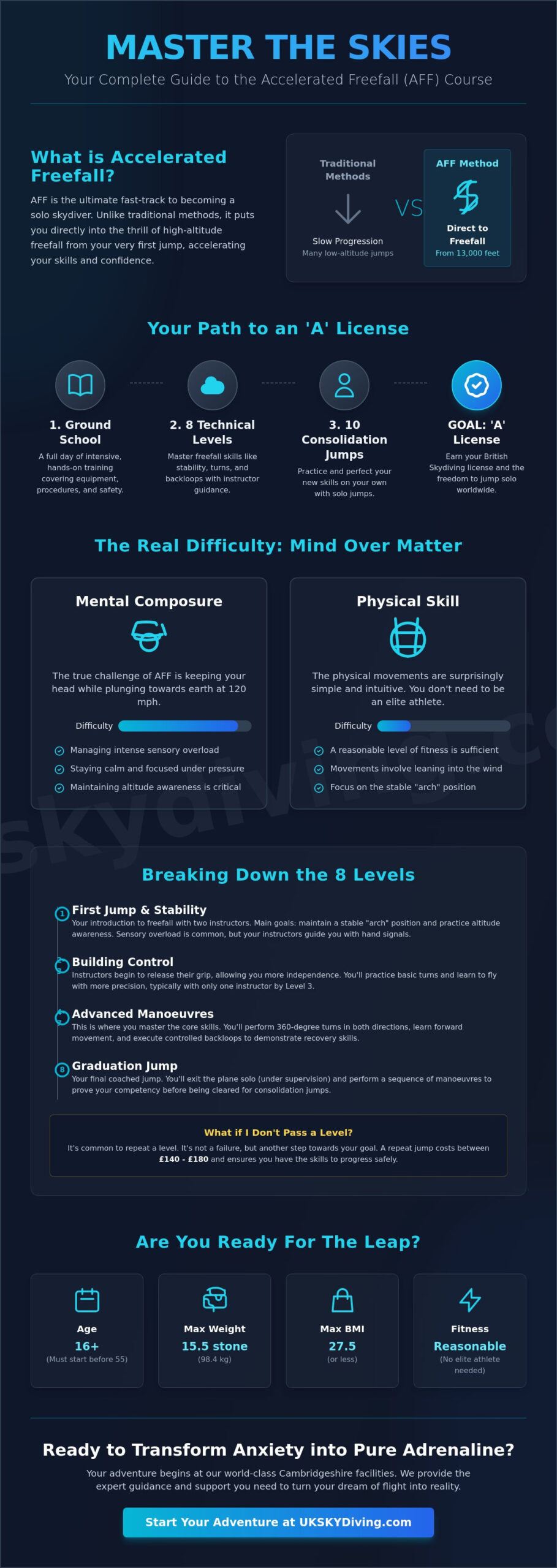
Breaking Down the Levels: Where Do Students Usually Struggle?
Every journey toward the ultimate high is unique. While you might wonder how hard is the AFF course, the answer often depends on which technical milestones you find most intuitive. Our goal isn’t to race you to the finish line. We focus on building your competence and safety so you can enjoy every intoxicating second in the sky. If you don’t pass a level on your first try, don’t panic. It’s a completely normal part of the learning process. Our highly skilled staff use video debriefs to show you exactly how your body moves in the air. Seeing yourself on screen makes it much easier to correct your position and prepare for your next breathtaking jump.
The Early Levels: Stability and Awareness
Levels 1 through 3 are all about finding your balance in the wind. You will have two instructors holding onto you to ensure you stay stable while you get used to the environment. The biggest challenge here isn’t the physical act of falling. It’s remembering to check your altimeter every few seconds. This is called altitude awareness. There is a wonderful breakthrough moment, usually around Level 3, when you first feel the air supporting your weight. You realize you aren’t just plunging toward the earth. You are actually flying.
The Mid-Course Hurdle: Release and Turns
The technical difficulty often shifts at Levels 4 and 5. This is when you transition to having just one instructor by your side. You will start practicing controlled turns. Some students experience unintentional turns where their body starts to rotate without them meaning to. This usually happens because one leg is slightly lower than the other or a shoulder is dipped. Your instructor will use hand signals to help you level out. Mastering a 360-degree turn is a massive confidence booster that brings you one step closer to total independence.
The Final Levels: Manoeuvres and Independence
By Level 7, you are performing backloops and tracking. Tracking involves moving forward across the sky to create distance from other jumpers before you open your canopy. It’s an extreme thrill that shows you have total control over your movement. Level 8 is the solo hop and pop jump from a lower altitude. This jump proves you can exit the plane and deploy your parachute immediately without needing a long freefall to stabilize. Once you’ve nailed these, you are ready to start your skydiving license application. We guarantee that the sense of accomplishment you’ll feel is something you will remember for the rest of your life.
5 Pro Tips to Make Your AFF Course Easier
Mastering the skies is as much about what you do on the ground as what you do at 13,000 feet. While you might be asking how hard is the AFF course, the answer depends largely on your preparation and mindset. You don’t need to be a natural born flyer to succeed. You just need the right tools to manage the adrenaline. By adopting a growth mindset, you can turn every challenge into a breathtaking victory. Every jump is a valuable learning experience that brings you closer to your goal of solo flight. We guarantee that with the right approach, you will feel more like a pilot and less like a passenger from day one.
Visualization and Mental Rehearsal
Top athletes use visualization to achieve peak performance, and skydiving is no different. You should walk through your entire jump sequence on the ground until the movements become muscle memory. This practice is often called “dirt diving” at the dropzone. You will work with your instructors to rehearse your exit, your 360-degree turns, and your altitude checks. Research in sports psychology suggests that mental rehearsal can reduce the perceived difficulty of a new physical task by as much as 50 percent by priming your brain for the movements before you even leave the ground. When you finally plunge into the air, your body will already know what to do.
Breathing and Relaxation Techniques
Physical relaxation is the secret to stable flight. When you are nervous, your muscles tend to stiffen up. This stiffness can cause instability and make it harder to maintain a good arch. We recommend using the “box breathing” method during the plane ride up to stay calm. Simply inhale for four seconds, hold for four, exhale for four, and hold again. This simple technique keeps your heart rate steady and your mind clear. A simple smile in the doorway can also reset your nervous system. It sends a signal to your brain that you are safe and ready for the ultimate high.
Using Video Debriefs to Your Advantage
One of the best ways to improve is to watch yourself in action. After every jump, our highly skilled staff will sit down with you to review the footage. This video debrief is an essential tool for identifying small body position errors that are easy to fix. You might not realize your legs are uneven until you see it on screen. Listen to your instructor’s feedback with an open mind. They are expert coaches who live for the thrill of seeing students succeed. If you are ready to put these tips into practice, you can book your AFF course today and start your journey toward the extraordinary.
Start Your Adventure at UK Skydiving in Cambridgeshire
By now, you should have a much clearer picture of how hard is the AFF course and the incredible rewards that await you. It’s a journey that takes you from the safety of the ground to the intoxicating freedom of the sky. Our world-class facilities in Cambridgeshire are designed to give you the ultimate high in a professional and supportive environment. We don’t just teach you how to fall. We give you the tools to master your own body and become a true pilot of the air. This is your chance to step away from the ordinary and embrace the adrenaline rush of a lifetime.
Expert Instruction in a Supportive Environment
Our team of highly skilled instructors lives for the thrill of the jump and the success of our students. They will be by your side for every breathtaking second of your freefall. We provide personalized feedback after every jump to ensure you have the confidence to pass every level. You will be using modern, student-friendly parachute systems that are maintained to the highest standards. We guarantee that our staff will guide you with a mix of expert knowledge and infectious enthusiasm. They understand the nerves of a first-timer because they were once in your shoes. We focus on creating a safe space where you can ask questions and perfect your technique until it feels like second nature. Our commitment to your success is what makes our AFF programme stand out from the rest.
Join a Community of Adrenaline Junkies
Skydiving is more than just an extreme sport. It’s a vibrant community of people who share a passion for the extraordinary. When you train at our Cambridgeshire dropzone, you are joining a club of like-minded adventurers. Our facilities are designed to make your ground school and wait times comfortable and social. You’ll make friends who will cheer you on as you progress from your first Level 1 jump to your final consolidation flights. The bond formed between skydivers is unique and often leads to lifelong friendships. We handle every detail of your journey so you can focus on the excitement of the jump. There is no better place to start your solo skydiving career than right here with us. Ready for the ultimate high? Book your AFF course with UK Skydiving today and prepare to fly!
Take Your First Step Into the Extraordinary
Mastering the skies is a journey of mental resilience and pure excitement. While you now know how hard is the AFF course, you also understand that it’s a challenge designed for anyone with a passion for adventure. By focusing on your breathing, trusting your visualization, and using video debriefs, you can turn any technical hurdle into a massive win. This isn’t just about falling. It’s about gaining the skills to pilot your own body through the ultimate high.
We are here to guarantee your success and safety every step of the way. Our full British Skydiving certified programme follows strict Red Dot standard safety protocols and uses the latest equipment. You will be training with highly skilled and experienced instructors who live for the thrill of seeing students succeed. Don’t let your doubts hold you back from the adrenaline rush of a lifetime. The view from 13,000 feet is waiting for you. Book your AFF course and start your solo journey today! We can’t wait to see you in the sky and help you achieve something you will remember for the rest of your life.
Frequently Asked Questions
Is the AFF course harder than a tandem skydive?
Yes, the AFF course is technically more demanding than a tandem because you are in control of your own parachute and body position. While a tandem is a breathtaking introduction where you are a passenger, AFF turns you into the pilot. You’ll be responsible for monitoring your altitude and deploying your own canopy. It’s a significant step up in responsibility but offers the ultimate high of solo flight.
What happens if I fail a level during my AFF course?
If you don’t meet the requirements for a specific level, you simply repeat that jump after a detailed video debrief. Failing a level is a normal part of the journey for many students and nothing to be ashamed of. You’ll pay for the repeat jump, which usually costs between £140 and £180, and try again with fresh guidance. Our highly skilled staff guarantee you’ll have the support needed to nail it next time.
Can I learn to skydive if I am afraid of heights?
Absolutely! Many of our most experienced skydivers started with a fear of heights. When you are at 13,000 feet, your brain doesn’t process the distance the same way it does when you are on a ladder or a tall building. There’s no sense of vertigo because there are no ground references close by. You’ll find that the intoxicating adrenaline rush quickly replaces any initial fear of being high up.
How long does it take to complete the full AFF programme?
You can complete the eight technical levels in as little as a few days if the weather is clear. However, most students spread their training over several weekends. After you finish the eight levels, you must complete ten consolidation jumps to earn your license. We recommend staying current by jumping as often as possible to keep your skills sharp and your confidence high. Prepare to fly as often as you can!
Do I need to be physically strong to pass the AFF course?
You don’t need to be an elite athlete or have extreme physical strength to pass. The most important physical skill is the ability to relax and maintain a stable arch position. If you can move comfortably and have a reasonable level of fitness, you’ll do great. We focus more on your mental composure and your ability to follow instructions while plunging through the air on this extraordinary adventure.
Is there a weight limit for the AFF course in the UK?
Yes, there are specific weight and BMI limits to ensure your safety and the proper function of the equipment. For most UK dropzones, the maximum weight is 15.5 stone or 100kg. You also need to have a Body Mass Index (BMI) of 27.5 or less. These requirements help our highly skilled instructors manage the intoxicating experience of freefall safely for everyone involved in the programme.
What is the hardest level of the AFF course for most people?
Level 4 is often considered the most challenging because it’s the first time you jump with only one instructor. This transition can feel like a big jump in responsibility as you start to perform controlled turns. While some students wonder how hard is the AFF course at this stage, most find that the breakthrough of mastering a 360-degree turn is an incredible boost to their confidence and skill.
Can I do the ground school one weekend and the jumps later?
You can certainly complete your ground school one weekend and return for your jumps later. We do recommend jumping as soon as possible after your training while the technical details are fresh in your mind. If a significant amount of time passes due to weather or personal schedules, our instructors will provide a thorough refresher. This ensures you are ready to enjoy the adrenaline rush of a lifetime safely.
Categorised in: Blog