Latest News
-
 Skydiving as a Confidence Booster: How One Jump Can Change Your Life September 20, 2026
 -
 How to Convince Your Parents to Let You Skydive September 19, 2026
 -
 How to Land a Parachute Safely: A Beginner’s Guide September 18, 2026
 -
 Static Line vs AFF: Choosing Your Path to Solo Skydiving in 2026 September 17, 2026
 -
 Skydiving A License: Your Passport to the Skies September 16, 2026
Static Line vs AFF: Choosing Your Path to Solo Skydiving in 2026
September 17, 2026 12:00 amStepping out of a moving plane into the vast open sky is a life-altering milestone that changes your perspective forever. Before you feel that rush of total independence, you face a critical decision. The debate of static line vs aff isn’t just about how you fall. It’s about how you learn. Choosing the right path determines how quickly you’ll be soaring solo over the British countryside.
We know the pressure is real. You don’t want to waste your hard-earned pounds on a course that doesn’t click with your learning style. It’s natural to feel a bit dazed by the technical jargon and the time commitment required. This guide clears the air. You’ll discover the key differences between Static Line and Accelerated Freefall to decide which solo skydiving course fits your budget and your thirst for adrenaline.
We’ll break down the progression stages for each method so you know exactly what you’re signing up for. From the traditional, steady climb of the Category System to the high-octane immersion of an AFF program, you’ll gain the confidence to book your spot. Get ready to learn exactly what to expect on day one at a UK dropzone as you start your journey toward that first incredible solo landing.
Key Takeaways
- Master the transition from being a passenger to becoming a licensed pilot of your own parachute.
- Weigh up the pros and cons of static line vs aff to find the perfect match for your budget and learning style.
- See why Accelerated Freefall (AFF) is the premium choice for those who want to experience the thrill of freefall on jump one.
- Get a clear breakdown of the time commitment and technical training required to reach solo status in the UK.
- Build your confidence by knowing exactly what happens on day one of your training at our professional Cambridgeshire base.
What is Solo Skydiving Training?
Imagine the moment the aircraft door opens and the rush of cold air hits your face. You aren’t just watching someone else do the work. Solo skydiving training is the exhilarating process of earning a recognized license that transforms you into a skydiver. You move from being a passenger to becoming the pilot of your own canopy. This journey begins with a comprehensive day of ground school. You’ll spend hours practicing your arch on the ground and learning how to steer your parachute. Your first solo jump is the point where theory becomes a breathtaking reality. British Skydiving sets the gold standards for all UK training courses to ensure your safety and success. Solo skydiving is the ultimate personal milestone.
Deciding between static line vs aff is the first major choice you’ll make on this path. Both methods are designed to take a complete beginner and turn them into a competent, safe solo flyer. During ground school, instructors use specialized rigs to show you exactly how the gear works. You’ll walk through every possible scenario until the movements become second nature. This preparation is what makes that first step out of the plane feel like a victory rather than a gamble. While the techniques differ, the end goal remains the same. You’re building a foundation of skills that will stay with you for a lifetime. It’s about more than just falling. It’s about mastering the environment of the sky.
The Goal of Becoming a Licensed Skydiver
The ultimate aim for any student is earning a British Skydiving A-License. This qualification is a massive achievement. It allows you to jump at dropzones across the UK and around the world. You gain the essential skills to handle your own equipment and navigate the skies with total confidence. The training covers everything from stable freefall positions to advanced canopy handling and landing patterns. It is a transformative experience that builds incredible self-reliance. You’ll find that the focus and discipline you learn in the air translate directly into your daily life. You’re not just getting a license. You’re unlocking a new version of yourself.
Why Choose Solo Over Tandem?
A Tandem Skydiving Experience is a brilliant introduction to the sport. It’s perfect for a one-off thrill or a charity event. However, solo training is for those who want to be in the driver’s seat. Solo training gives you total control over the experience from the very first jump. Instead of being strapped to an instructor, you are responsible for your own parachute deployment and landing. This level of autonomy is what makes the static line vs aff decision so exciting. You aren’t just along for the ride. You are the one making the decisions. Choosing solo training means you’re ready to embrace the challenge and the unmatched reward of flying on your own terms.
Static Line Skydiving: The Traditional Path
Static line skydiving is the bedrock of the sport. It’s the same method used by military paratroopers for decades. When you exit the aircraft, a strong cord remains attached to the plane. This line pulls your parachute container open automatically as you fall away. This means you don’t need to worry about pulling a ripcord on your very first jump. It’s a structured and disciplined way to enter the world of flight. When comparing static line vs aff, many students appreciate this mechanical certainty. The immediate canopy opening serves as a reassuring safety net for your first few leaps into the blue.
You’ll typically jump from a lower altitude than other methods. Most static line jumps happen at around 3,500 feet. This is high enough to enjoy the view but low enough for the aircraft to make quick circuits for multiple students. It creates a focused environment where you can master canopy control before moving on to higher altitudes. This traditional route is a testament to the history of the sport and remains a valid way to earn your wings in the UK.
How Static Line Progression Works
The journey follows the British Skydiving Category System. You begin with several jumps where the static line does all the deployment work. Your main job is to maintain a stable body position as you leave the door. Once you prove your stability, you move on to dummy pulls. This involves going through the motions of pulling a ripcord without actually doing it. After you demonstrate consistent technique, you finally progress to your first actual freefall. It takes many more jumps to reach this stage compared to other training routes. You’ll move from three seconds of freefall to five, and eventually to ten, as you climb the categories.
The Pros and Cons of the Traditional Method
The primary advantage of the traditional path is the lower cost per jump. It’s a fantastic option if you want to spread the financial commitment over several months. You can pay as you go, making it accessible for a wider range of budgets. It is also excellent for those who prefer to take the learning process slow and steady. However, the downside is the long time spent without experiencing the thrill of freefall. You might complete fifteen or twenty jumps before you get to feel the wind rushing past you at terminal velocity. If you’re eager to experience that sensation on day one, you might prefer the intensity of an Accelerated Freefall (AFF) Course.
Accelerated Freefall (AFF): The Fast Track to the Skies
If you crave the ultimate rush of flying through the air at 120mph, Accelerated Freefall (AFF) is your ticket to the clouds. Unlike the traditional method, AFF puts you into a full freefall on your very first jump. It’s the most efficient way to learn to skydive and reach solo status. You won’t be tethered to the plane. Instead, two highly qualified instructors hold onto your harness during the descent to keep you stable. This professional oversight ensures you stay safe while experiencing the incredible sensation of true flight. You are in command of your gear from the moment you leave the door. You’ll deploy your own parachute at around 5,000 feet and navigate your way back to the landing area.
This method is designed for those who want to dive straight into the heart of the sport. When weighing up static line vs aff, the speed of progression is the biggest factor. You aren’t just a student. You are an active participant in every second of the jump. To get started on this journey, check out our Learn to Skydive: Your Ultimate Guide to Becoming a Licensed Skydiver. It covers everything you need to know about the path to your A-License.
The AFF Level System
The course is structured into eight progressive levels. Each stage is a thrilling challenge that introduces new aerial skills. On Level 1, you focus on basic stability and altitude awareness. As you move through the levels, you’ll learn to perform controlled turns, backloops, and tracking. You receive intensive one-on-one coaching throughout the process. Your instructors are right there beside you in the air, providing hand signals to correct your position. This immediate feedback is why students progress so rapidly. Once you successfully complete Level 8, you’re cleared for solo jumps and well on your way to becoming a fully licensed skydiver.
Why the Adrenaline is Higher with AFF
The sheer magnitude of an AFF jump is hard to put into words. You’ll head up to 13,000 feet on your very first training flight. This gives you nearly a full minute of freefall time to practice your moves and soak in the scenery. The sensation of falling at terminal velocity is life-altering and purely addictive. You can read more about these intense feelings in our guide on What Does Skydiving Feel Like? A Journey Through Every Sensation. This high-energy environment is what makes AFF the premium choice for adrenaline seekers. It’s a peak life event that will stay with you forever.
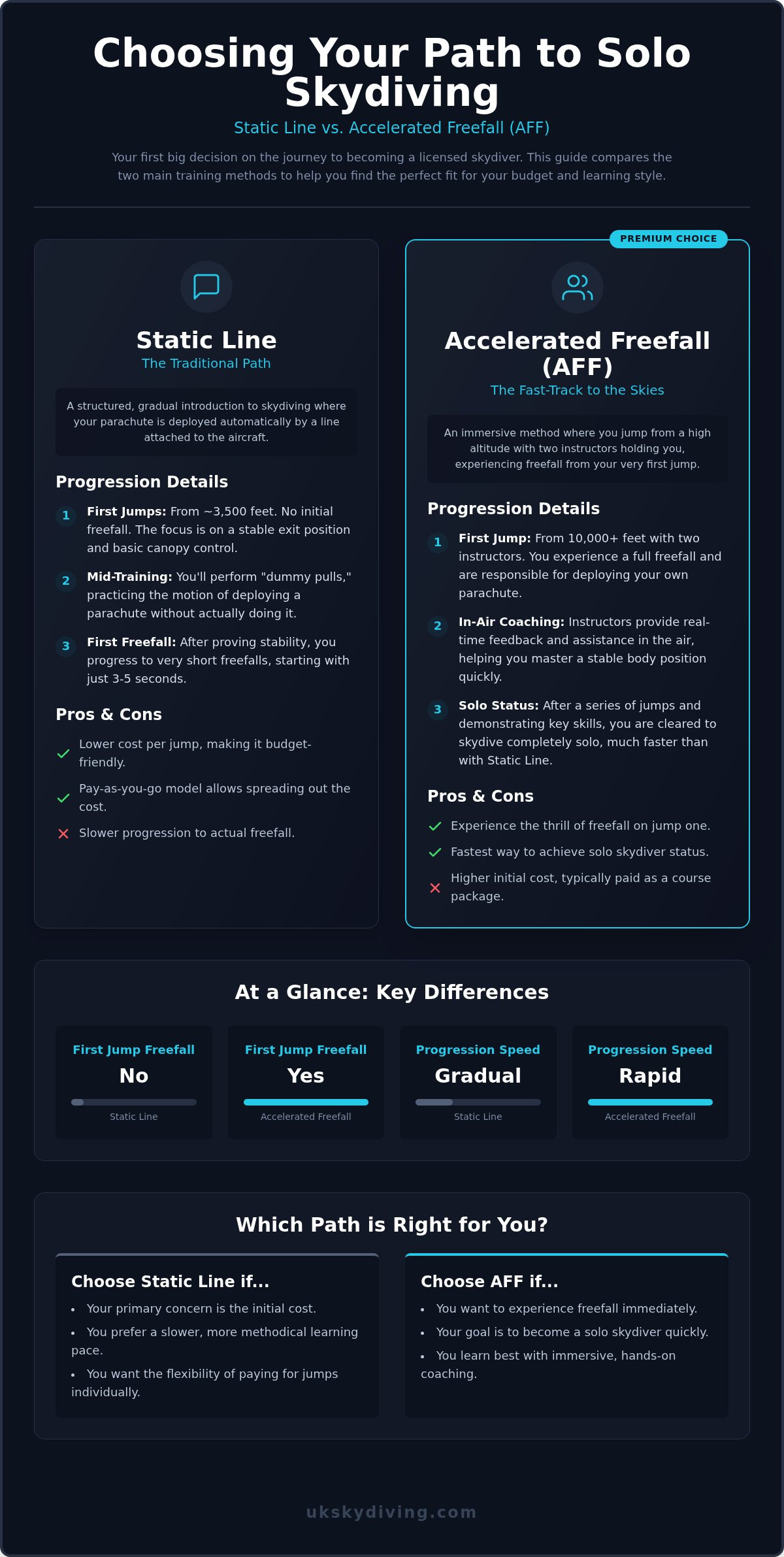
Static Line vs AFF: Side-by-Side Comparison
Choosing your path to solo skydiving is a major decision that shapes your entire journey in the sport. When you look at the choice between static line vs aff, you are balancing your personal budget against your desire for speed. Both routes lead to the same incredible goal of becoming a licensed skydiver. However, the experience of getting there is vastly different. You need to decide if you want a slow-burn traditional approach or a high-octane leap into the deep end of the sky.
Cost vs. Value
Static line training has a much lower entry price for your very first jump. You can pay for each jump as you go, which helps spread the financial load over several months. On the other hand, an AFF course often works out cheaper if your primary goal is to finish as quickly as possible. While the upfront cost is higher, you reach your license in far fewer jumps. You must also consider the hidden costs of travel and time. Taking the traditional route usually means making multiple weekend trips to the dropzone. Petrol and accommodation costs can add up fast over a long period. AFF is an investment in speed that gets you into the air as a solo flyer much faster.
The Learning Curve and Safety
The learning styles for these two methods are unique and cater to different types of students. AFF provides more direct instructor feedback while you are actually in the air. Having a professional by your side at 120mph is incredibly reassuring. They can physically correct your position with hand signals to ensure you pass each level. Conversely, static line offers more repetition at the canopy stage. Since you spend more time under your parachute on those early jumps, you build a very strong foundation for steering and landing. Both methods are exceptionally safe and strictly regulated by British Skydiving. You can find out more about the risks and precautions in our guide: Is Skydiving Safe? The Honest, Fact-Based Answer.
One thing to keep in mind is the pressure of the levels. In AFF, if you don’t master a specific skill like a turn or a backloop, you’ll need to repeat that level. This adds to the overall cost but ensures you are truly ready for the next challenge. Static line progression is also performance-based, but because you start with shorter, simpler tasks, the jumps are often easier to repeat. Ultimately, the best method is the one that matches your personality and how you handle new challenges. If you want the most efficient and exhilarating path to the skies, book your Accelerated Freefall (AFF) Course with us today and start your journey at our Cambridgeshire base.
Ready to Take the Leap with UK Skydiving?
The decision is finally here. You’ve weighed up the pros and cons of static line vs aff and you’re ready to taste the pure freedom of the skies. At UK Skydiving, we offer world-class Accelerated Freefall (AFF) training at our specialized base in Cambridgeshire. Our team of professional instructors is passionate about two things: your absolute safety and your exhilarating success. We don’t just teach you how to jump. We welcome you into a high-energy world where every milestone is celebrated with cheers. The incredible rush of your first solo landing is waiting for you. Booking your ground school today is the first step toward a life-changing new hobby that will redefine your limits.
What to Expect at Our Cambridgeshire Base
Our base in March, Cambridgeshire, is designed for the modern student skydiver. You’ll enjoy top-tier facilities and a friendly community atmosphere from the moment you arrive on site. We use the latest modern equipment to ensure you have the most reliable and comfortable learning experience possible. Safety is our absolute cornerstone but we never lose sight of the adrenaline-fueled fun. Our location is perfectly situated for students traveling from London or the North of the UK. You’ll find a supportive environment where instructors and veteran jumpers are always happy to share a tip. It’s more than just a training center. It’s a place where you’ll feel right at home among fellow adventurers.
Your First Step to the Clouds
If you want the fastest and most immersive route to solo flight, our AFF course is the definitive answer. You’ll skip the long wait times of the traditional method and dive straight into the heart of the action. Beyond the intense adrenaline, you’ll join a unique community of thrill-seekers and make life-long friends. If you know someone else who is ready to join you in the clouds, check out our skydiving gift voucher options. It’s the ultimate way to give an unforgettable adventure to a friend or family member who craves excitement. Join us and discover why so many people find their true passion at terminal velocity.
When you eventually look back at your static line vs aff decision, you’ll realize that choosing the path of most excitement was the best move you ever made. The sky is calling you today. Your gear is ready and our instructors are standing by. All that’s left is for you to take that final leap and book your place on our next ground school. We can’t wait to see you at the dropzone and watch you soar through the clouds for the first time.
Your Journey to the Clouds Starts Today
You now have the full picture of the static line vs aff debate. Whether you choose the steady progression of the traditional route or the high-speed thrill of an Accelerated Freefall course, you are on the brink of something truly life-changing. Both paths offer a professional and highly regulated way to earn your wings over the UK. You’ll gain the skills to navigate the skies with total independence and join an elite group of solo flyers who live for the rush.
Our British Skydiving certified instructors are ready to guide you through every stage of your training. You will learn in a high-energy training environment designed to build your skills and your confidence simultaneously. We focus on making the extraordinary feel accessible and safe for every student who walks through our doors. The rush of that first solo landing is a permanent memory that will stay with you forever.
Don’t let another season pass you by on the ground. Take the first step toward your A-License and experience the incredible views at our stunning Cambridgeshire dropzone. Book your Accelerated Freefall course with UK Skydiving today! The sky isn’t the limit. It is your new playground. We’ll see you at the aircraft door!
Frequently Asked Questions
Is Static Line skydiving safer than AFF?
Both methods are incredibly safe and strictly governed by British Skydiving standards. Static line offers the mechanical certainty of an automatic deployment from the plane. AFF provides the security of two professional instructors who hold onto you throughout the freefall. Neither method is safer than the other. They simply use different techniques to ensure your parachute opens correctly. You’ll be using modern, reliable gear and receiving expert training regardless of the path you choose.
How much does a full AFF course cost in the UK?
Pricing for an Accelerated Freefall program varies depending on the dropzone and any current seasonal offers. It is generally considered a premium training route due to the intensive one-on-one instructor time and the high altitude jumps. While we don’t list specific costs here, we recommend checking our current packages to see what fits your budget. Investing in an AFF course is the most efficient way to reach your solo license and start your journey as a skydiver.
Can I switch from Static Line to AFF halfway through?
You can certainly transition between methods, but it’s usually more efficient to stick to one path from the start. Switching from static line vs aff typically requires a conversion briefing to get you up to speed with freefall techniques. Your previous canopy control experience will be a huge advantage. However, you’ll still need to complete the core AFF levels to demonstrate your stability at high speeds. Talk to our instructors at the Cambridgeshire base to plan your best route.
How many jumps do I need to get a skydiving license?
To earn your British Skydiving A-License through the AFF route, you typically need to complete the eight levels plus ten consolidation jumps. This totals 18 jumps where you demonstrate your skills and safety awareness. The static line method usually requires more jumps because the progression happens in smaller, incremental steps. Both paths require you to pass specific canopy handling and equipment tests. Once you hit these milestones, the world of solo skydiving is yours to explore.
What happens if I fail a level in my AFF course?
Don’t worry if you don’t nail a specific skill on your first try. If you fail to meet the objectives of an AFF level, you’ll simply repeat that jump with your instructors. This is a normal part of the learning process for many students. You’ll receive a detailed debrief to understand what went wrong and how to fix it. Our goal is to ensure you are a safe and confident skydiver before you move on to more advanced maneuvers.
Do I need to do a tandem jump before starting a solo course?
You aren’t required to complete a tandem jump before enrolling in a solo skydiving course. Many students dive straight into ground school and their first solo exit. However, a tandem experience is a fantastic way to get used to the sensations of freefall and the environment of the aircraft. It can help calm those first-day nerves and give you a head start on understanding canopy flight. It’s a personal choice based on your comfort level and adrenaline goals.
How long does ground school take for solo skydiving?
Ground school is a comprehensive, full-day training session that prepares you for your first solo leap. You’ll spend roughly six to eight hours learning about equipment, aircraft exits, and emergency procedures. Our instructors make the day engaging and high-energy so the information really sticks. You’ll practice your arch and your parachute steering until the movements feel like second nature. It’s a vital foundation that ensures you’re ready for the exhilarating rush of the sky.
Categorised in: Blog