
Latest News
-
 Skydiving as a Confidence Booster: How One Jump Can Change Your Life September 20, 2026
 -
 How to Convince Your Parents to Let You Skydive September 19, 2026
 -
 How to Land a Parachute Safely: A Beginner’s Guide September 18, 2026
 -
 Static Line vs AFF: Choosing Your Path to Solo Skydiving in 2026 September 17, 2026
 -
 Skydiving A License: Your Passport to the Skies September 16, 2026
Skydiving Safety Statistics: A Data-Driven Look at the Real Risks
January 19, 2026 12:00 amThat heart-pounding moment in the open doorway of the plane. It’s the ultimate thrill, but one question echoes louder than the wind: Is it really safe? Your mind might race with what-ifs and images from the movies, but what do the facts actually say? It’s time to push past the myths and look at the hard data. We believe that true confidence comes from knowledge, which is why we’ve pulled together the official skydiving safety statistics to give you the complete picture.
Get ready to replace fear with facts! In this article, we’re diving deep into the official figures from British Skydiving to show you the real risks involved. You’ll see the difference between a tandem jump with a highly experienced instructor and a solo jump, understand the incredible reliability of modern equipment, and discover why this extraordinary, life-changing adventure is far safer than you ever imagined. By the end, you’ll have the data you need to make your decision with total confidence and even reassure your most worried family members. Let’s get you ready to fly!
The Official UK Skydiving Safety Record: What the Numbers Say
When you’re thinking about the ultimate thrill of jumping from a plane, your first question is probably about safety. Forget the wild stories and American-centric figures you might see online. Let’s get straight to the facts, right here in the UK. The real skydiving safety statistics paint a picture that’s not just exciting, but incredibly reassuring.
British Skydiving: The Authority on UK Safety
In the UK, every single parachute jump is overseen by one expert organisation: British Skydiving. They are the official governing body, and they set the uncompromising safety standards that every single dropzone in the country, including ours, must follow. From rigorous instructor training to meticulous equipment checks and mandatory incident reporting, their protocols are the bedrock of our sport’s safety. When you jump with us, you’re jumping under one of the world’s most respected safety systems.
Annual UK Fatality and Injury Rates
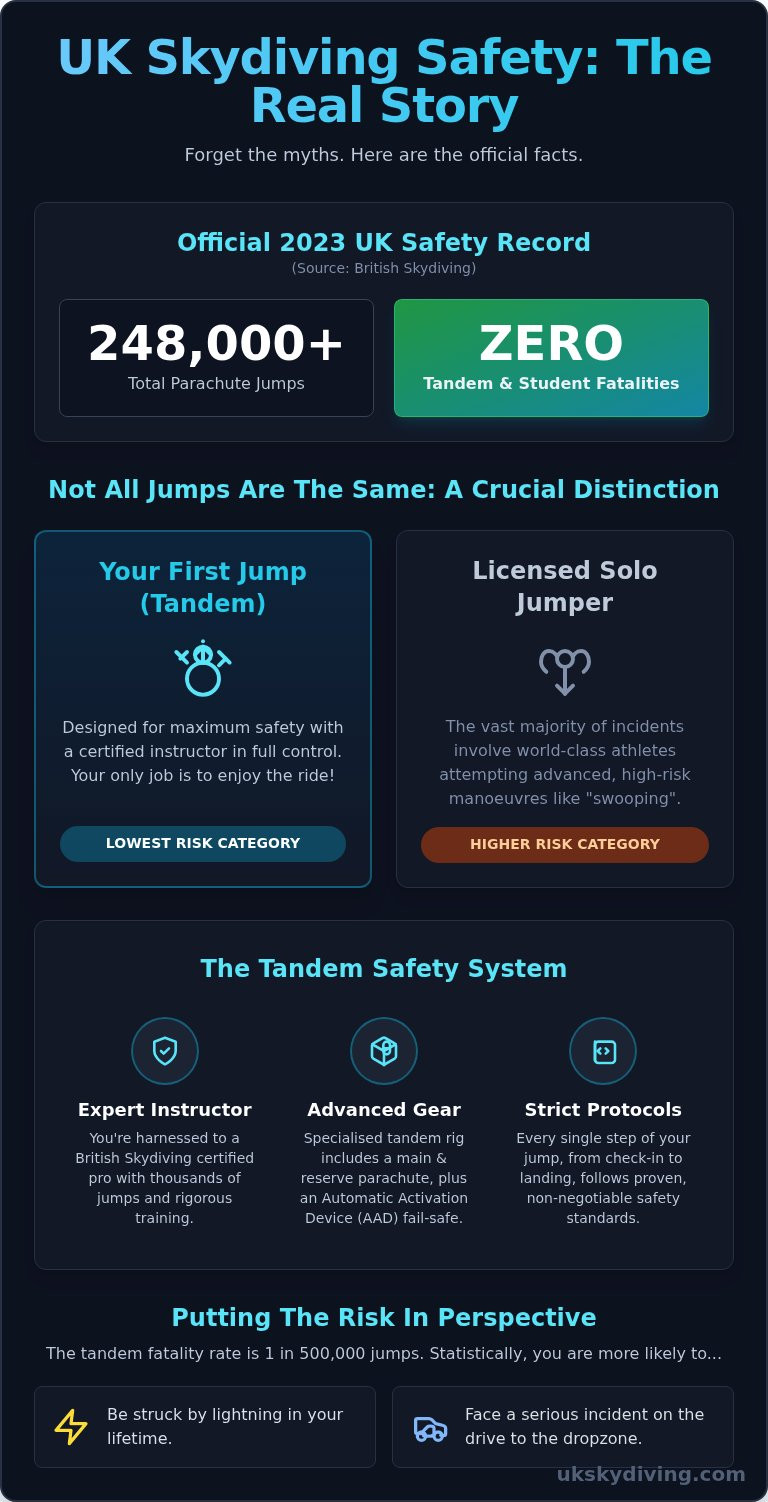
Ready for the numbers? The official 2023 British Skydiving annual report is in, and it confirms the extraordinary safety of the sport. In 2023, there were:
- Over 248,000 parachute descents made in the UK.
- ZERO student or tandem fatalities.
That’s right. For the thousands of people who took the leap of a lifetime, the safety record was perfect. While minor injuries can happen, they are extremely rare. The most common are simple sprains or twists on landing-similar to what you might get in any active sport. This incredibly low rate is part of a consistent global improvement in historical skydiving safety trends, driven by decades of innovation in training and technology.
How UK Safety Standards Compare Globally
So, how does the UK stack up? British Skydiving’s record is world-class, standing proudly alongside other leading bodies like the United States Parachute Association (USPA). While procedures might differ slightly, the core mission is identical: a relentless, shared commitment to making this breathtaking experience as safe as humanly possible. You can feel confident that the UK’s standards for training, equipment, and operations are among the highest on the planet. You’re in the best hands to experience the ultimate adventure.
Tandem vs. Experienced Skydiving: A Crucial Safety Distinction
When you hear about skydiving incidents, what’s the first image that comes to mind? For many, it’s a nervous first-timer. But the reality is completely different. A crucial part of understanding skydiving safety statistics is knowing that not all jumps are created equal. The vast majority of incidents involve highly experienced, licensed jumpers pushing the absolute limits of the sport-not beginners experiencing the ultimate thrill for the first time.
Your first jump is in a category all its own, with a safety record that is truly extraordinary.
Why Tandem Skydiving Has an Exceptional Safety Record
Your tandem skydive is engineered from the ground up for one purpose: to give you the most breathtaking, intoxicating, and safest possible introduction to freefall. This isn’t by accident; it’s by design. The entire process is built around a robust system of checks and fail-safes.
- You’re Paired with an Expert: You are securely harnessed to a highly experienced, British Skydiving certified instructor. They have thousands of jumps, rigorous training, and are in complete control of the entire experience. Your only job is to enjoy the ride!
- Specialised, Redundant Equipment: Tandem gear is specifically designed for two people. It includes a larger, more stable main parachute and, most importantly, an Automatic Activation Device (AAD)-a small computer that will automatically deploy the reserve parachute if necessary.
- Standardised Procedures: From the moment you arrive, every step follows strict, proven protocols that adhere to the Official UK Skydiving Safety Standards. This removes variables and ensures a predictable, controlled, and safe adventure.
Breaking Down the Statistics for Tandem Jumps
Let’s get to the number that matters most to you. Based on decades of data from millions of jumps, the tandem skydiving fatality rate is approximately 1 in every 500,000 jumps. To put that into perspective, you are statistically more likely to be struck by lightning in your lifetime. This incredible safety record makes tandem skydiving one of the most secure ways to experience an extreme adrenaline rush. This is the statistic that should give you the ultimate confidence to take the leap.
Ready for the world’s safest thrill? Book your tandem jump!
The Real Cause of Skydiving Accidents
So, where do the other skydiving safety statistics come from? The leading cause of skydiving fatalities is human error, almost exclusively among licensed solo jumpers. These are often world-class athletes attempting highly advanced and aggressive manoeuvres, such as high-speed landings known as “swooping.” Comparing their activities to your tandem jump is like comparing a Formula 1 race to your first driving lesson. Both involve a car, but the level of risk is worlds apart. It’s vital to know that catastrophic equipment failure is exceptionally rare, thanks to modern technology and meticulous maintenance standards.
Putting the Risk in Perspective: How Safe Is Skydiving, Really?
Raw numbers and data points are one thing, but what do they actually mean for you, standing at the edge of the aircraft door? The truth is, the feeling of fear is completely natural, but the actual risk is far lower than your mind might lead you to believe. Context is everything. When you look at the skydiving safety statistics in comparison to everyday life, you’ll see that this ultimate thrill is managed with an extraordinary level of precision and care.
Let’s ground that adrenaline in reality and see how the risk of skydiving stacks up against activities you probably don’t think twice about.
Skydiving vs. Your Daily Commute
Here’s a staggering thought: for most people, the most dangerous part of their skydiving day is the drive to the dropzone. UK Department for Transport figures consistently show that driving on our roads carries a measurable, daily risk. In contrast, tandem skydiving has an incredible safety record, thanks to rigorous training, meticulous equipment checks, and experienced instructors. In 2022, British Skydiving recorded zero student fatalities. You are statistically safer jumping out of our plane than you are driving on the M1! To ensure your peace of mind extends to your vehicle for that journey, specialists like Safe & Sound Mobile can enhance its security.
This principle of trusting experts to manage risk applies to other major life decisions, too. While the risks of buying a property are financial rather than physical, they are just as significant. That’s why an expert evaluation, such as a RICS level 3 building survey South London, is crucial for making an informed choice and securing your investment.
Odds of Other Unlikely Events
The human brain isn’t great at processing risk. We worry about dramatic events while ignoring common dangers. To make the low risk of skydiving more tangible, consider the odds of other rare occurrences in the UK:
- Being struck by lightning: Roughly 1 in 20,000,000
- A fatal dog attack: Roughly 1 in 17,000,000
- A fatal bee sting: Roughly 1 in 7,000,000
When you see the numbers side-by-side, the skydiving safety statistics paint a clear picture of a well-managed and surprisingly low-risk adventure.
How It Stacks Up Against Other Adventure Sports
Skydiving is often seen as the pinnacle of extreme sports, but its safety record is the envy of many other adventure activities. Sports like scuba diving, skiing, and even recreational rock climbing can carry higher rates of injury. This isn’t a coincidence. The sport of skydiving has evolved over decades with a relentless focus on safety innovation, from reserve parachutes and Automatic Activation Devices (AADs) to the world-class training programmes that every single one of our instructors must pass. It’s an extreme thrill built on an unshakable foundation of safety.
The Technology and Training That Make The Statistics Possible
The incredible skydiving safety statistics you’ve read about aren’t a happy accident. They are the direct result of decades of innovation, relentless training, and an unwavering commitment to making this extraordinary experience as safe as it is thrilling. It’s safety by design, with layers of protection built into every single jump, ensuring you can focus on the pure, breathtaking exhilaration of freefall.
Failsafes for Failsafes: Main, Reserve & AAD
Every piece of skydiving equipment is an engineering marvel with built-in redundancy. You jump with a container holding two separate parachutes: a main canopy and a reserve. In the extremely rare event the main parachute has an issue, your instructor simply deploys the reserve. As a final layer of protection, every rig is fitted with an Automatic Activation Device (AAD). This tiny computer constantly measures your altitude and speed, and if you are too low while still falling too fast, it will automatically deploy the reserve parachute for you. It’s the ultimate backup for the ultimate adventure.
The Making of a Tandem Instructor
The person you are securely attached to is not just an enthusiast; they are an elite professional. To become a British Skydiving Tandem Instructor, a skydiver must first complete hundreds-often thousands-of solo jumps. They then undergo a gruelling series of exams, practical assessments, and certification courses that test their skills under extreme pressure. Your safety and your experience are in the hands of a highly dedicated expert whose passion is matched only by their professionalism.
Meticulous Equipment Maintenance and Checks
Our commitment to safety extends far beyond the sky. On the ground, our team of certified parachute riggers meticulously inspects and maintains all our equipment to the highest standards. Every reserve parachute, by law, must be inspected and repacked by a certified rigger every six months, whether it has been used or not. Before you even board the plane, your instructor will perform multiple, thorough gear checks. This obsession with detail is what makes the outstanding skydiving safety statistics possible. Our highly skilled staff guarantee your adventure. Meet the team!
The Data is Clear: It’s Time to Feel the Rush!
The numbers don’t lie. The perception of extreme risk gives way to a reality of extreme professionalism. As we’ve explored, the official skydiving safety statistics reveal a sport governed by meticulous standards, constant technological innovation, and rigorous training protocols that make tandem jumps exceptionally secure. The data paints a clear picture: this is a breathtaking adventure, not a reckless gamble.
At UK Parachuting, that safety is our guarantee. We are fully regulated by British Skydiving, the UK’s highest authority. Every instructor brings thousands of jumps and elite certifications to your experience. Every single rig is equipped with a main parachute, a reserve, and an Automatic Activation Device (AAD) for an unparalleled layer of security. We manage the risk so you can embrace the extraordinary.
You’ve seen the evidence. You understand the commitment to safety. Now, there’s only one thing left to do. Face your fears with facts. Book the adventure of a lifetime today! The sky is waiting.
Frequently Asked Questions About Skydiving Safety
What is the skydiving fatality rate in the UK?
The UK boasts one of the most robust safety records in the world for skydiving. According to British Skydiving, the sport’s governing body, the fatality rate is incredibly low, averaging around one death per 100,000 jumps. While skydiving is the ultimate adventure, it is governed by stringent safety protocols and expert training. These figures demonstrate that you are in exceptionally safe hands when you decide to take the leap with a professional UK dropzone.
Is tandem skydiving safer than jumping solo?
Absolutely! For your first breathtaking experience, a tandem jump is the safest way to fly. You are securely attached to a highly experienced and certified instructor who controls every part of the skydive, from exit to a soft landing. This allows you to fully immerse yourself in the intoxicating thrill and stunning views, knowing a seasoned professional is managing all the technical procedures. It’s the perfect combination of extreme excitement and guaranteed safety.
How often does a parachute fail to open?
A complete parachute failure is extraordinarily rare thanks to modern technology and rigorous checks. Every skydiving rig is equipped with both a main and a reserve parachute. While minor malfunctions can occasionally occur with the main canopy, they are typically resolved by deploying the meticulously packed reserve. This built-in redundancy means that even in a one-in-a-thousand situation, there is an expert-approved backup ready to ensure your safe descent.
What are the most common skydiving injuries?
While plunging towards earth at 120 mph sounds extreme, the most common injuries are surprisingly minor. They typically involve sprains or bruises that can occur during landing, usually from not following the correct body position. Our highly skilled instructors provide a thorough briefing on proper landing technique to minimise this risk. Following their expert guidance is the key to ensuring your adventure ends with nothing but amazing memories.
Is skydiving safer than it was 20 years ago?
Without a doubt. The sport has seen huge safety advancements over the last two decades. Innovations in equipment, like the Automatic Activation Device (AAD), and more reliable parachute designs have made a massive impact. Furthermore, training programmes are more refined and regulations are stricter. The comprehensive skydiving safety statistics clearly show that this ultimate thrill is safer today than it has ever been in its exhilarating history.
Are there weight limits for skydiving and do they improve safety?
Yes, and they are a non-negotiable part of our safety guarantee. Every piece of skydiving equipment is certified to perform within a specific total weight range. Exceeding this limit can affect the parachute’s deployment speed, flight characteristics, and landing force. By strictly adhering to weight limits, we ensure the gear functions exactly as designed, guaranteeing a smooth ride and a safe, gentle landing for you and your instructor.
How does the Automatic Activation Device (AAD) work?
The AAD is an incredible piece of technology that provides ultimate peace of mind. It is a small, precise computer that constantly monitors your altitude and rate of descent during your skydive. If it detects that you are still falling at a high speed below a safe deployment altitude, it will automatically activate a cutter to deploy the reserve parachute for you. It’s a crucial final backup that makes this extraordinary sport even safer.
Categorised in: Uncategorized