
Latest News
-
 Skydiving as a Confidence Booster: How One Jump Can Change Your Life September 20, 2026
 -
 How to Convince Your Parents to Let You Skydive September 19, 2026
 -
 How to Land a Parachute Safely: A Beginner’s Guide September 18, 2026
 -
 Static Line vs AFF: Choosing Your Path to Solo Skydiving in 2026 September 17, 2026
 -
 Skydiving A License: Your Passport to the Skies September 16, 2026
Master the Parachute Landing Fall Technique: Your Essential Safety Guide
September 15, 2026 10:00 amImagine the adrenaline surging through your veins as the ground rushes up to meet you. It’s the ultimate moment of truth! The parachute landing fall technique is your secret weapon for turning a high-speed arrival into a smooth, professional roll. You might feel a flicker of anxiety about your knees or ankles during those final few seconds of descent. That’s completely normal. Every solo jumper has felt that same ground rush tension before their first big landing.
We’re here to turn that fear into absolute confidence. In this essential guide, you’ll learn the professional parachute landing fall technique to ensure every skydive ends with a safe and triumphant finish. We’ll master the five points of contact together. You’ll gain a clear understanding of how to protect your body in any landing condition. Whether you’re dreaming of your first solo jump or preparing for an AFF course in Cambridgeshire, you’re about to become a master of the skies and the earth. Let’s get you ready for that perfect touchdown!
Key Takeaways
- Discover how the parachute landing fall technique protects your joints by transforming impact energy into a smooth and controlled roll.
- Master the five points of contact to ensure your body remains in a tight and safe position during every touchdown.
- Learn why first-time tandem jumpers focus on lifting their legs while solo students prepare for professional rolling landings.
- Understand why keeping your eyes on the horizon is the secret to timing your descent and executing a perfect landing.
- Find out how hands-on training in dedicated pits at our Cambridgeshire dropzone builds the muscle memory you need for total confidence.
What is the Parachute Landing Fall (PLF) Technique?
You’ve just spent several minutes soaring through the clouds. You’ve felt the incredible rush of the British air against your face. Now, the green fields of our Cambridgeshire dropzone are getting closer. This is where the magic of the parachute landing fall technique comes into play! While it might look like a simple tumble, this professional rolling motion is actually a high-performance safety move designed to protect your most vulnerable joints.
The Parachute Landing Fall (PLF) is a foundational skill for every civilian skydiver. While its roots are in the military, it remains the absolute gold standard for anyone learning to jump solo. Professional skydivers rely on this technique whenever a landing is faster or more turbulent than they expected. It turns a potential hard impact into a controlled, fluid motion that keeps you safe and ready for your next adventure.
Why Energy Dissipation Matters
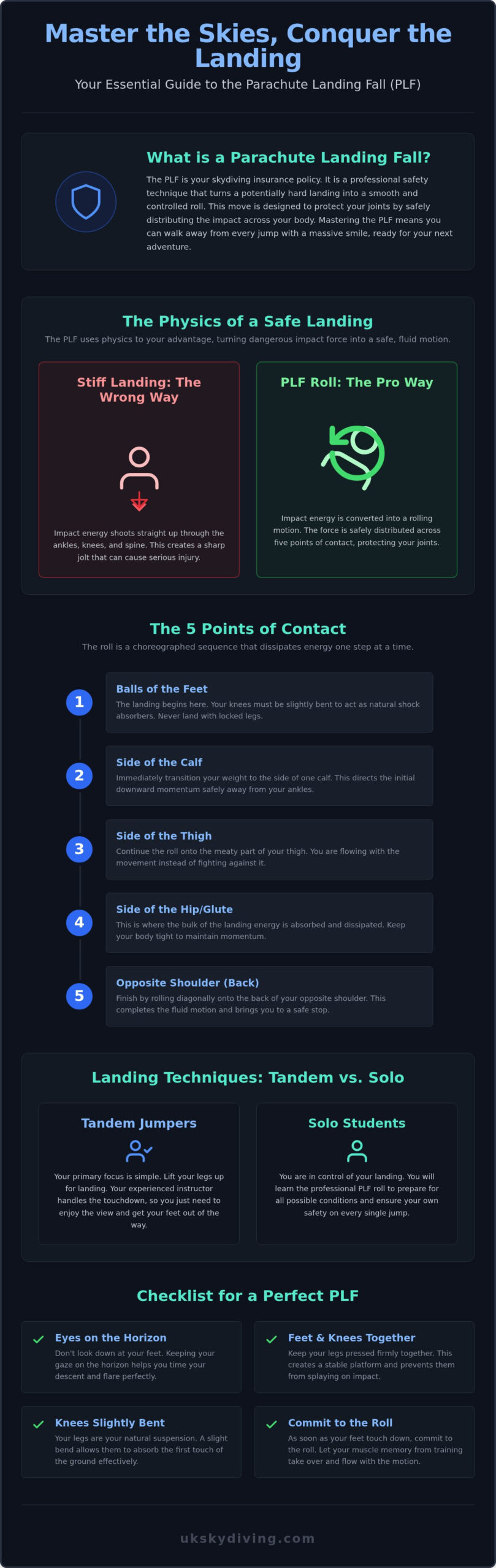
Landing involves a significant amount of kinetic energy. When you hit the ground, that energy has to go somewhere. If you land stiffly, that force can jar your ankles, knees, and hips. The PLF solves this problem by using physics to your advantage. By rolling, you spread the impact across five different parts of your body in a rapid, seamless sequence.
This specific movement prevents the shock from travelling straight up your spine. Instead of a single, sharp jolt, the energy is bled off through the roll. It is a brilliant way to keep your body safe while keeping the adrenaline levels high. You aren’t just falling. You are executing a tactical transition from the air to the earth that ensures your skydiving journey continues without a hitch.
The PLF as Your Skydiving Insurance Policy
Modern parachutes are incredibly steerable and usually allow for wonderfully soft landings. Most of the time, you will simply step onto the grass like you are stepping off a kerb. However, the sky can be unpredictable. Unexpected wind shifts or uneven patches of ground can make a landing tricky at the very last second. This is why we focus so heavily on this skill during our training sessions.
Think of the parachute landing fall technique as your ultimate insurance policy. It is there to catch you if the conditions aren’t perfect. Mastering this skill ensures you walk away from every jump with a massive smile and the confidence to go again. It is the most important safety tool in your kit. It gives you the freedom to focus on the pure joy of the flight without worrying about the final few seconds.
The Five Points of Contact: How the Roll Works
The parachute landing fall technique is much more than just a tumble. It is a high-speed, choreographed dance with the earth! When you are coming in for a landing, your body needs to be a focused machine. The secret to a successful roll is keeping your body in a “tight” position. Imagine you are a coiled spring ready to release its energy. By keeping your feet and knees pressed firmly together, you prevent your legs from splaying. This tension is what allows you to roll smoothly across the grass rather than catching an edge and tumbling awkwardly. It is an incredible feeling when the sequence clicks into place.
Each of the five contact points is designed to take a specific portion of the landing impact. You aren’t just hitting the ground. You are distributing energy. Practising this sequence on the ground builds the vital muscle memory you need for the sky. When the ground rush begins, you won’t have time to think. You will simply react. Your training takes over, and your body knows exactly what to do. It is all about turning that adrenaline into a controlled, professional finish.
From Feet to Calves
The impact begins on the balls of your feet. You must keep your knees slightly bent to act as your body’s natural shock absorbers. Never land with locked legs! As soon as your feet touch the dropzone, you immediately transition your weight to the side of one calf. This first stage is absolutely critical because it absorbs the initial downward momentum safely. It is the same foundational principle taught in U.S. Army parachute training to ensure paratroopers can land in any terrain. By directing the energy to the side of your leg, you protect your ankles and knees from the sharpest part of the impact. It’s fast. It’s efficient. It works every time.
Thigh, Hip, and Shoulder
Once your calf has touched the ground, the roll continues across the meaty part of your thigh and your hip. This is where the bulk of the landing energy is dissipated. You are flowing with the movement rather than fighting it. You finish the motion by rolling diagonally onto the back of your opposite shoulder. This fluid motion ensures no single joint takes the full force of the landing. You will feel the grass rush past as you complete the roll and pop back up. It is a total rush! If you are ready to feel this excitement for yourself, our Accelerated Freefall (AFF) Course provides the expert coaching you need to master these points of contact with total confidence.
Tandem vs Solo: Landing Techniques for Beginners
Whether you are strapped to an expert or flying your own wing, the final seconds of a jump are pure magic! One of the most common questions we hear is whether every jumper needs to roll on the grass. The answer depends entirely on your path to the skies. While the Parachute Landing Fall (PLF) is a legendary safety move, it isn’t a requirement for everyone on day one. Understanding the difference between tandem and solo landings helps you appreciate how your skills will grow as you progress through the sport.
The Tandem Landing Experience
For your very first experience, you will likely choose a tandem jump. In this setup, your instructor is the pilot. They handle the canopy control and the crucial landing flare. You don’t need to worry about the parachute landing fall technique here! Instead, you simply follow a clear command to lift your legs. By tucking your knees toward your chest, you allow the instructor to touch down first and slide in for a seated landing. It is incredibly smooth and lets you focus on the breathtaking views of the Cambridgeshire countryside. You can read more about the tandem skydiving experience to see just how accessible this adventure really is. We make sure you feel totally supported from the moment you leave the plane until your feet touch the grass.
Why Solo Students Need the PLF
Everything changes when you decide to take the controls yourself. Solo students in our Accelerated Freefall (AFF) course are responsible for their own canopy flight. This is where the parachute landing fall technique becomes your best friend. Even with modern, steerable parachutes, a student might misjudge the height of their flare. The PLF provides a reliable, built-in backup for those moments. It is a core part of the learn to skydive training programme. Mastering this roll before your first solo jump gives you the ultimate peace of mind. You know that no matter what the wind does, you have the skills to land like a pro. It turns a moment of uncertainty into a display of professional competence and ensures you are ready for your next big milestone.
Step-by-Step Guide to Executing a Perfect PLF
The ground rush is an incredible, heart-pounding sensation. One moment you are floating in peaceful silence and the next the lush green grass of Cambridgeshire is racing toward you at high speed. Preparation for the parachute landing fall technique starts well before you actually touch the grass of the dropzone. You need to stay calm, breathe, and keep your focus sharp. Keep your eyes fixed on the horizon rather than looking straight down at your feet. Looking down can distort your depth perception and cause you to tense up too early. By looking forward, you allow your body to react naturally to the terrain and time your move perfectly.
The Prepare Phase
As you enter the final few metres of your descent, it is time to lock your focus. Keep your feet and knees pressed firmly together to avoid any dangerous twisting of your lower legs. This creates a solid, unified base that can handle the impact energy effectively. Bend your knees slightly to act as your body’s built-in shock absorbers. You want to tension your muscles just enough to stay controlled but not so much that you become rigid. A rigid body is more prone to injury. A controlled, slightly flexible body flows with the force. Maintain a tight “tuck” position with your chin on your chest and your elbows tucked firmly into your sides to protect your ribs and head.
The Action Phase
Commit to the roll the very second your feet touch the ground! Hesitation is your only enemy here. You must execute the roll in one continuous and fluid motion without stopping. Any pause in the movement forces your joints to absorb energy that should be dissipated through the roll. One of the most critical safety rules is to avoid reaching out with your hands to break your fall. Your wrists and arms are not designed to take this kind of force. Keep them tucked in tight to your torso. Keep your chin tucked to protect your head throughout the entire motion as you roll rapidly across your calf, thigh, hip, and shoulder.
It is a fast, powerful movement that feels absolutely amazing when you nail it. You will pop up from the grass with a surge of adrenaline and the pride of a total pro. If you are ready to put these steps into practice under the watchful eye of a seasoned expert, book your Accelerated Freefall (AFF) Course today and start your journey toward solo mastery. Our instructors will guide you through every roll until it becomes second nature!
Professional Training at UK Skydiving in Cambridgeshire
Now that you have the theory, it is time to turn those steps into muscle memory! Reading about the roll is one thing, but feeling the grass beneath you as you nail a perfect finish is a whole different level of excitement. At our professional centre in Cambridgeshire, our expert instructors provide the hands-on training you need to feel like a total pro. We don’t just tell you how to do it. We show you. We use dedicated training pits to help you perfect your roll safely. These pits are filled with soft material to cushion your arrival while you master every nuance of the parachute landing fall technique.
Learning at a professional centre ensures you follow the strict British Skydiving safety standards. This is the ultimate environment for growth. Safety is always our absolute priority while we help you achieve the most exhilarating adrenaline rush of your life. You aren’t just learning a skill. You are joining a community of adventurers who live for the thrill of the descent. We take the time to ensure every student feels confident and prepared before they ever board the aircraft. It’s an absolute rush to see your progress from the classroom to the clouds!
Expert Oversight for Every Jump
Our instructors are some of the best in the business. They have thousands of jumps under their belts and years of professional experience to share. They have seen every type of landing and know exactly how to coach you to success. We guide you through every single step of the process. This journey begins in ground school and carries you all the way to your first solo freefall. If you have any lingering nerves, you can check if skydiving is safe for more details on our rigorous protocols. We believe that knowledge is the best cure for anxiety. Once you understand the systems and training in place, you can let go of the fear and embrace the adventure.
Join the Adventure Near North London
Our dropzone in March is perfectly located for anyone looking for a thrill. We are easily accessible for adventurers from North London and right across the UK. It is the perfect place to experience the incredible feeling of skydiving with a team you can trust. This is more than just a weekend activity. It is a transformative personal milestone that you will remember forever. You will leave our airfield with a new sense of accomplishment and a story that will last a lifetime. Book your training or tandem experience today to start your journey. The sky is waiting for you!
Ready to Master the Skies?
You now have the knowledge to turn every landing into a professional achievement. By mastering the parachute landing fall technique, you’ve gained the ultimate insurance policy for your skydiving journey. You understand how the five points of contact protect your body and how a simple roll can transform your landing confidence. Whether you’re starting with a tandem jump or diving into a solo AFF course, you’re ready for the rush. This skill is your ticket to total freedom in the air.
Our top-rated dropzone serves North London from our base in Cambridgeshire. With British Skydiving affiliated instructors guiding you, you’re in the safest hands in the industry. Imagine the thrill of over 13,000 feet of adrenaline-pumping freefall followed by a perfect, controlled touchdown. It’s time to stop dreaming and start flying. This is a transformative milestone that stays with you forever. We’ve helped thousands of jumpers find their wings and we’re ready to help you too.
Book your skydiving adventure in Cambridgeshire today and join the ranks of those who have conquered the clouds. Your life-altering memory is just one jump away. We can’t wait to see you at the airfield!
Frequently Asked Questions
Is the parachute landing fall technique still used today?
Yes, the parachute landing fall technique remains the gold standard for safety in modern skydiving. While modern canopies are incredibly steerable and usually provide soft landings, the PLF is your ultimate backup. It is a core requirement for anyone undergoing solo training in the UK. Professional instructors still teach this method because it is the most effective way to handle unexpected wind shifts or uneven ground. It turns a potential stumble into a professional and safe roll.
Can I break my legs if I do not do a PLF?
Landing with locked or stiff legs significantly increases the risk of injury to your ankles and knees. The PLF is specifically designed to prevent the impact energy from focusing on a single joint. By rolling, you spread that force across your body. While most landings are gentle, neglecting proper technique during a faster arrival can lead to sprains or fractures. Mastering the roll ensures you walk away from every jump feeling powerful and uninjured.
How do I practice the parachute landing fall at home?
You can practice the basic rolling motion on a soft patch of grass or a gym mat. Start from a standing position with your feet and knees pressed firmly together. Practice the sequence of touching your feet, then rolling onto your calf, thigh, hip, and shoulder. Always keep your chin tucked and your elbows in tight. While home practice builds basic muscle memory, nothing beats the professional coaching and dedicated training pits at our Cambridgeshire dropzone.
Do tandem skydivers need to know how to do a PLF?
Tandem students do not need to perform a PLF during their experience. Your instructor is in total control of the parachute and the landing flare. Your only job during the final descent is to follow the command to lift your legs high. This allows the instructor to touch down first and slide in for a seated landing. It is a simple and incredibly safe way to enjoy the rush of your first jump without complex training.
What are the five points of contact in a PLF?
The five points of contact are the balls of your feet, the side of your calf, the meaty part of your thigh, your hip, and the back of your opposite shoulder. This specific sequence is designed to bleed off kinetic energy in a fluid, continuous motion. By hitting these points in order, you ensure that no single part of your body takes the full force of the landing. It is a brilliant piece of safety engineering for the human body.
Is skydiving landing hard on the knees?
Modern skydiving landings are typically very gentle and feel like stepping off a small kerb. Our high-performance canopies allow for a controlled flare that slows your descent almost to a stop. If you use the parachute landing fall technique during a faster landing, the impact on your knees is minimal. The roll is designed to protect your joints by moving the energy away from them. You will find the experience surprisingly smooth and comfortable.
What happens if I forget to roll during my landing?
If you forget to roll during a fast landing, you might experience a sharp jolt or a stumble. This is why we focus so heavily on muscle memory during our AFF courses. We train you until the motion becomes an automatic reaction to the ground rush. Even if you forget the perfect sequence, keeping your feet and knees together is the most important step. It protects your lower limbs and helps you stay upright or tumble safely.
Do I need to be an athlete to perform a parachute landing fall?
You certainly do not need to be a professional athlete to master this move! The PLF is about technique and timing rather than raw strength or extreme flexibility. If you can jump off a chair and roll on the grass, you can perform a successful landing fall. Our instructors are experts at making the extraordinary feel accessible to everyone. We welcome adventurers of all fitness levels to experience the life-changing thrill of a jump in Cambridgeshire.
Categorised in: Blog