Latest News
-
 Skydiving as a Confidence Booster: How One Jump Can Change Your Life September 20, 2026
 -
 How to Convince Your Parents to Let You Skydive September 19, 2026
 -
 How to Land a Parachute Safely: A Beginner’s Guide September 18, 2026
 -
 Static Line vs AFF: Choosing Your Path to Solo Skydiving in 2026 September 17, 2026
 -
 Skydiving A License: Your Passport to the Skies September 16, 2026
How to Land a Parachute Safely: A Beginner’s Guide
September 18, 2026 12:00 amImagine the adrenaline coursing through your veins as you plummet through the clouds at 120mph. It’s the ultimate rush, but as the ground starts rushing up to meet you, a tiny voice in your head might start asking some big questions. Will it hurt? Can I actually stick the landing? It’s completely normal to feel a flicker of anxiety about breaking a leg or “messing up” your first jump. Most beginners worry that they’ll hit the grass with a bone-shaking thud, but the reality is far more graceful and exhilarating than you think.
Learning how to land a parachute safely isn’t about luck, it’s about mastering a few professional techniques that turn a high-speed descent into a soft, controlled arrival. We’re going to share the safety secrets used by our expert instructors at our March airfield to ensure every touchdown feels like stepping off a low kerb. You’ll discover the magic of the ‘flare’ technique, understand the key differences between solo and tandem landings, and gain the rock-solid confidence you need to finally book that life-changing leap. From the physics of the canopy to the final tip-toe onto the grass, we’ve got you covered.
Key Takeaways
- Discover why modern parachutes are actually high-tech wings that give you total control and a smooth glide back to earth.
- Master the “flare” maneuver to learn exactly how to land a parachute safely by turning forward speed into a soft, graceful finish.
- Learn the specific body positions that protect you during impact and why tandem students have one simple task to ensure success.
- Identify the common landing mistakes that cause anxiety and get expert tips on how to avoid them for a perfect touchdown.
- Find out how the professional team at our Cambridgeshire airfield uses years of expertise to guide you through a flawless landing.
Understanding the Science of a Controlled Parachute Descent
Forget everything you think you know about “falling” out of the sky. When you’re under the canopy, you aren’t just a passenger of gravity. You’re a pilot. Modern parachutes are incredible pieces of engineering that function as high-performance, rectangular wings. They don’t just catch the air, they slice through it. This aerodynamic design is the foundation of how to land a parachute safely, turning a vertical drop into a controlled, horizontal glide.
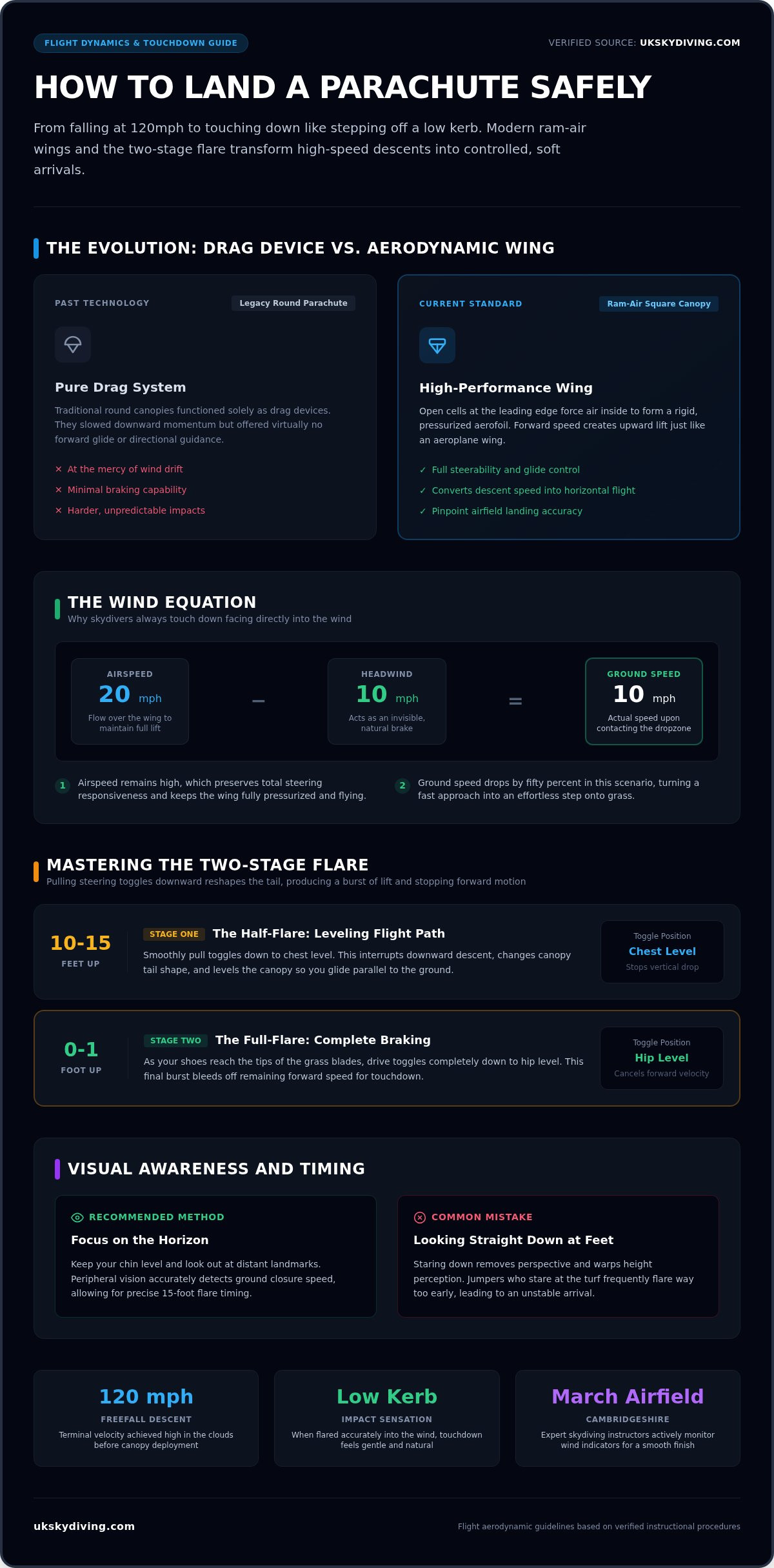
The canopy stays rigid because of a “ram-air” design. As you move forward, air is forced into open cells at the front of the parachute, creating a pressurized wing that generates lift just like an aeroplane. You’ll feel the lift as a subtle upward pull that keeps you gliding smoothly through the crisp Cambridgeshire air. Forward speed is actually your best friend in this scenario. It provides the airflow needed to keep the wing stable and responsive to your every move. While gravity provides the constant energy for your descent, you provide the direction and the finesse.
From Round Chutes to Modern Wings
Skydiving has evolved massively over the decades. Old-fashioned round parachutes were essentially giant drag devices that only slowed your vertical descent. You were largely at the mercy of the breeze, often landing wherever the wind decided to deposit you. Modern square canopies have completely transformed the experience. These wings allow for precise steering and powerful braking. By studying parachuting techniques and equipment, you’ll discover how today’s pilots can navigate with incredible accuracy. You aren’t just hoping for a soft spot, you’re actively choosing your exact landing point on the airfield.
The Role of Wind in Your Landing
Wind is one of the most important factors in a successful touchdown. Skydivers always aim to land facing directly into the wind. Think of the wind as an invisible, natural brake. When you fly into the wind, your “airspeed” stays high enough to keep the wing flying, but your “ground speed” drops significantly. This is the secret to a soft landing. If you’re moving at 20mph through the air and there’s a 10mph headwind, you’re only moving at 10mph relative to the ground. Our instructors at the March airfield constantly monitor wind indicators to plan the perfect final approach, ensuring you have the gentlest possible arrival on the grass.
Mastering the Flare: The Key to a Soft Landing
The final seconds of your flight are where the real magic happens. This is the moment you transition from a high-speed descent to a graceful, tip-toe landing on the grass. The secret to this transformation is a manoeuvre called the “flare”. It’s the most critical skill you’ll learn when discovering how to land a parachute safely. By pulling your steering toggles down in a smooth, controlled motion, you change the shape of the parachute tail. This creates a sudden burst of lift that levels out your flight path and bleeds off your forward speed.
Think of it as the ultimate braking system. A well-timed flare can bring your vertical descent to a complete stop just inches above the ground. You’ll feel the sensation of the wing “biting” into the air, lifting you slightly before you settle gently onto the dropzone. It’s an incredible feeling of precision and control that turns every jump into a masterclass in flight. If you want to see this in action, our Tandem Skydive Experience puts you in the hands of a pro who times every flare to perfection.
The Two-Stage Flare Technique
Timing and technique go hand-in-hand for a soft finish. Professional instructors teach a two-stage flare to ensure maximum stability. You’ll start the move when you’re roughly ten to fifteen feet above the ground. First, bring the toggles down to your chest level. This “half-flare” levels out your flight, stopping your downward drop and letting you glide parallel to the grass. As your feet are about to touch the blades of grass, you’ll push the toggles all the way down to your hips. This final push provides the “full flare” that stops your forward motion entirely.
Visual Cues for Perfect Timing
Judging your height above the ground can be tricky for first-timers. The most common mistake is staring straight down at your feet. This actually distorts your depth perception and often leads to flaring too early. Instead, keep your eyes fixed on the horizon. Using your peripheral vision to judge the ground rushing up allows you to sense your height much more accurately.
- Look ahead: Focus on a distant point to maintain a level head position.
- Trust your periphery: Let the ground in your side-vision tell you when you’re 15 feet up.
- Avoid the early reach: Resisting the urge to flare too soon prevents a premature stall, which can lead to a harder landing than intended.
Mastering these visual cues takes practice, but it’s the fastest way to build your confidence and ensure every landing is a soft one.
The Two Essential Body Positions for Every Landing
Your body is the final piece of flight equipment you need to master before you touch the grass. While the parachute does the heavy lifting, your physical position determines how you absorb the remaining energy of the jump. The technique you use changes completely depending on whether you are strapped to an instructor or flying solo. Mastering these positions is the most practical way to answer the question is skydiving safe? as it puts the power of a soft arrival directly in your hands.
Understanding how to land a parachute safely means preparing your muscles and mind for the transition from air to earth. It is an exhilarating moment of focus where everything you’ve learned comes together. Whether you’re sliding into the landing area on a tandem jump or rolling through a solo landing, your posture is your best protection. Our instructors at the March airfield will drill these positions with you until they become second nature.
The Tandem Legs Up Position
If you are joining us for a Tandem Skydive Experience, you have one primary job during the landing phase. Lift your legs! As you approach the ground, your instructor will shout a clear command to “get your legs up”. You need to lift your knees toward your chest and extend your feet out so your legs form a ninety-degree angle with your torso. This isn’t just for show. It is a vital safety move that allows your professional instructor to touch down first.
By keeping your legs up, you ensure the instructor’s legs take the initial momentum of the landing. They are the expert pilots trained to handle the impact. Most tandem landings at our Cambridgeshire dropzone end with a smooth, controlled slide on your bottom. It’s an incredibly comfortable way to finish your adventure. Just keep those toes up until you’ve come to a complete stop on the grass!
The Parachute Landing Fall (PLF)
Solo jumpers and those on our AFF course learn a legendary technique called the Parachute Landing Fall, or PLF. This move is designed to protect your joints by distributing the energy of the landing across the strongest parts of your body. Instead of trying to stand up and potentially jarring your ankles, you turn yourself into a human shock absorber. The key is to keep your feet and knees pressed tightly together. This creates a single, unified point of contact rather than two separate legs that could twist.
As your feet touch the ground, you simply “crumple” in a controlled roll. You’ll move the impact energy through five points of contact: the balls of your feet, your calf, your outer thigh, your hip, and finally your back muscle. It happens in a flash! A good PLF feels like a coordinated tumble across a gymnastics mat. It is a professional skill that ensures you can get right back up, pack your kit, and head straight back up for another jump.
Common Landing Mistakes and How to Avoid Them
Even the most exhilarating adventures have rules to keep the adrenaline pumping safely. When you’re gliding toward the dropzone, your brain might try to take over with old habits. It’s vital to recognize these common pitfalls so you can master how to land a parachute safely every single time. Most landing issues don’t come from the equipment. They come from the natural “fight or flight” response we all have. By trusting your professional training at our March airfield, you can override these instincts and stick the landing like a pro. Our instructors are experts at spotting these habits early during your ground school training.
One of the biggest hurdles is the “flare freeze”. This happens when a student starts the flare but stops their hands at chest level instead of pushing all the way down to the hips. This leaves the parachute in a partial state of flight, meaning you’ll touch down much faster than intended. You must commit to the full motion to bleed off all that forward speed. It’s a bold, decisive move that ensures a gentle arrival on the grass. You’ll feel the difference immediately as the canopy gives you that final, supportive lift.
The Danger of Reaching for the Ground
Your body naturally wants to reach out and “catch” the ground with your feet. You must resist this urge! Reaching down early is one of the most frequent mistakes beginners make. It often leads to tripping or losing your balance just as you touch the earth. Whether you’re in the tandem position or prepping for a solo PLF, keep your legs tucked and ready until the very last second. This transition is a huge part of what skydiving feels like as the high-speed rush of freefall gives way to the absolute precision of the landing phase. Trust the wing to bring the ground to you rather than trying to meet it halfway.
Staying Square to the Wind
Stability is your best friend when you’re close to the earth. A common cause of hard landings is making sharp, low turns near the landing area. When you turn a parachute, the wing tilts and loses a significant portion of its lift. This is perfectly fine at 3,000 feet, but it’s incredibly risky when you’re only 50 feet up. For the final hundred feet of your descent, keep the wing level and fly straight into the wind. A stable wing is a safe wing. If you want to master these manoeuvres and take total control of your flight, our Accelerated Freefall (AFF) Course is the perfect way to build your skills under expert guidance. Stay focused, keep your toggles level, and enjoy the smooth ride all the way to the finish.
Experience a Perfect Landing with UK Skydiving
Ready to put this knowledge into action? At UK Skydiving, we don’t just teach you the theory. We provide the ultimate stage to perform it. Our base in March, Cambridgeshire, is specifically chosen to provide the safest and most exhilarating environment for your first touchdown. When you’re learning how to land a parachute safely, having a massive, clear landing area is a complete game-changer. It removes the stress of tight spaces and lets you focus entirely on the thrill of the descent.
Our expert instructors are the backbone of every successful jump. If you’re going for a tandem, you’re strapped to a seasoned pro who has mastered thousands of landings. They handle the precision work while you enjoy the view. For those who want to take the controls themselves, our AFF courses provide the most intensive ground training in the UK. We ensure you feel confident, capable, and ready to stick your landing before you even board the aircraft. Book your adventure today and discover just how gentle and controlled a high-speed descent can be.
Why Our Cambridgeshire Base is Ideal for Beginners
Location is everything in aviation. Our airfield offers vast amounts of open space, which is perfect for beginners who need a wide, forgiving area to touch down. We’ve eliminated the worry of obstacles or hazards, leaving you with nothing but smooth grass and clear skies. Our team monitors weather conditions with obsessive detail, ensuring that every jump takes place in safe, predictable winds. You can experience the pure adrenaline of tandem skydiving knowing that the ground conditions are as perfect as the view from the clouds.
Start Your Journey to Becoming a Licensed Pilot
If you’ve ever dreamed of flying your own wing, there’s no better place to start. You can master your own landings and earn your wings when you choose to learn to skydive with our professional instructors. We provide one-on-one feedback after every single jump, using detailed debriefs to help you perfect your flare and body position. Our kit is world-class and designed for maximum forgiveness, making it easier for new pilots to build their confidence quickly. It’s more than just a hobby. It’s a transformative process that turns a first-time jumper into a skilled, licensed pilot. Come and join our community of adventure seekers and see for yourself why the landing is often the most rewarding part of the entire journey.
Take Your First Step Into the Skies
You have now mastered the secrets of the flare and the science behind the modern wing. Understanding how to land a parachute safely is the final bridge between a thrilling freefall and a graceful return to earth. By focusing on your body position and resisting the urge to reach for the ground, you can ensure every touchdown is as smooth as it is exhilarating. The fear of the unknown is replaced by the confidence of a pilot, making your first jump a peak life event rather than a source of anxiety.
Our team at the March airfield is ready to turn your adrenaline dreams into reality. With expert instructors who have thousands of jumps to their names, you’re in the safest possible hands. You’ll enjoy a full safety briefing before taking to the air to soak in stunning views over the Cambridgeshire countryside. This is your moment to accomplish something extraordinary and join the ranks of those who have dared to leap. Book your life-changing tandem skydive experience today! We’re waiting to welcome you to the skies for an adventure you’ll never forget.
Frequently Asked Questions
Does it hurt when you land a parachute?
It shouldn’t hurt at all! Modern wing technology and the flare technique mean you’ll usually touch down with the same impact as stepping off a low kerb. Our instructors at the March airfield are experts at timing the final flare to bleed off all your speed. Most tandem students find the experience surprisingly gentle and smooth. It feels more like a controlled slide on the grass rather than a sudden, bone-shaking impact.
What happens if the wind is too strong for landing?
Safety is our absolute priority at UK Skydiving. Our ground team monitors wind speeds constantly to ensure they stay within strict safety limits. If the wind becomes too strong or gusty for a beginner to how to land a parachute safely, we simply pause jumping until conditions improve. We wait for that perfect window of weather to ensure your experience is both exhilarating and completely controlled from the moment you leave the aircraft.
Can I land a parachute if I am not very fit?
Absolutely! Skydiving is an inclusive adventure that is accessible to people with various fitness levels. For a tandem jump, the most important physical requirement is the ability to lift your legs up to a ninety-degree angle for the landing. Your instructor handles all the steering and heavy lifting. If you can hold your legs out for a few seconds as you approach the grass, you are ready for this life-changing adrenaline rush!
How fast are you going when you hit the ground?
Thanks to the flare manoeuvre, your forward speed is reduced to a slow jog or even a walking pace at the moment of touchdown. While you might be falling at 120mph during freefall, the parachute wing slows your vertical descent significantly. The final flare then converts your remaining forward motion into a tiny bit of lift. This allows you to settle onto the Cambridgeshire turf with very little momentum left.
What is the most important thing to remember during a tandem landing?
The golden rule for every tandem student is to lift your legs! When your instructor gives the command, you need to bring your knees toward your chest and extend your feet out. This allows the instructor’s legs to touch the ground first, taking the initial contact. It is the simplest yet most effective way to ensure a flawless finish to your skydiving adventure. Just listen for the command and stay focused.
Do I have to stand up when I land my first skydive?
No, you don’t have to worry about sticking a perfect standing landing on your first go. Most tandem students at our dropzone finish their jump with a smooth slide on their bottom. This is actually the preferred method for beginners because it is incredibly stable and comfortable. Your instructor will guide the parachute to the grass, and you’ll simply glide into a sitting position as you come to a stop.
What is a PLF and why do skydivers use it?
A Parachute Landing Fall, or PLF, is a professional rolling technique used primarily by solo jumpers. It is designed to protect your body by distributing the landing energy across five points of contact: your feet, calf, thigh, hip, and back. By rolling through the landing, you avoid jarring your joints and ensure a safe arrival even if the wind is a bit tricky. It is a core skill taught in our AFF courses.
Can the instructor control where we land during a tandem jump?
Yes, your instructor has total control over the flight path. Modern square parachutes are high-performance wings that can be steered with incredible precision. Your pilot will navigate the canopy through the sky, accounting for wind direction and speed to bring you back to our designated landing area in March. You will enjoy a scenic tour of the countryside before arriving exactly where the ground crew is waiting for you at our professional dropzone.
Categorised in: Blog