Latest News
-
 4 ways to make your first skydive feel more manageable November 10, 2026
-
 What’s the Scariest Part of Skydiving? How Freefall Feels November 9, 2026
-
 Parental Consent for Skydiving and Young Jumpers November 8, 2026
-
 How to Position Your Body and Breathe During Freefall November 7, 2026
-
 Pressure Changes During Skydiving: Why Your Ears Hurt November 6, 2026
Can You Talk During Freefall? What You Can Really Hear
October 14, 2026 12:00 amWhat if you shout in freefall but the person right beside you still can’t hear a word? It sounds surprising, but it gets to the heart of the question: can you talk during freefall? You can open your mouth and make sounds, but the rush of wind makes conversation impractical.
If you’re wondering how you’ll communicate with your instructor, that’s completely understandable. A tandem skydive is an intense new experience, and you’ll be harnessed to a professional instructor. Before the jump, you’ll go over what to expect, including any simple cues to use when talking isn’t practical.
This guide explains what you’re likely to hear in the aircraft, why speech gets lost during freefall, and how things change once the parachute opens and the descent becomes quieter. You’ll also learn how communication works with your instructor, so you can arrive informed and focus on the experience ahead.
Key Takeaways
- Can you talk during freefall? You can make sounds, but don’t expect another person to hear or understand you.
- Communication changes across the skydive. Know what to expect on the ground, in freefall and under the canopy.
- For a tandem jump, focus on your instructor’s guidance and the cues covered before the jump.
- Knowing when conversation is practical can help you feel prepared and focus on the experience.
Can You Talk During Freefall? The Short, Honest Answer
Yes, you can try to speak during freefall, but you shouldn’t expect a conversation. Making a sound is one thing. Having someone nearby hear it clearly, recognise the words and reply is quite another. The rush of air around you creates so much noise that ordinary speech is easily overwhelmed.
That’s the practical answer to “can you talk during freefall?” You might shout, laugh or yell with excitement, and someone close by might notice the sound. But speech isn’t a reliable way to communicate. Even if a word reaches another person, they may not make it out or be able to reply in a way you can understand.
Freefall is also a fast-moving, physically intense part of a skydive, not a quiet moment in which to pause and chat. Airflow, your body position and the distance to another person can all affect what you hear. Experiences vary, so think of speech as possible but conversation as impractical. Don’t assume that nobody can hear a sound, but don’t rely on anyone understanding it either.
Can you make yourself heard in freefall?
Shouting louder doesn’t create a dependable back-and-forth. The wind can mask your voice, while the other person is dealing with the same noisy conditions. Hearing that someone has made a sound is different from understanding specific words, and neither guarantees they can answer you. In short, you can speak, but don’t count on being heard or understood.
Why movie conversations are not realistic
Films often let skydivers deliver crisp one-liners while falling side by side. It makes a thrilling scene, but real freefall is far noisier and less controlled. The basic idea of free fall helps explain how a skydiver’s motion changes as air resistance builds. It doesn’t make the surrounding rush of air quiet enough for dialogue.
So if you’re picturing a relaxed chat, you’re not missing a trick. The cinematic version leaves out the effort of speaking and the difficulty of listening in a powerful stream of air. A shout may be part of your reaction to the moment, but it won’t work like talking across a room. Airflow and noise are the main reasons clear speech is difficult.
Why Freefall Makes Conversation So Difficult
In freefall, the air isn’t just background noise. It rushes around your body and past your ears, making it harder to hear your own voice and anyone else’s. Speaking also means trying to form words while air moves across your face. You may manage a shout, but the sound can be swallowed by the surrounding rush before it reaches someone clearly.
Distance and direction matter, too. Another skydiver might be nearby, but they’re moving through the same noisy air. If they can’t hear the words, they can’t reliably answer you. Even a voice that’s briefly audible may come through as a muffled sound rather than a sentence you can understand.
Ordinary conversation is impractical in freefall because rushing air can drown out speech and make replies difficult to hear. A skydive isn’t like stepping outside for a quick chat. The experience is intense and changing, and your attention is naturally drawn to the movement, the view and the sensation of falling.
What does freefall sound and feel like?
Many people describe a powerful rush of air, though the exact sound and sensation can vary from one jumper to another. Body position, surroundings and personal perception all shape what you notice. For a broader sense of the sensory experience, read about what skydiving feels like. The key point is that freefall isn’t silent, even if your reaction to the noise differs from someone else’s.
The rush can make it difficult to tell whether a nearby person is speaking at all. Skydive New England also describes wind noise as a barrier to verbal communication. Rather than trying to decipher every sound, expect a busy sound environment and focus on the experience.
Does speaking become easier later in the skydive?
Yes, conditions change after the parachute opens. The intense airflow of freefall eases, so hearing and speaking may become more realistic. That doesn’t mean conversation is automatically easy or uninterrupted. You’re still in the air, and the canopy phase has its own sensations and demands. The next section compares communication across each stage of the skydive.
Knowing that the soundscape changes can help you feel more prepared. You don’t need to make yourself heard throughout the jump to enjoy it. If you’re considering a first jump, learn about a tandem skydive experience and arrive ready for the adventure.
Freefall vs. Canopy Flight: When Can Skydivers Communicate?
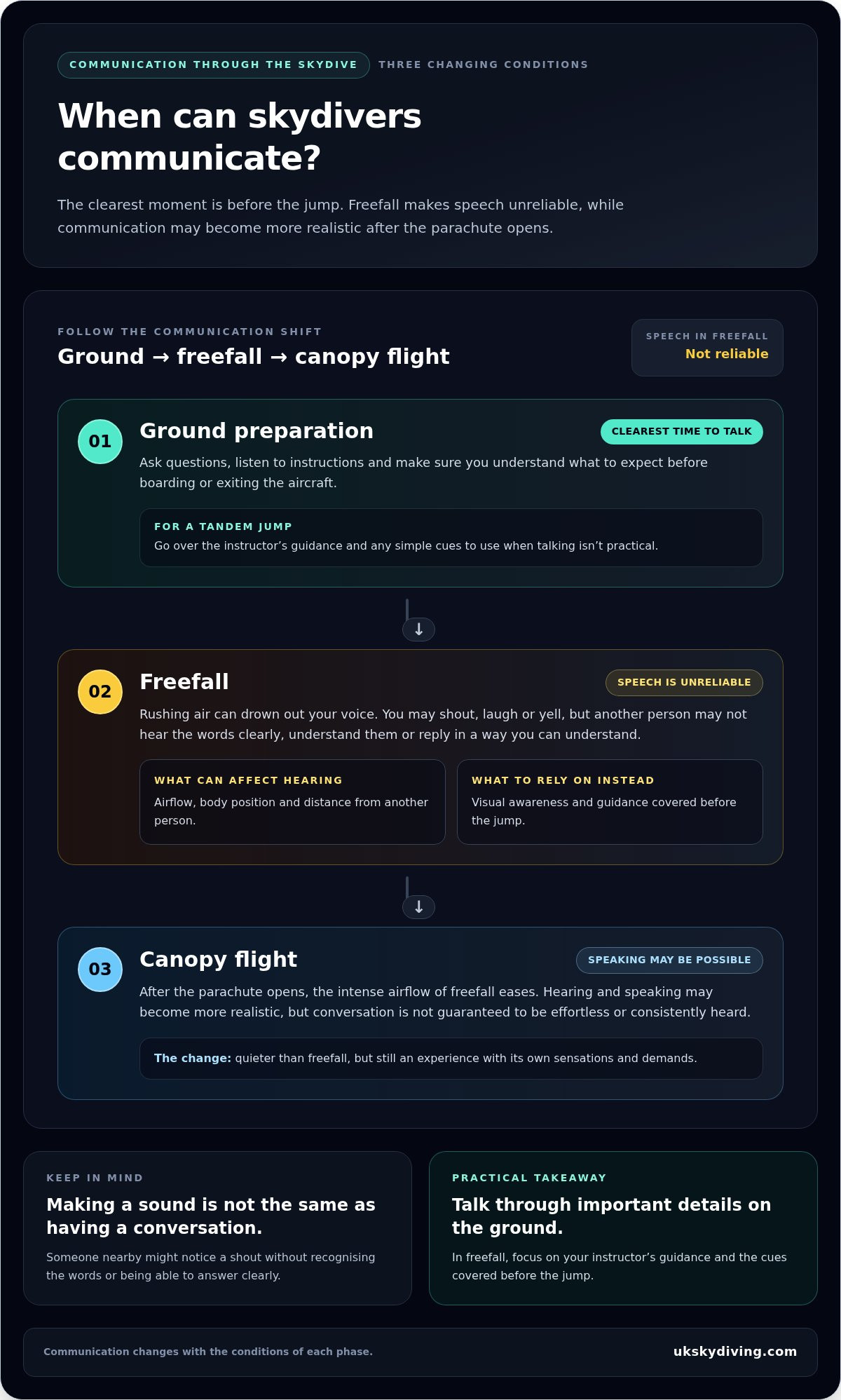
Communication isn’t the same throughout a skydive. On the ground, you can talk things through at a normal pace. In freefall, speech is difficult to rely on, so attention and agreed guidance matter more than conversation. After the parachute opens, the environment changes, and speaking may be more realistic, though it isn’t guaranteed to be effortless or consistently heard.
| Phase | What communication is like |
|---|---|
| Ground preparation | The clearest time to ask questions, listen to instructions and make sure you understand what to expect. |
| Freefall | Ordinary speech isn’t a practical way to exchange information. Visual awareness and any guidance covered beforehand are more useful. |
| Canopy flight | The rush of freefall eases, so speaking may be possible. Whether it can be heard or understood depends on the situation. |
So the useful question isn’t only “can you talk during freefall?” It’s also when to have important conversations and what to rely on once you’re in the air. Skydive Monroe also highlights how noise affects verbal communication during a jump. The practical takeaway is simple: don’t depend on spoken messages in freefall, and follow the guidance given for your jump.
Before the jump: the clearest time to communicate
Before boarding or exiting the aircraft, you have the best opportunity to ask questions and take in instructions without the rush of freefall around you. Listen carefully, and speak up if something isn’t clear. For a tandem skydive, you’ll be harnessed to a professional instructor. Understanding what to expect beforehand can help you feel more settled and ready to enjoy the experience.
This preparation is especially helpful if you’re making your first jump. A tandem skydiving first-jump guide can also give you a clearer picture of the experience. Use the ground briefing for questions that need a proper answer, rather than expecting to ask them mid-air.
Under canopy: a different communication environment
Once the parachute opens, conditions differ from freefall and conversation may become more practical. Still, the canopy phase isn’t automatically quiet or suited to an easy chat. Whether speech can be heard depends on the circumstances, so follow your instructor’s guidance rather than relying on a particular exchange.
Communication doesn’t always have to be spoken. Non-verbal cues may be useful where appropriate, but the specific approach depends on the jump and the guidance you’ve received. Think of the canopy as a different communication environment, not a promise of uninterrupted conversation. The next section looks at what this means for first-time tandem jumpers.
What First-Time Tandem Jumpers Should Expect About Communication
Your first tandem skydive is a new experience, so it’s natural to wonder how you’ll communicate once you’re in the air. You don’t need to hold a conversation during freefall to take part. You’ll be harnessed to a professional instructor, and the most useful communication happens before the jump, when you can hear instructions and ask questions clearly.
Keep this simple sequence in mind:
- Ask questions beforehand. Raise anything you’re unsure about before the jump begins, while there’s time to talk it through.
- Listen carefully to your instructor. Pay attention to the briefing and any guidance about what to expect at each stage.
- Focus on the experience. In freefall, don’t depend on speech to exchange messages. Follow the instruction you’ve been given and take in the moment.
This article can help you arrive informed, but it isn’t a substitute for your instructor’s briefing. Your instructor will give you guidance relevant to your jump, so use that as your reference rather than relying on general advice online.
How tandem communication differs from a conversation
In a tandem skydive, you and your instructor are connected through the tandem harness. That close physical connection is different from standing beside someone and chatting, but it doesn’t make spoken conversation in freefall practical. Wind and the intensity of the moment can make words hard to hear or understand. So if you’re asking, “can you talk during freefall?”, the realistic expectation is that you may make sounds, but shouldn’t rely on a clear exchange.
Communication is planned around the experience, not improvised as a running conversation. Your instructor’s briefing explains what you need to know beforehand. Once you’re in the air, follow their guidance and stay focused on what’s happening rather than trying to speak over the rush.
What to do if you have a question or concern
Ask before the jump begins. Whether you’re unsure about the instructions or want to know what a particular part may feel like, raising your question beforehand gives you a chance to hear the answer without the distractions of the jump. There’s no need to feel awkward about being a first-timer. Getting clear on what to expect is a sensible part of preparing.
If a concern comes up as you get ready, tell your instructor and listen to their guidance. You don’t have to memorise every detail from an article. Take in the briefing, ask about anything that remains unclear and let your instructor guide you through the experience.
To make those questions part of your preparation, learn about the tandem skydive.
Ready for Your First Jump? Focus on the Experience, Not a Conversation
The answer is straightforward: you may be able to make a sound in freefall, but having a conversation isn’t practical. Being able to speak doesn’t mean another person can hear your words, understand them or reply. That’s a normal expectation for a skydive, not a sign that anything is wrong.
For a first jump, preparation matters more than trying to talk mid-air. Take time to understand your instructor’s briefing and raise questions before the jump begins. Once you’re in the air, focus on the guidance you’ve received and the remarkable experience unfolding around you. You don’t need to carry on a conversation to feel connected to the moment.
A simple takeaway for anyone considering a skydive
Keep three things distinct: speaking means making a sound, being heard means that sound reaches someone, and communicating effectively means they understand what you mean. Freefall makes that last step difficult to rely on. Not chatting as you fall is entirely normal, so leave the imagined film dialogue behind and focus on what the jump feels like for you.
Beforehand, use the quieter time to ask what you need to know. Then listen to your instructor and follow their guidance throughout the experience. Understanding what to expect before the jump can help you arrive informed, rather than worrying about whether you’ll be able to talk at the key moment.
Explore tandem skydiving in Cambridgeshire
UK Skydiving’s base in Cambridgeshire offers a tandem experience for beginners. You’ll be harnessed to a professional instructor, and jumps are from up to 13,000 feet. If this will be your first skydive, knowing that conversation isn’t something you need to depend on can help you focus on preparation, listen closely and take in the views and sensations.
You don’t need to have every feeling figured out before you go. It’s enough to understand how communication changes, raise questions beforehand and be ready to experience the jump with your instructor’s guidance. The moment itself is yours to enjoy, without trying to talk your way through it.
Take a look at the tandem skydive experience to explore a first jump in Cambridgeshire.
Make Your First Skydive a Moment to Remember
The question “can you talk during freefall?” is worth asking, but it doesn’t need to shape your decision. You don’t have to know exactly how you’ll react or find the perfect words for the experience. Give yourself the chance to be present, take in the moment and let the memories do the talking afterwards.
If you’re feeling curious and a little nervous, that’s a natural place to start. Use what you’ve learned to feel more prepared, then let your instructor’s briefing guide you through the practical details. Your first skydive can be a personal milestone, and you can approach it at your own pace.
Ready to see where that curiosity could take you? Explore your tandem skydive experience and take the next step when it feels right. An unforgettable adventure could be closer than you think.
Frequently Asked Questions
Can you talk to your instructor during freefall?
You can try, but airflow and surrounding noise make ordinary conversation difficult. If you’re wondering, “can you talk during freefall?”, the practical answer is that your instructor may not hear or understand your words, so don’t rely on speaking to pass on a message. For a tandem jump, you’re harnessed to a professional instructor. Follow the guidance you receive before the jump, and raise questions while you can talk comfortably.
Can skydivers hear each other during freefall?
Sometimes a person might notice that someone nearby has made a sound, but that’s not the same as understanding speech. Airflow can mask words, and a clear reply can be just as difficult to hear. Experiences vary, so don’t assume nobody will hear anything, or that a message will get through. Treat freefall as an unreliable setting for conversation, not a chance to exchange important information.
Is it easier to talk after the parachute opens?
Communication can feel more realistic after the parachute opens because the environment changes from freefall. But easier doesn’t mean effortless. Whether words can be heard or understood depends on the situation, so don’t count on holding a conversation throughout canopy flight. Follow your instructor’s guidance and keep expectations flexible. The shift in sound and sensation is part of how the skydive changes as it progresses.
Can you communicate without talking while skydiving?
Yes, communication may involve non-verbal cues, depending on the phase of the skydive and the situation. The exact approach isn’t something to guess at or improvise, especially during a first jump. If you’re taking part in a tandem skydive, listen to your instructor’s briefing and follow their guidance rather than relying on gestures you’ve made up yourself. That way, you know what to expect before you’re in the air.
What should a first-time tandem skydiver do if they have a question?
Ask your question before the jump begins, while there’s time to hear and understand the answer. Then listen carefully to the professional instructor’s guidance. Freefall isn’t the moment to expect a conversation or save an important question for later. At UK Skydiving, tandem participants are harnessed to a professional instructor. If nerves make you forget what you wanted to ask, mention your concern as you prepare.
Is freefall too noisy to talk?
Airflow and surrounding noise can make both speaking and hearing difficult, so a clear conversation isn’t a realistic expectation. You might still make a sound, such as a shout, but that doesn’t mean someone else can hear the words or understand what you mean. The exact experience can vary between people and jumps. The sensible approach is to enjoy the moment and not depend on speech to communicate clearly.
Categorised in: Blog