Latest News
-
 Skydiving as a Confidence Booster: How One Jump Can Change Your Life September 20, 2026
 -
 How to Convince Your Parents to Let You Skydive September 19, 2026
 -
 How to Land a Parachute Safely: A Beginner’s Guide September 18, 2026
 -
 Static Line vs AFF: Choosing Your Path to Solo Skydiving in 2026 September 17, 2026
 -
 Skydiving A License: Your Passport to the Skies September 16, 2026
AFF Course Requirements UK: Your Guide to Starting Solo Skydiving in 2026
September 15, 2026 12:00 amWhat if the only thing standing between you and the ultimate adrenaline rush isn’t your fear, but a simple checklist? Many people assume that skydiving solo is reserved for elite athletes or the incredibly young. We know it’s frustrating to feel held back by confusion over British Skydiving medical forms or the worry that you aren’t fit enough to qualify. Understanding the AFF course requirements UK is your first step toward the most exhilarating experience on the planet. Don’t let uncertainty ground your dreams before you even reach the airfield.
You’re about to discover exactly what it takes to qualify for an Accelerated Freefall course and begin your journey toward a solo skydiving licence. This guide provides a clear checklist of eligibility criteria and explains the medical self-declaration process in simple terms. We’ll give you the confidence to handle the ground school training and manage the time commitment needed for success. It’s time to stop wondering if you can do it and start preparing for the moment you step into the sky on your own. Prepare to leave the ground behind and join the ranks of solo skydivers with total clarity and absolute excitement.
Key Takeaways
- Confirm you meet the essential age and weight limits to start your solo training. You can begin this life-changing adventure from the age of 16 with parental consent.
- Master the medical side of skydiving by understanding the British Skydiving health forms. Learning the AFF course requirements UK helps you navigate the self-declaration process with total confidence.
- Prepare for an intensive day of ground school where you’ll learn vital safety drills and canopy control. This mandatory training ensures you’re mentally and physically ready for your first solo exit.
- Commit to a structured programme that takes you from a beginner to a licensed skydiver. You should set aside at least a full week or several weekends to complete the eight levels of the course.
- Discover why our Cambridgeshire base is the perfect environment for your training. Expert instructors will guide you through every step of this transformative personal milestone.
Basic Eligibility: Age and Weight Limits for UK AFF
The dream of flight is within your reach. Accelerated Freefall (AFF) is the fastest way to become a solo skydiver, taking you from a ground-based student to a solo flyer in record time. It is a high-octane journey that replaces the passive experience of a tandem jump with the thrill of total control. Before you can scream through the air at 120mph, you must meet the basic AFF course requirements UK centres enforce to keep every student safe. These criteria ensure you have the physical ability to handle the intense sensations of freefall and the technical demands of landing your own parachute.
Minimum and Maximum Age Rules
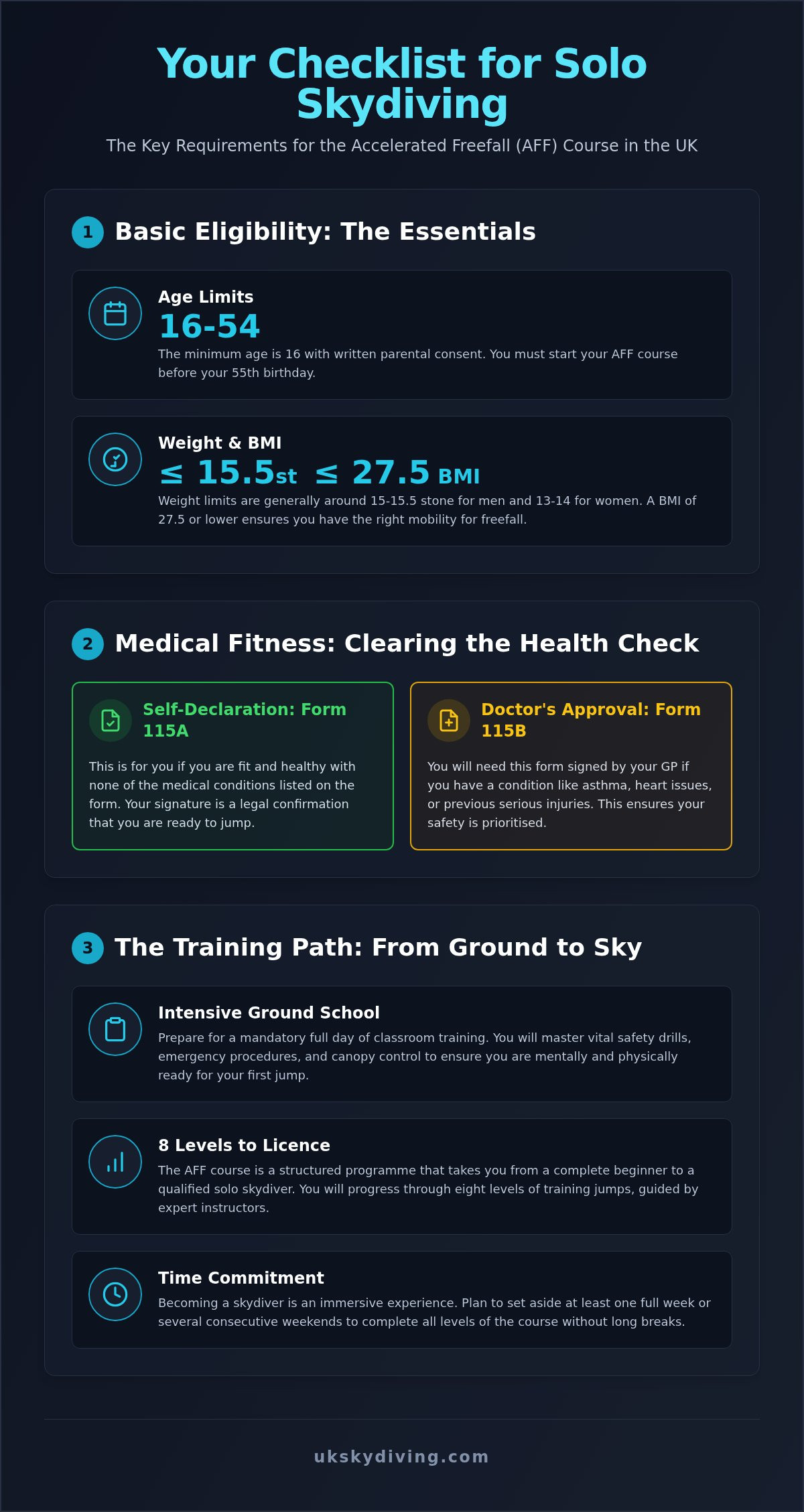
You can start your solo skydiving journey as soon as you turn 16. It is an incredible way to build life-altering confidence and join a community of passionate adventurers. If you are 16 or 17, you must have written consent from a parent or guardian on specific British Skydiving forms. This paperwork is essential, so make sure you have it signed and ready before you arrive at the airfield. While many people think skydiving is only for the very young, the sky is more inclusive than you might imagine. However, there are specific limits for those starting out. According to current regulations, the maximum age to begin your AFF training is 54. You must start the course before your 55th birthday to qualify for this specific training programme. This ensures that every student has the physical agility required for the intensive ground school and the movements needed during freefall.
Understanding Weight and BMI Restrictions
Safety is our absolute priority, and that means being strict about weight and Body Mass Index (BMI). These AFF course requirements UK exist because parachute equipment has specific weight ratings and instructors must be able to assist you safely in the air. Most centres set a maximum weight limit between 15 and 15.5 stone for men and around 13 to 14 stone for women. Your BMI is equally important, as a limit of 27.5 or lower is often required to ensure you have the mobility to arch your body and react quickly. Be completely honest about your weight during the booking process. We use this data to pair you with the right equipment and instructors, ensuring your first solo jump is as safe as it is exhilarating. If you are close to the limit, focus on your fitness now to ensure you are ready for the physical demands of the sky.
The Medical Side: British Skydiving Health Requirements
Safety is the primary driver for all medical scrutiny in the world of skydiving. We want your first solo jump to be a peak life event, not a source of worry or risk. To ensure every student is fit for the rush, all UK skydivers must meet the rigorous medical standards established by British Skydiving. These regulations are supported by the Civil Aviation Authority to maintain the highest safety levels in the world. When you look at the AFF course requirements UK, you’ll see that the paperwork is designed to be inclusive while keeping everyone safe in the skies. It’s a simple process that guarantees you are physically prepared for the adrenaline and the physical demands of landing.
The Self-Declaration Process (Form 115A)
If you are a fit, healthy adult, the path to the plane is incredibly straightforward. Form 115A is a self-declaration of fitness designed for people who don’t have any of the medical conditions listed on the document. By signing this, you are effectively certifying that you are fit to jump. Your signature on this document carries significant legal weight. It’s a personal guarantee that you are ready for the physical intensity of freefall and the sensory overload of your first solo exit. You can find these forms on the British Skydiving website. Download them early to avoid any last-minute stress at the airfield. Meeting these AFF course requirements UK is the first victory on your way to becoming a licensed pilot of your own parachute.
When You Need a Doctor’s Signature (Form 115B)
Do you have a history of asthma or heart issues? Maybe you’ve had a recurring back injury or take specific medication? This doesn’t mean your dream is over. It just means you need Form 115B signed by your GP. This requirement is a vital part of how we ensure is skydiving safe for every student and instructor. Your doctor needs to see the specific skydiving medical form to understand the unique pressures of the sport. They’ll check that your condition won’t be triggered by the altitude or the physical demands of canopy control. Interestingly, being over 40 no longer requires an automatic doctor’s signature. As long as you are healthy, you might still qualify for self-declaration. Once you have that signature, you’re one step closer to the most transformative experience of your life. If you’re ready to clear the paperwork and get into the air, you can book your AFF course today and start your training.
Ground School: The Mental and Physical Readiness Requirement
Ground school is where your transformation truly begins. It is a mandatory, intensive day that turns you from a curious spectator into a dedicated student of the sky. You will spend between six and eight hours absorbing technical knowledge and safety protocols. This isn’t a dry classroom lecture. It’s a high-stakes briefing for the most exhilarating moment of your life. Every minute spent on the ground builds the foundation for your success at 13,000 feet. You’ll leave the centre with the skills needed to pilot your own body through the air.
What to Expect During Ground School
Prepare to dive deep into the mechanics of the parachute system. Our expert instructors will teach you how to check your own gear and understand exactly how every toggle and strap functions. The most iconic part of your training is mastering the ‘arch’ position. You’ll practice this stable freefall technique on the ground until it becomes second nature. This position is your key to a controlled and stable flight. You’ll also run through emergency drills repeatedly until your reactions are automatic. You must demonstrate that you can handle unexpected situations with a cool head and absolute precision. Before you even step toward the plane, you’ll need to pass both written and practical exams. These are essential AFF course requirements UK instructors use to guarantee you’re ready for the ultimate rush of your first solo exit.
Physical Fitness for Solo Flight
You don’t need to be a marathon runner or an Olympic athlete to skydive solo. However, you do need a basic level of flexibility and core strength to succeed. The ability to arch your back is the most important physical requirement for a stable and safe freefall. You also need enough leg strength to handle the landing. While modern parachutes are incredibly steerable and offer soft touchdowns, you might still need to run a few steps as you reach the grass. It’s about being active and capable rather than being a fitness fanatic.
Many students find that a previous tandem skydiving experience is the perfect way to gauge their physical comfort. It lets you feel the wind resistance and the intense physical pressure of freefall without the responsibility of operating the equipment. If you handled the sensations of a tandem jump well, you’re likely ready for the physical demands of an AFF programme. Mental focus is just as vital as physical agility. You’ll be processing vital instructions while falling at 120mph. This mental readiness is one of the most rewarding AFF course requirements UK students master. It’s about taking charge of your adrenaline and turning it into focused, life-saving action.
Time and Gear: Practical Requirements for Your Course
Becoming a solo skydiver is a monumental achievement. Unlike a one-off tandem experience, an Accelerated Freefall programme is a deep dive into a new world. You are no longer just a passenger. You are the pilot. Meeting the AFF course requirements UK centres demand means committing more than just a single afternoon to the dropzone. It requires focus, dedication, and a healthy dose of patience with the famous British weather. Low clouds or high winds can pause operations at any time. Think of these moments as a chance to bond with your fellow students and study your manuals. You should prepare for a journey that transforms your weekends into high-altitude adventures.
The Multi-Level Commitment
The path to your solo licence is structured into eight distinct levels. Each jump introduces new skills, from basic stability to advanced 360-degree turns and solo exits. It is a fast-paced progression, but everyone learns at their own speed. You might need to repeat a level to truly master a specific skill before moving on. Don’t see this as a setback. See it as more time in the air to perfect your technique. We recommend setting aside at least one full week or several consecutive weekends for your training. Consistency is your best friend when learning to fly. Regular visits to our Cambridgeshire base allow you to build muscle memory and keep your skills sharp. The more often you jump, the faster you will reach that incredible milestone of solo flight.
What You Need to Bring
While we provide the high-tech equipment, you need to arrive prepared. Proper clothing is a core part of the AFF course requirements UK safety standards. Wear comfortable, athletic layers that allow for a full range of motion. Remember that it is significantly colder at 13,000 feet than it is on the ground. Even in the height of summer, a thermal base layer can make your experience much more enjoyable. Your choice of footwear is also critical. You need sturdy trainers with flat soles that offer good support. Avoid any boots with lace hooks, as these can snag on the parachute lines during deployment. We take care of the technical gear. From your jumpsuit and helmet to the state-of-the-art parachute system, we provide everything needed to stay safe in the sky. If you’re ready to commit to this life-altering challenge, you can enrol in your AFF course and start your solo journey today.
Start Your Solo Journey at UK Skydiving in Cambridgeshire
Your path to the clouds is clear. Now that you understand the AFF course requirements UK regulations set out, it’s time to choose the perfect base for your adventure. Our Cambridgeshire centre is the ideal environment to learn to skydive and join an elite group of solo flyers. We are perfectly positioned to serve students from North London and across the entire UK. Our airfield at March isn’t just a training ground. It’s a vibrant community of adrenaline junkies and experts who live for the rush of freefall. You’ll feel the energy the moment you arrive. This is where your dream of solo flight becomes a reality. The flat, expansive landscapes of Cambridgeshire provide the perfect backdrop for your first solo canopy flight. It’s a place where focused learning meets pure, unadulterated excitement.
Why Train with UK Skydiving?
Safety is our foundation and excitement is our fuel. We strictly follow British Skydiving standards to ensure every jump is as safe as it is thrilling. Our team of professional instructors has years of expertise in guiding students through the sensory overload of their first solo exits. We don’t just teach you the mechanics. We provide the reassuring guidance you need to conquer your fears and pass every level with confidence. From the first hour of ground school to the moment you deploy your own canopy, we are right by your side. The atmosphere at our March airfield is electric. You’ll be surrounded by people who understand exactly what you’re feeling. It’s this supportive community that makes us the best choice for your training. We celebrate every milestone with you. Whether it’s your first stable freefall or your final Level 8 solo exit, we are there to cheer you on.
Book Your AFF Level 1 Today
Taking the first step is the most important part of your journey. You can start your first day of training by booking your AFF Level 1 and committing to this life-altering milestone. Make sure you have all your British Skydiving paperwork ready before you arrive at the centre. This includes your medical forms and parental consent if you are under 18. Having everything prepared allows you to focus entirely on the ground school and the incredible experience ahead. If you have any specific questions about the AFF course requirements UK or your personal eligibility, our team is ready to help. Reach out to us for expert advice and clear answers. We love helping new students navigate the process and get into the air. The sky is waiting for you. Stop dreaming about the view from 13,000 feet and start living it. Your solo skydiving licence is just a few jumps away. Book your place now and prepare for the most exhilarating chapter of your life.
Your Solo Skydiving Adventure Starts Now
You now have the complete roadmap to the skies. From understanding the essential age and weight limits to navigating the British Skydiving medical forms, you’re fully prepared to transition from a passenger to a pilot. Meeting the AFF course requirements UK is the final hurdle before you experience the life-altering rush of your first solo exit. This is more than just a hobby. It’s a transformative milestone that will stay with you forever.
As a British Skydiving Affiliated Centre, our team of expert instructors has thousands of jumps and the reassuring expertise to guide you through every level. Our convenient Cambridgeshire location is the ideal home for London adventurers seeking the ultimate high-altitude escape. Stop dreaming about the horizon and start moving toward it. Take the leap and join a community of flyers who’ve discovered what it truly means to be free.
Book your AFF Level 1 Course and start your solo journey! We can’t wait to see you at the airfield and help you earn your solo wings. The sky is waiting for you.
Frequently Asked Questions
Do I need to do a tandem jump before starting an AFF course?
No, you don’t need to complete a tandem jump before enrolling. While a tandem experience is a fantastic introduction to the sensation of freefall, the AFF programme is designed to take you from a complete beginner to a solo flyer. You’ll start with a full day of ground school to learn the technical skills required for your first jump. Many students find the transition from tandem to solo natural, but you can dive straight into your training.
What is the maximum weight for AFF in the UK?
Strict safety standards dictate weight limits for all student jumpers. For men, the maximum weight is typically between 15 and 15.5 stone. For women, the limit is usually around 13 to 14 stone. These limits ensure the parachute equipment operates correctly and instructors can assist you safely. You must also maintain a BMI of 27.5 or lower to meet the AFF course requirements UK centres enforce for your physical agility and safety.
Can I do an AFF course if I wear glasses or contact lenses?
Absolutely! You can wear glasses or contact lenses while skydiving. We provide specialized, flexible goggles that fit comfortably over your frames to keep them secure during freefall. If you wear contact lenses, the goggles will protect your eyes from the 120mph wind, ensuring your vision remains crystal clear. It’s vital that you can see your altimeter and the landing area perfectly, so bring your usual eyewear and prepare for the view.
How long does it take to complete the full AFF course?
The timeline for completion varies based on your progress and the weather. If conditions are perfect, you could complete the eight levels in as little as three days. However, most students spread their training over several weekends or a full week. After finishing the levels, you’ll need ten consolidation jumps to earn your British Skydiving ‘A’ Licence. Patience is a requirement, but the reward of solo flight is worth every second of waiting.
What happens if the weather is bad on my training day?
Safety is our priority, so we only jump when conditions are right. If the weather is too windy or cloudy for your first solo exit, your ground school training will still go ahead. You’ll complete your technical briefings and exams so you’re ready the moment the skies clear. We’ll reschedule your jumps for the next available day with suitable conditions. Use the time to review your drills and bond with your fellow adventurers.
Is there an upper age limit for solo skydiving in the UK?
Yes, there is a specific age limit for starting your solo journey. According to British Skydiving regulations, the maximum age to begin an AFF course is 54. You must start your training before your 55th birthday to qualify. This ensures that every new student has the physical flexibility and reaction speeds necessary for safe solo flight. If you’re within this age range and fit, there’s nothing stopping you from reaching the clouds.
Do I need my own equipment to start the course?
You don’t need to buy any technical gear to start your training. We provide everything from the state-of-the-art parachute system and jumpsuit to your helmet, goggles, and altimeter. All student equipment is meticulously maintained to meet the highest safety standards. You only need to bring comfortable, layered clothing and flat-soled trainers. Once you’re a qualified solo skydiver, you might choose to invest in your own gear, but we’ve got you covered for now.
What medical conditions stop you from skydiving solo?
Certain conditions like heart disease, epilepsy, or chronic lung issues may prevent you from jumping solo. However, many conditions only require a doctor’s signature on Form 115B to clear you for flight. Meeting the AFF course requirements UK medical standards is about ensuring you can handle the physical stress of freefall and canopy control. Always check the official British Skydiving medical forms or consult your GP if you have any history of serious injury or illness.
Categorised in: Blog