Latest News
-
 Skydiving as a Confidence Booster: How One Jump Can Change Your Life September 20, 2026
 -
 How to Convince Your Parents to Let You Skydive September 19, 2026
 -
 How to Land a Parachute Safely: A Beginner’s Guide September 18, 2026
 -
 Static Line vs AFF: Choosing Your Path to Solo Skydiving in 2026 September 17, 2026
 -
 Skydiving A License: Your Passport to the Skies September 16, 2026
Skydiving A License: Your Passport to the Skies
September 16, 2026 12:00 amThe moment you peel off that “student” sticker, the entire sky changes from a classroom into your personal playground! You’ve spent weeks under the watchful eye of an instructor, perhaps feeling the weight of student restrictions as you master the basics. Now, you’re standing on the edge of a new reality. You’re likely wondering, what can you do with a skydiving a license once that hard-earned qualification is finally in your hands? It’s more than just a piece of paper. It’s your official entry into an elite global community of adrenaline junkies.
We know the learning curve can feel steep and the UK regulations might seem like a maze, but the reward is absolutely worth the effort. It’s normal to feel a bit of nerves before your first solo flight without a coach in sight. This guide will show you exactly how this certification transforms your life. We’ll explore the thrill of jumping with your mates, the total freedom of solo flight, and how your British Skydiving A license lets you explore drop zones across the globe. Get ready to discover why this is the ultimate milestone for every aspiring skydiver!
Key Takeaways
- Say goodbye to student status and discover the total autonomy of jumping without a coach holding your hand.
- Learn exactly what can you do with a skydiving a license, from self-dispatching on the ground to mastering solo maneuvers in the air.
- Unlock the ability to jump at drop zones across the globe and participate in international skydiving events.
- Use your A license as the essential foundation for more advanced ratings like the B license and specialized disciplines.
- Find out why our Cambridgeshire base is the ultimate launchpad for your journey from a beginner to a certified solo flyer.
The Moment Everything Changes: Life as a Licensed Skydiver
The moment you receive your British Skydiving A license, everything shifts. You’ve officially graduated from being a student to a qualified skydiver. It’s a massive personal milestone that changes your relationship with the sky forever. No more yellow student suits. No more instructors holding your harness during freefall. You’re now the commander of your own flight, and the sense of freedom is absolutely electric. This is the end of the beginning and the start of your real journey into the clouds.
Becoming a licensed jumper means you’ve proven your safety, your skills, and your passion. You’ve survived the nerves of ground school and the intensity of your first few levels. Now, you stand on the aircraft step as an equal. The sky is no longer a classroom where you’re graded on every movement. It’s a playground where you can finally start to express yourself. Your logbook isn’t just a list of requirements anymore. It’s a passport to adrenaline-fueled adventures across the globe.
Goodbye Student Status
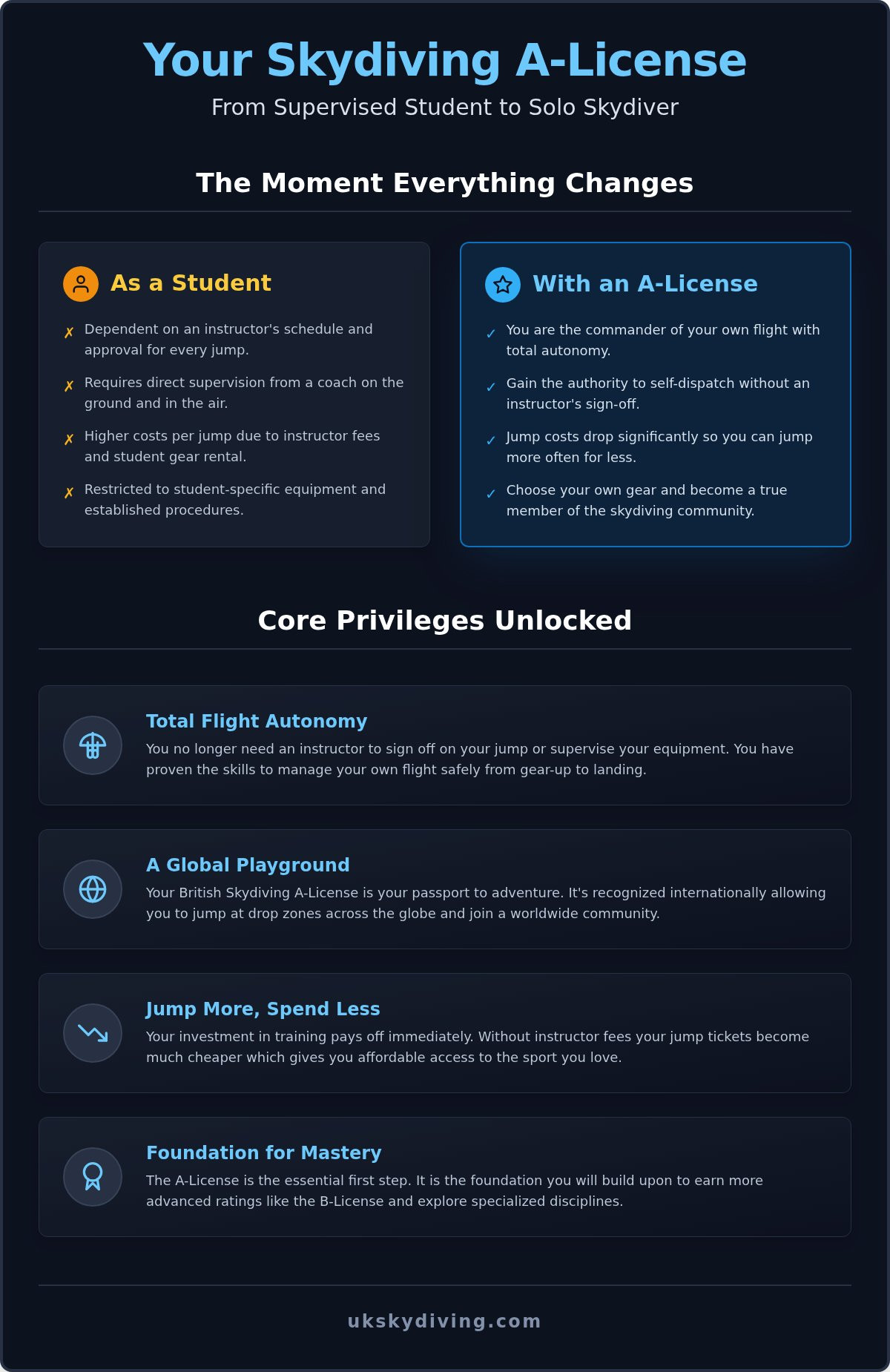
The difference between being on a course and being a qualified jumper is night and day. As a student, you’re dependent on your instructor’s schedule and approval. You wait for them to clear you for every jump. Once you’re licensed, that restriction vanishes. You gain the authority to self-dispatch without an instructor watching your every move on the ground. It’s a massive boost to your confidence and a true mark of your evolution within the sport of parachuting.
Checking the weather becomes a completely different experience. You don’t have to wonder if your instructor thinks it’s okay for a student to go. You look at the clouds, check the wind speeds, and make your own informed decision. There’s also a huge sense of pride in the hangar. You’re part of the “hangar talk” now. You can start looking at your own gear, choosing your own canopy colors, and truly belonging to the community. You’re a skydiver, not just someone who’s learning to skydive.
The ROI of Your AFF Course
When people ask, what can you do with a skydiving a license to justify the effort, the answer often comes down to freedom and finances. Your investment in an learn to skydive program or an Accelerated Freefall (AFF) course pays off the second you qualify. The initial training is an investment in your future self. Once you have that A license, the cost of the sport drops significantly.
The A license is the ultimate reward for your hard work during training. You’re no longer paying for instructor time, intensive supervision, or student gear hire. Jump tickets become much cheaper, which means you can jump more often. Every flight to altitude becomes an affordable thrill rather than a major expense. You’ve put in the hours and the effort. Now, you get to reap the rewards of cheaper access to the most exhilarating experience on Earth.
Core Privileges: What Your British Skydiving A License Actually Allows
Once you’ve cleared your consolidation jumps and the paperwork is signed, your world expands. Many people ask, what can you do with a skydiving a license that you couldn’t do as a student? In the UK, the answer is governed by very specific rules that differ from the American system. Earning your British Skydiving A Licence isn’t just about the glory. It’s about the legal authority to take charge of your own safety and progression. You’re no longer a guest in the sky. You’re a qualified pilot of your own canopy.
The primary benefit is the sheer freedom of solo jumping. You no longer need an instructor to hold your hand or watch your every move. You’ve proven you have the skills to handle emergencies, maintain altitude awareness, and land safely. This license is your official recognition as a competent member of the skydiving community. It opens doors to new drop zones and new experiences that were previously off-limits.
Solo Flight and Self-Dispatch
Self-dispatch is the ultimate sign of respect in the hangar. It means you no longer need an instructor to supervise your equipment checks or sign off every individual jump on the manifest. You are now the pilot in command. This freedom requires a sharp mind and high safety awareness. The community trusts you to know the flight patterns and landing priorities without being told. You’ve proven you can handle the intensity of freefall and the technicality of the landing. It’s a massive responsibility, but it’s also where the real fun begins.
Equipment and Packing Responsibilities
As a student, you likely had someone else pack your parachute. Now, that changes. One of the best perks of your new status is the right to pack your own main canopy. This saves you money on every single jump ticket because you won’t be paying packing fees anymore. It also forces you to understand your gear inside and out. Knowing exactly how your lines are stowed and how your pilot chute is tucked away builds an incredible level of trust in your equipment. You can even start looking at buying your first rig. Owning your own gear is a huge milestone that makes every weekend at the drop zone feel like a professional outing.
Finally, your license is a golden ticket to every British Skydiving affiliated drop zone in the country. You’re no longer tethered to your home base. You can travel to different locations, meet new people, and experience different aircraft. If you’re ready to start this journey, check out our AFF courses to see how we can get you into the air and help you earn these incredible privileges.
Beyond the Home Drop Zone: Traveling with Your License
Your home drop zone is where you learned to fly. It’s where you made your first mistakes and celebrated your first solo landing. But the sky is much bigger than one airfield in Cambridgeshire. Earning your certification is like getting an international driver’s license for the clouds. One of the most exciting answers to the question of what can you do with a skydiving a license is that you can take it almost anywhere in the world. Your logbook is now a record of your travels and a testament to your skills that every jump center will respect.
Traveling with your license turns every holiday into a high-stakes adventure. You’re no longer just a tourist looking at landmarks from the ground. You’re an athlete experiencing the landscape from 15,000 feet up. The social aspect of the sport expands massively as you meet jumpers from different cultures and backgrounds. The bond between skydivers is universal, and your A license is the only introduction you’ll ever need to join the community at a new hangar.
The UK Drop Zone Circuit
The UK has an incredible network of drop zones. Each one has a unique personality and its own stunning views. You might find yourself jumping over the rugged coastline of Devon one weekend and looking down at the rolling hills of Scotland the next. Visiting other UK sites is the best way to sharpen your skills and build your confidence. Every time you land at a new airfield, you’ll undergo a “visiting jumper” briefing. This is a standard safety chat where the local Jump Gurus explain the landing patterns and local hazards. It’s a great way to meet the locals and get a feel for the different vibes in hangars across the country.
International Skydiving Adventures
Once you have your A license, your holiday planning will never be the same again. Forget lying on a beach for a week. You’ll be looking for the nearest drop zone to your hotel. Many UK jumpers head to Spain or the USA during the winter months to keep their skills sharp in the sunshine. Imagine freefalling over the Mediterranean or the vast deserts of Arizona. It’s an incredible way to experience the world. You’ll jump from massive aircraft like Skyvans or twin-engine Otters that offer a completely different exit experience than smaller planes.
Traveling to international “boogies” is the ultimate social experience. These are large-scale skydiving festivals where hundreds of jumpers gather for a week of epic jumps and evening parties. Just remember to check the local regulations before you board the plane. While your British Skydiving license is recognized globally, some countries might require a quick check-out jump with a local instructor. It’s a small price to pay for the chance to see the world from a completely new perspective!
The Path to Mastery: Progression and New Disciplines
Earning your A license is an incredible achievement, but it’s really just the baseline for a lifetime of aerial learning. Many new jumpers ask, what can you do with a skydiving a license once the initial thrill of solo flight becomes second nature? The answer is simple: you start specializing. The sky is vast, and there are dozens of different ways to move through it. From high-speed tracking to graceful canopy work, your journey of discovery is only just beginning. You’re moving from a student mindset to that of a true aerial athlete.
This stage of your career is all about building a solid foundation. You’ll move from being a solo flyer to a disciplined pilot. Specialized coaching becomes your best friend here. Our Jump Gurus at the March drop zone are experts at helping you refine your maneuvers and master canopy control. It’s about moving with intent and precision. Every jump is an opportunity to learn something new about your gear, your body, and the physics of flight. Constant improvement is the name of the game.
Learning to Fly with Others
The next logical step after your A license is the FS1 qualification. This is the “Formation Skydiving” merit that finally allows you to jump with your friends. Up until this point, you’ve been a lone wolf in the sky. Getting your FS1 changes the game entirely. You’ll learn how to approach other jumpers safely, take grips, and build complex formations at 120mph. It’s an electric feeling that completely contrasts with the passive nature of tandem skydiving. Now, you’re an active part of a high-speed team. Building a four-way formation with your mates is a thrill you’ll never forget.
The Road to 200 Jumps
The journey toward your B license is your next major goal. In the UK, this requires a minimum of 50 jumps along with specific canopy handling skills and a written exam. It’s a period of rapid growth where you’ll start to feel truly at home in the air. Many jumpers also set their sights on the legendary 200-jump milestone. This is the point where British Skydiving regulations typically allow you to start wearing a camera. Capturing your own high-definition footage is a massive incentive to keep progressing and staying safe. If you’re ready to take that next step toward mastery, check out our Accelerated Freefall course options to see how we can help you reach these milestones.
Join the Elite: Why Our Cambridgeshire Base is the Perfect Place to Start
Choosing where to begin your journey is the biggest decision you’ll make. At our Cambridgeshire base in March, we don’t just teach you to fall. We welcome you into a family of elite aerial explorers. Our drop zone is specifically designed to be the ultimate launchpad for your skydiving career. Whether you’re coming from London or the Midlands, you’ll find a supportive environment that takes you from your very first jump to that glorious moment you earn your certification. People often ask us, what can you do with a skydiving a license once you’ve trained here? You can do anything! You’ll leave our hangar with the skills, the confidence, and the community backing to conquer any sky in the world.
The community at our March base is incredibly welcoming to new solo jumpers. We know that the transition from a student to a qualified flyer can feel a bit daunting. That’s why we’ve built a culture of inclusivity and encouragement. You’ll find seasoned veterans and fresh A-license holders sharing stories and tips in the hangar. It’s a place where your successes are celebrated and your progression is supported by everyone around you. We provide the perfect platform to launch your new life in the clouds.
Expert Guidance Every Step of the Way
Our instructors are the heart of everything we do. We call them Jump Gurus for a reason. With some of our team boasting over 11,500 jumps, you’re learning from the absolute best in the business. They are dedicated to your success and, above all, your safety in the air. We understand that taking your first solo leap is a massive emotional event. That’s why we focus on building your skills through a structured, reassuring process. You might wonder, is skydiving safe when you’re going solo? Our rigorous training standards and expert oversight ensure you’re always in the best hands. Come visit us in March and see our solo jumpers in action. You’ll feel the energy and the professionalism the second you step onto the airfield.
Start Your Journey Today
The transformation from a tandem passenger to a licensed pro is one of the most rewarding experiences you’ll ever have. It’s a journey of self-discovery that changes how you see the world. You’ll move from being a spectator to a participant in the most exhilarating sport on the planet. Don’t let your dreams stay on the ground. Booking an Accelerated Freefall (AFF) course is the fastest way to get your license and start answering the question of what can you do with a skydiving a license for yourself. Join our community of adrenaline junkies and experience the incredible freedom of the skies. Your new life as a skydiver starts right here. Take the leap and join the family today!
Grab Your Ticket to the Clouds
The sky is no longer a limit. It’s your new home. Earning your certification is a life-altering milestone that turns every weekend into a high-octane adventure. You’ve learned that the answer to what can you do with a skydiving a license is limited only by your own ambition. From self-dispatching at your local drop zone to joining massive international boogies in the sun, the world is now your playground.
You don’t have to face the learning curve alone. Our Cambridgeshire base offers top-rated safety standards and a community that treats every new flyer like family. With expert Jump Gurus who have over 11,500 jumps of experience, we provide a full progression from your first tandem to a confident solo pro. It’s time to stop watching from the ground and start leading the formation.
Are you ready to claim your place among the elite? Book your AFF course and start your solo journey today! The horizon is waiting for you. We’ll see you at the hangar door!
Frequently Asked Questions
Can I jump completely alone as soon as I get my A license?
Yes, you can jump without instructor supervision as soon as you have your A license in hand. This means you are cleared to exit the aircraft and manage your own freefall and landing patterns. You’ve proven you have the safety skills to handle emergencies and navigate the sky alone. It’s an incredible feeling of freedom. While you’re jumping solo, you’ll still be under the overall safety oversight of the Chief Instructor at the drop zone.
Can I wear a GoPro or camera once I have my A license?
No, you generally cannot wear a camera immediately after qualifying. In the UK, British Skydiving regulations typically require a skydiver to have a minimum of 200 jumps before they can fly with a camera like a GoPro. This is a vital safety rule. It ensures you have enough experience to handle your gear and emergency procedures without the distraction of filming your flight. Your focus stays on safety while you build those crucial early skills.
Is the British Skydiving A license recognized in other countries?
Yes, your British Skydiving A license is recognized at drop zones all over the world. It acts as your passport to the global skydiving community. Whether you’re heading to the sunshine in Spain or the vast drop zones in the USA, your qualification proves your competence. You’ll simply show your license and logbook to the local manifest team. They might require a quick safety briefing or a check-out jump to ensure you’re familiar with their local landing patterns.
Do I need to buy my own parachute immediately after getting licensed?
You don’t need to rush out and buy your own gear immediately after qualifying. Most drop zones, including our base in Cambridgeshire, offer high-quality equipment hire for licensed jumpers. This allows you to try different canopy sizes and brands as you progress. It’s often better to wait until you have a bit more experience before investing in your first rig. When you’re ready, the community and our Jump Gurus can offer expert advice on finding the right equipment.
How many jumps do I need to get my A license in the UK?
You need a minimum of 25 jumps to be eligible for a British Skydiving A license. This total includes your initial Accelerated Freefall (AFF) levels and the necessary consolidation jumps that follow. You’ll also need to demonstrate specific skills in the air and land consistently within a designated area. Once you’ve met these requirements and passed a written exam, you can apply for your license and start exploring what can you do with a skydiving a license in the wider world.
Can I jump with my friends if we both have A licenses?
You can’t jump in a formation with your friends just yet. While you are both licensed solo jumpers, you need to earn your FS1 (Formation Skydiving) merit before you can legally take grips in the air. This qualification teaches you how to safely approach other jumpers and maintain your position in a team. It’s the next logical step after your A license. Once you have that sticker in your logbook, the sky becomes a social playground for you and your mates.
How much does it cost to jump once I am a licensed skydiver?
The cost of jumping drops significantly once you’re a licensed pro. You’ll no longer be paying for instructor time or specialized student supervision. Instead, you’ll just pay for your jump ticket to altitude. While prices vary between drop zones, you’ll find that your hobby becomes much more affordable. If you don’t own your gear, you’ll also need to factor in equipment hire and packing fees. It’s a great way to see your hard work during training pay off.
What happens if I don’t jump for a long time after getting my license?
If you take a long break from the sport, you’ll need a refresher jump with an instructor. Skydiving is a skill-based activity, and safety is our top priority. British Skydiving rules have specific currency requirements. If you haven’t jumped in several months, a Jump Guru will take you through a ground briefing and watch your next jump. This ensures your emergency procedures are sharp and your confidence is high before you return to solo flight. It’s a supportive way to get back into the air.
Categorised in: Blog