Latest News
-
 Skydiving as a Confidence Booster: How One Jump Can Change Your Life September 20, 2026
 -
 How to Convince Your Parents to Let You Skydive September 19, 2026
 -
 How to Land a Parachute Safely: A Beginner’s Guide September 18, 2026
 -
 Static Line vs AFF: Choosing Your Path to Solo Skydiving in 2026 September 17, 2026
 -
 Skydiving A License: Your Passport to the Skies September 16, 2026
What to Expect on AFF Level 1: Your First Step to Solo Skydiving in 2026
June 10, 2026 12:00 amThe second you step into the hangar for your first day of training, you stop being a passenger and start being a pilot. It’s an electrifying transition that turns a thrill-seeking hobby into a massive personal accomplishment. While roughly 350,000 people skydive in the U.S. every year according to recent industry data, very few take the leap to fly solo. It’s completely normal to feel a rush of nerves about that transition. You might worry about forgetting your hand signals or feel anxious about landing that canopy by yourself. We understand those fears, and we’re here to help you conquer them. Understanding exactly what to expect on AFF level 1 is the ultimate way to transform that nervous energy into pure, focused adrenaline.
This guide reveals the full roadmap for your most adventurous day yet. We’ll walk you through the entire experience from your morning arrival to that final, triumphant touchdown on the grass. You will learn how two world-class instructors support your every move and how ground school prepares you to ace your exam with total confidence. Get ready to visualize every heart-pounding second of your first solo-style flight. Your journey to becoming a licensed skydiver in 2026 starts right now.
Key Takeaways
- Discover how AFF Level 1 transforms you from a passenger into a pilot in command of your own parachute. This is your first major step toward earning a solo skydiving license.
- Master the technical drills of ground school so you can confidently handle the mechanics of flight. You will learn exactly how your equipment works before you ever leave the ground.
- Get the inside scoop on what to expect on AFF level 1 during the exhilarating exit from 13,000 feet. Visualize the entire process from the aircraft door to your first solo landing.
- Understand the role of your two instructors and the advanced safety gear that ensures a secure experience. Learn how to manage sensory overload and stay focused during the intense rush of freefall.
- Learn how professional video debriefs help you refine your form and prepare for the next level. Reviewing your performance is the key to mastering the skills needed for solo flight.
The Shift to Solo: What is AFF Level 1?
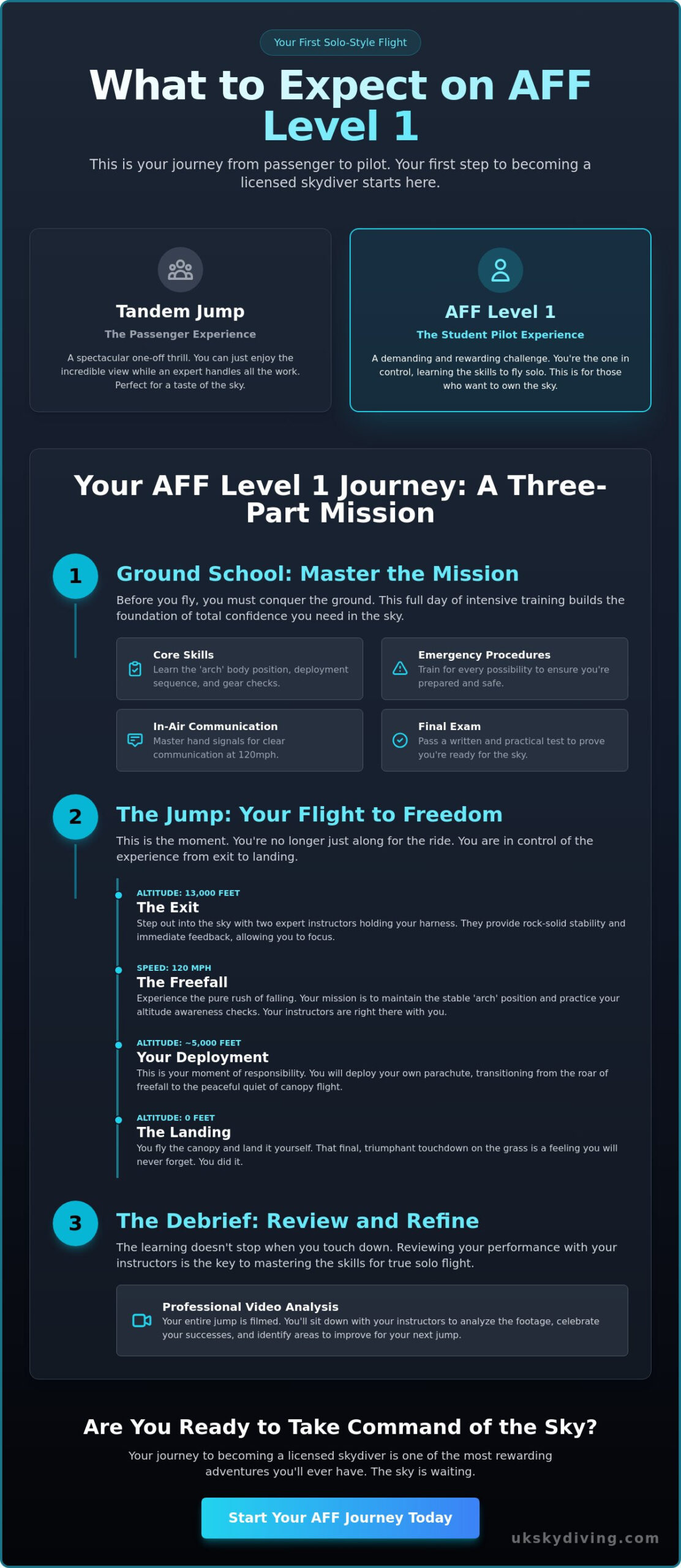
AFF Level 1 is the official launchpad for your journey toward a solo skydiving license. It is a transformative experience that changes how you view the world and yourself. This isn’t just another jump. It is the moment you transition from being a passenger to becoming a student pilot. When you understand what to expect on AFF level 1, you can focus entirely on the thrill of the mission. You are no longer just along for the ride. You are the one in control of the experience.
Unlike a tandem skydive, you are in the driver’s seat from the very beginning. You are responsible for your own parachute deployment and constant altitude awareness. The course pairs a full day of intensive ground school with a high-altitude jump that will stay with you forever. Throughout the freefall, two highly qualified instructors will hold onto your harness. They are there to provide rock-solid stability and immediate feedback. This expert tuition is designed to build your confidence rapidly. It turns that initial nervous energy into focused, professional action.
This training program is the gold standard for anyone serious about the sport. It combines the technical precision of an Accelerated Freefall program with the raw adrenaline of a 13,000-foot exit. You will learn the mechanics of flight, the physics of your parachute, and the emergency procedures that keep you safe. It is a high-stakes, high-reward environment that rewards preparation and courage. Every drill you perform on the ground prepares you for that triumphant moment when you finally leave the aircraft.
Tandem vs AFF: Choosing Your Path
A tandem jump is a spectacular passenger experience. It is perfect for a one-off thrill where you can simply enjoy the view while someone else does the work. AFF is a completely different beast. It is a student pilot experience that demands your full mental engagement. You aren’t just strapped to an expert. You are the expert in training. You must master the drills before you even board the plane. Decide now if you want a momentary rush or if you’re ready for a lifelong hobby that will redefine your limits. AFF is for those who want to own the sky.
Why the Accelerated Freefall Method Works
The beauty of the AFF method lies in its directness. You learn in the actual skydiving environment from day one. There are no half-measures here. You experience the full, heart-pounding sensation of freefall from 13,000 feet on your very first jump. This immersion is why the method works so well. It is the fastest way to gain your British Skydiving ‘A’ license. By jumping with two instructors who provide physical stability, you can focus on your form and altitude. It is the ultimate way to fast-track your skills and join the ranks of licensed solo skydivers.
Ground School: Mastering the Drills Before Takeoff
Before you ever set foot on the aircraft, you must conquer the ground. Ground school is a full day of intensive, high-energy learning that transforms you from an enthusiast into a prepared student pilot. It is an exhilarating day of discovery that sets the stage for your first solo-style jump. This is where the real work happens. You will dive deep into the mechanics of flight and learn exactly how your parachute functions. It is about building a foundation of total confidence. When you know what to expect on AFF level 1, the classroom becomes your training ground for greatness.
Your instructors will focus heavily on the ‘arch’ body position. This is the golden rule of stable flight. You will practice this position on the ground until your muscles remember it perfectly. You will visualize every second of your deployment sequence until it becomes an automatic reflex. Safety is the heartbeat of everything we do. You will receive extensive training on emergency procedures and equipment checks. We follow the highest standards of safety, often looking toward established protocols like the FAA Sport Parachuting Guidelines to ensure every student is equipped with world-class knowledge. The day concludes with a written and practical test. This ensures you are 100% ready for the sky.
Hand Signals and In-Air Communication
Communication changes when you’re falling at 120mph. You can’t speak, so your hands do the talking. You will practice specific signals for ‘arch’ and ‘legs out’ until they are second nature. You will also learn to read your altimeter with lightning speed. Communicating your altitude to your instructors is a vital skill that keeps everyone on the same page during the rush of freefall. If you are ready to start this journey, check out our Accelerated Freefall (AFF) Course options today.
The Parachute Landing Fall (PLF)
Landing is an art form. The Parachute Landing Fall, or PLF, is your safety net for every touchdown. It is a specific technique designed to distribute the impact of landing across your body. You will spend time rolling on the mats and practicing the motion until it is fluid. Mastering the PLF gives you the peace of mind to focus on the flight itself. You will know that you have the skills to land safely and walk away with a massive smile on your face.
The Jump Experience: From Aircraft Exit to Landing
The ride to 13,000 feet is a masterclass in mental focus. As the aircraft climbs, you have about fifteen minutes to perform your final mental rehearsals. This is your time to visualize the exit, the arch, and the deployment. You are no longer just a student. You are a pilot preparing for a mission. The hum of the engine and the sight of the ground dropping away build an incredible sense of anticipation. When you know what to expect on AFF level 1, this ride becomes a calm before the most exhilarating storm of your life. You’ll feel the energy in the plane as everyone gears up for the leap.
When the door opens, the air rushes in with a roar. Stepping into the slipstream at 13,000 feet is the most electrifying moment you will ever experience. Once you are in the air, your training kicks in immediately. You will perform your first ‘circle of awareness’. This involves checking your left instructor, checking your altimeter, and checking your right instructor. This drill keeps you grounded and focused amidst the high-speed rush of the wind. At the designated altitude, you will reach for your ripcord and deploy the canopy yourself. It is a moment of pure, unadulterated power and accomplishment.
The Freefall Phase with Two Instructors
During the freefall, your two instructors are your wings. They provide the physical stability you need to practice your maneuvers with total confidence. They will use the hand signals you perfected in ground school to help you adjust your form in real-time. If you need more arch or need to extend your legs, they will be right there to guide you. Focus on maintaining a relaxed, powerful arch as you fall through the clouds. This phase is intense, but the presence of your world-class instructors ensures you stay safe and stable.
Under Canopy: Your Solo Flight
The moment your parachute opens, the world changes. The roar of the wind vanishes. It is replaced by an incredible, peaceful silence. You are now in control of your own flight path. You will use the radio instructions from the ground to navigate your way back to the dropzone safely. This five-minute descent offers some of the most beautiful views you will ever see. It is a time to breathe and soak in your achievement. For a deeper dive into these sensations, check out our guide on what does skydiving feel like to prepare your senses for the big day.
Safety and Sensory Overload: Managing the Rush
The moment you leave the aircraft, your senses will explode. This sensory overload is a completely normal part of what to expect on AFF level 1. The roar of the wind at 120mph and the infinite horizon can feel overwhelming at first. It’s a massive rush that most people never experience in their lives. However, you aren’t just a passenger caught in the storm. You are a trained student pilot with a clear mission. By understanding that this “brain lock” is a natural physiological response, you can prepare yourself to push through it and perform your drills with precision. It is the ultimate test of your focus and resolve.
Safety is our absolute priority. We follow the strict British Skydiving safety standards to ensure every jump is as secure as it is thrilling. Your equipment is a marvel of modern engineering. Every student rig is equipped with an Automatic Activation Device (AAD). This computerised system is designed to deploy your parachute automatically if you reach a certain altitude at a high rate of speed. It provides total peace of mind so you can focus on the joy of the flight. Your reserve parachute is also a reliable backup plan that is always ready. It’s inspected and packed by certified professionals to ensure it works perfectly every single time. Trusting your gear allows you to embrace the adrenaline without fear.
Managing Performance Anxiety
Many students worry they will forget their hand signals or drills the second the door opens. To combat this, we use the same tools as professional athletes. Deep breathing techniques are vital for keeping your mind sharp during the exit. Taking slow, controlled breaths helps lower your heart rate and keeps you focused. Visualisation is another powerful tool. Spend time before the jump picturing yourself performing the “circle of awareness” flawlessly. Remember that your two instructors are right there beside you. They are experts at handling stability issues and will guide you through every second of the freefall.
The Reliability of Modern Equipment
Trusting your gear is the first step toward a successful solo-style jump. Every piece of equipment undergoes rigorous packing and maintenance standards. We take no shortcuts when it comes to your safety. You can learn more about the facts and statistics in our is skydiving safe breakdown. This transparency helps you build the confidence needed to step out of that plane. If you are ready to face the rush and start your training, book your Accelerated Freefall (AFF) Course with us today and join the elite world of solo skydivers.
The Debrief and What Comes After Level 1
You’ve just touched down on the grass. Your heart is racing. The adrenaline is surging through your veins. This is the moment you’ve worked for all day. But the learning doesn’t stop once your feet are back on solid ground. A massive part of what to expect on AFF level 1 is the professional video debrief that follows your jump. Your instructors record every second of your performance from the exit to the parachute deployment. Watching yourself fly through the air is a surreal and enlightening experience. It turns the high-speed blur of freefall into a clear, technical lesson.
Reviewing the footage allows you to see exactly where your form was perfect and where you can improve. You might notice your legs were a bit too wide or your arch could be deeper. Seeing these details on screen makes the feedback click in a way that words alone cannot. After the debrief, you will receive your official AFF logbook. This is your passport to the skies. It tracks your progress and marks your triumphant completion of the first step. You’ll celebrate this massive achievement with the incredible community at our March dropzone. It’s a place where every jumper, from beginners to veterans, shares in the excitement of your success. The energy in the hangar is infectious and welcoming.
This milestone is a permanent, life-altering memory. You have faced your fears and mastered the basics of solo flight. The sense of accomplishment is unlike anything else on earth. You are no longer someone who just dreams of flying. You are someone who has done it. The path forward is clear and filled with even more excitement. Your journey as a skydiver has officially begun.
Progressing Through the AFF Levels
Level 1 is just the beginning of a spectacular adventure. Level 2 and 3 focus on maintaining your stability with only one instructor holding your harness. This gives you more freedom to feel the air and control your body. You will start to feel the true power of the wind. As you move into the later levels, you will introduce controlled turns and forward movement in freefall. Every single jump is a vital building block. Each one brings you closer to your ultimate goal of becoming a licensed skydiver. You are building the skills of an elite athlete with every exit.
Joining the Skydiving Community
Skydiving is more than just a sport. It is a welcoming global family that spans every continent. When you start your training, you aren’t just buying a service. You are joining a tribe of adventurers. Hang out at the dropzone after your course and swap stories with experienced jumpers. You will learn as much from these conversations as you do in the classroom. The bond formed between skydivers is unbreakable and unique. It is a culture of support, safety, and shared passion. Don’t wait for another day to change your life. Book your AFF Level 1 today and start your journey to the clouds. The sky is waiting for you.
Your New Life Starts at 13,000 Feet
You have just discovered the ultimate blueprint for a total life transformation. From the high-stakes technical drills in ground school to that heart-stopping moment at the open aircraft door, you are now equipped with the vital knowledge of what to expect on AFF level 1. You’ve learned how our expert British Skydiving instructors provide rock-solid stability during your freefall. You’ve also seen how a comprehensive video debrief turns your first flight into a masterclass in solo piloting. This isn’t just about a one-day thrill. It is the official launch of your fast-track solo license program. The sky is no longer a limit. It is your new playground and your massive personal accomplishment.
Stop watching from the ground and start leading the way. Your journey to the clouds is waiting for you right now. Take the leap and join our global family of adventurers. Your future self will thank you for the courage you show today. Ready to fly solo? Book your AFF Level 1 course at our Cambridgeshire dropzone today! We can’t wait to see you in the hangar and celebrate your first solo-style landing!
Frequently Asked Questions
Do I need to have done a tandem jump before starting AFF Level 1?
No, you don’t need any prior experience to start your journey as a solo pilot. Many students choose to dive straight into the Accelerated Freefall (AFF) Course as their very first skydiving experience. It’s an incredible way to fast-track your skills and build confidence from day one. You’ll get all the training you need during ground school to feel completely ready for the sky.
What happens if I fail the ground school test or the first jump?
Don’t worry, our instructors are here to ensure you succeed. If you don’t pass the written or practical test initially, we’ll spend extra time retraining you until you are 100% confident. If your first jump doesn’t go exactly as planned, we use the video debrief to identify improvements. You might simply need to repeat the level to master the skills before moving on to Level 2.
How long does the AFF Level 1 ground school actually take?
Expect to spend a full day in the classroom for your initial training. This usually takes between six and eight hours of intensive, high-energy learning. We cover everything from equipment mechanics to emergency procedures so you know exactly what to expect on AFF level 1. It’s a transformative day that prepares your mind for the thrill of the aircraft exit.
Can I still do AFF Level 1 if I am nervous about heights?
Absolutely, and you certainly won’t be the first person to feel that way! Skydiving feels very different from standing on the edge of a tall building because there’s no ground nearby to provide a sense of scale. Most people find that the exhilaration of the flight completely overrides their initial nerves. Our supportive team will guide you through every step to help you conquer those fears.
What should I wear for my first AFF jump in 2026?
Wear comfortable, weather-appropriate layers that allow for a full range of movement. Choose secure trainers that won’t fly off during freefall. We provide a professional jumpsuit to wear over your clothes to keep you protected and streamlined. Knowing what to expect on AFF level 1 includes being physically prepared, so avoid bulky hoodies or boots with hooks.
Are there weight or age limits for the AFF course in the UK?
Yes, safety regulations require all students to be at least 16 years old. If you are under 18, you’ll need notarized parental or guardian consent to participate. Most dropzones also have a weight limit, typically around 15 or 16 stone, to ensure the equipment functions perfectly. It’s always best to check the specific requirements for our location before you book your training.
What happens if the weather is bad on my scheduled jump day?
Safety is our absolute priority, so we only jump when the conditions are perfect. If the weather is unsuitable, we’ll reschedule your jump for the next available day. Ground school often goes ahead regardless of the clouds, so you can still complete your training and be ready for the first break in the weather. Your booking remains valid until you get into the air.
Do I have to pay for the whole AFF course upfront?
No, you have the flexibility to choose the path that works for you. You can book and pay for AFF Level 1 individually to see if the sport is the right fit. Many students prefer this “pay-as-you-go” approach as they progress through the levels. We also offer full packages for those who are ready to commit to the entire exhilarating journey from the very start.
Categorised in: Blog