Latest News
-
 4 ways to make your first skydive feel more manageable November 10, 2026
-
 What’s the Scariest Part of Skydiving? How Freefall Feels November 9, 2026
-
 Parental Consent for Skydiving and Young Jumpers November 8, 2026
-
 How to Position Your Body and Breathe During Freefall November 7, 2026
-
 Pressure Changes During Skydiving: Why Your Ears Hurt November 6, 2026
The Feeling of Jumping Out of a Plane and What It Costs
October 27, 2026 12:00 amThe biggest surprise is that the feeling of jumping out of a plane can be more like floating than plunging. At around 120 miles per hour, rushing air supports your body, while the aircraft view, the moment of exit and the sudden roar of freefall each bring a different sensation.
It’s natural to wonder about the cost before deciding whether to take the leap. The price depends on the type of jump and any extras, such as video or photo options, and is provided after a quote request. But the experience is about more than the price: the pause at the open door, the rush as you leave the aircraft and the surprising calm that can follow.
Here, you’ll discover what each stage can feel like, how adrenaline and other brain chemicals may shape your emotions, and what influences the cost of a skydive in the UK. If nerves are already kicking in, you’ll also learn why the exit can feel intense without feeling like a stomach-dropping fall.
Key Takeaways
- Find out why the view from the aircraft can make the ground seem strangely far away, and how that may affect your nerves.
- Learn how your body’s stress response can shape the rush of emotion before and after a jump.
- Understand why freefall can feel more like floating than dropping, and what changes your sense of speed.
- See how fear can affect your perception of time during the exit, and what to expect from a tandem jump.
The view from the aircraft before a skydive
At 12,000 feet, the view changes from familiar fields and roads into a patchwork of colour. In a tandem skydive, the aircraft’s climb gives you time to notice the landscape, then the open doorway makes the height feel immediate. After a few thousand feet, distant ground features offer few nearby visual clues for judging how far away you are. That can make the drop seem less tangible than expected.
The aircraft exit can feel intense, but skydivers generally don’t experience it as a stomach-dropping fall. Air supports your body as soon as you leave, creating pressure across your front and limbs. A roller coaster involves sharp changes in direction, while a bungee jump includes a distinct rebound. Skydiving feels more like a strong rush of air and open space. The exact sensation varies from person to person.
Fear of heights is a normal survival response, not proof that you can’t make a first jump. On a tandem skydive, you’re attached to a professional instructor by a harness, and you leave the aircraft together beneath one canopy. Focus on steady breathing and the instructor’s directions. For example, looking towards the horizon may feel less confronting than staring straight down.
UK age and weight limits depend on the operator, while health suitability depends on your circumstances. Share relevant health information before jumping so the operator can assess it against its requirements. Tandem skydiving carries risks, as any parachute jump does. The harness, instructor and shared canopy are part of the tandem arrangement, but they don’t remove the risks.
At 5,000 feet, the parachute is pulled, and the change from freefall to canopy descent is noticeable. The harness supports you as the canopy slows the descent, and the ride becomes quieter. Wear comfortable clothes suited to the conditions, follow the pre-jump briefing and aim for eight hours of sleep the night before. A tandem skydive’s price depends on the jump format, date and optional extras, and is provided after a quote request. Consider any discount only in light of its eligibility and what the booking includes.
Adrenaline, serotonin and dopamine
The aircraft’s climb can build anticipation before the exit, and your body responds to the moment in its own way. Adrenaline, serotonin and dopamine are part of the complex chemistry behind arousal, mood and reward.
Adrenaline and Physical Arousal
Adrenaline is a hormone released into the bloodstream when your body responds to a perceived threat. During a skydive, that response can bring a pounding heartbeat, sharper alertness and faster breathing. These sensations are physical arousal, not a reliable measure of danger. Knowing the difference can help you recognise nerves as your body preparing for an intense experience, rather than proof that you can’t continue.
Adrenaline and Thrill-Seeking
Thrill-seeking is the appeal of intense experiences that combine excitement with uncertainty. Adrenaline contributes to the body’s response, while your expectations and interpretation help shape whether the rush feels frightening or exhilarating. For example, the same racing heartbeat might feel unsettling during a stressful event but exciting during an adventure you’ve chosen. That contrast helps explain why people can feel nervous before a jump and energised afterwards.
Dopamine is associated with motivation and reward, while serotonin is involved in mood regulation. Neither chemical alone explains how a skydive feels. Your emotions also reflect the situation, your expectations and how your body responds. As the aircraft climbs, anticipation can intensify. At the exit, your focus may narrow to the instructor’s directions and the sensations around you.
After landing, some people describe a rush of euphoria that lasts for the rest of the day. That feeling may involve the memory of facing a fear, the excitement of the jump and the body settling after intense arousal. It isn’t the same for everyone. Noticing your own response, from nerves in the aircraft to relief on the ground, can help you understand what made the experience powerful.
If you’re considering a first jump, explore ways to prepare for a tandem skydive and think about what would help you feel ready.
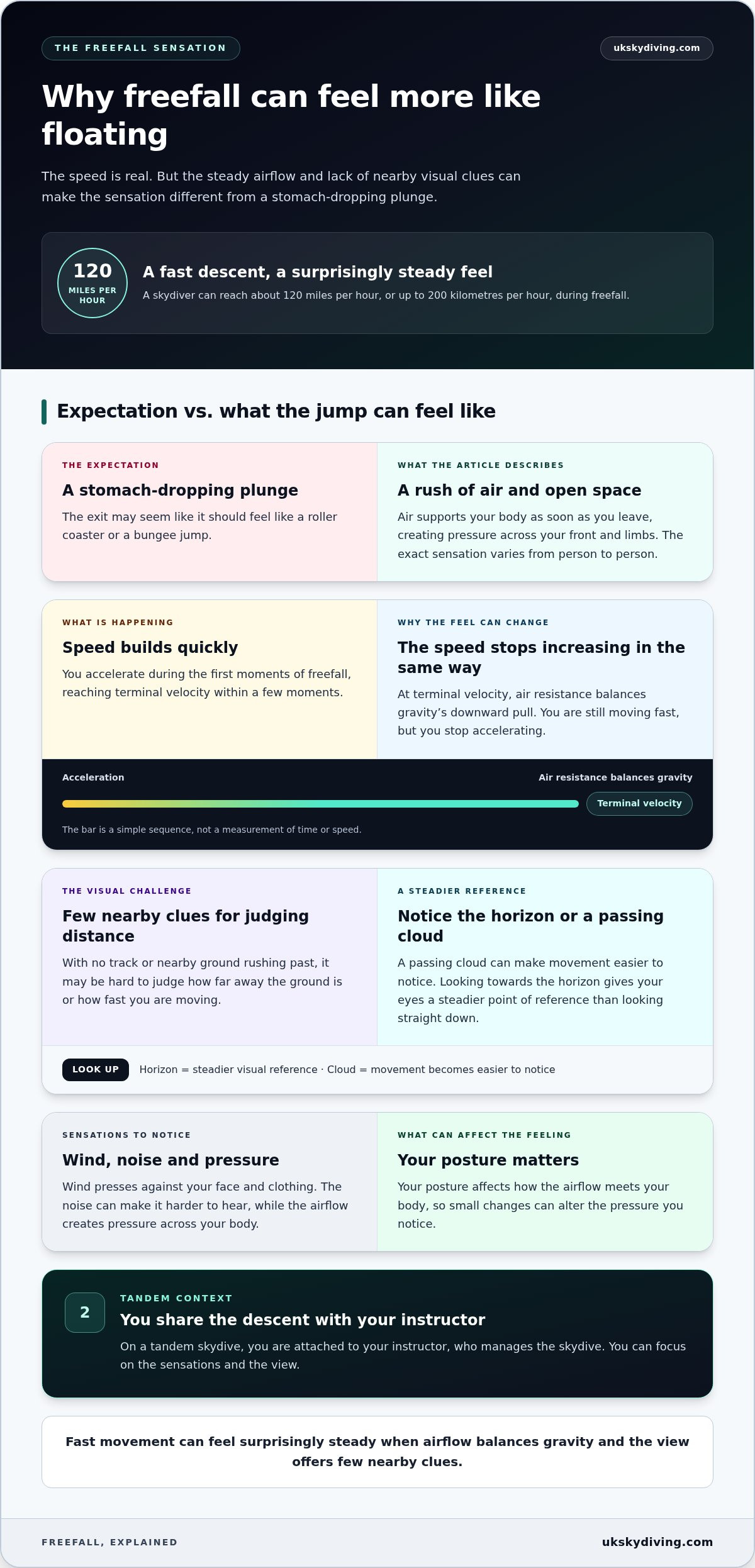
The floating sensation during freefall
Freefall can feel less like a plunge and more like being held in a powerful stream of air. On a tandem skydive, you’re attached to your instructor, so you share the descent while the landscape moves below.
What does freefall feel like during a tandem skydive? The first moments bring a rush of wind, noise and pressure across your body. Once the airflow feels steady, some people describe the sensation as floating, even though they’re travelling rapidly downwards.
A skydiver can reach about 120 miles per hour, or up to 200 kilometres per hour, during freefall. The speed builds quickly, then reaches terminal velocity within a few moments. At that point, you stop accelerating because air resistance balances gravity’s downward pull. Your body is still moving fast, but the speed no longer keeps increasing in the same way.
That balance helps explain why freefall doesn’t necessarily feel like a roller-coaster drop. There’s no track or nearby ground rushing past to provide an obvious reference for speed. A passing cloud can make your movement easier to notice. Looking towards the horizon can also give your eyes a steadier point of reference than watching the ground directly below.
Other sensations come from the air itself. Wind presses against your face and clothing, while the noise can make it harder to hear. Your posture affects how the airflow meets your body, so small changes can alter the pressure you notice. On a tandem jump, the instructor manages the skydive while you’re attached, leaving you free to focus on the moment and take in the view.
Freefall is brief compared with the whole jump, but the combination of speed, wind and open space can make it feel vivid. Some people notice excitement first, while others need a moment to settle into the sensation. As the parachute opens, the fast, noisy rush gives way to a slower descent beneath the canopy.
The experience of exiting the plane
The exit is a sudden shift from the aircraft’s enclosed cabin to open air. One moment, you’re hearing the engine and following instructions. Then the doorway fills your view, and wind and noise take over. Nothing about that transition feels ordinary. For a first-time tandem jumper, the contrast can make the doorway feel like the most intense part, even before freefall settles into a steady rush.
Fear can also change how long that instant seems to last. In a skydiving study, jumpers who felt more fear and stress perceived time as passing more slowly. A brief exit may therefore feel stretched out, especially if your attention fixes on the aircraft door or the ground. That altered sense of time is a perception, not a sign that the jump has slowed.
At the doorway, several sensations arrive together: engine noise, rushing air, height and the instructor’s movements. Your attention may jump between them. For example, you might first notice the open space, then focus on a spoken instruction. This rapid shift can make the exit seem like a blur afterwards, even if it felt vivid in the moment.
A simple focus can help you respond to that intensity. Breathe steadily, relax your body and smile rather than repeatedly telling yourself to be scared. Listen for the instructor’s directions and let each cue guide your attention. These actions won’t erase nerves. They give your mind something specific to do instead of replaying the same worry as the aircraft approaches the exit.
The key takeaway is that the doorway can feel more dramatic than the freefall that follows. Your view, the noise, your expectations and stress all shape how you experience those first seconds. If you’re ready to turn that anticipation into a real jump, explore your first skydive and learn what the experience involves.
UK Skydiving: Tandem Skydive Experience
UK Skydiving’s Tandem Skydive Experience gives beginners a way to experience the aircraft exit and freefall while securely harnessed to a professional instructor. The jump takes place from up to 13,000 feet, bringing the sensations described above into a real skydive, with an instructor alongside you throughout the jump.
A tandem skydive is a fitting option if you want to try skydiving without pursuing solo training. If your interest grows into learning to jump independently, UK Skydiving also offers an Accelerated Freefall (AFF) Course. Charity Jumps and Video and Photo Packages offer other ways to take part or remember the experience.
To explore the Tandem Skydive Experience or discuss your next step, contact UK Skydiving or visit ukskydiving.com.
Make your next step your own
The feeling of jumping out of a plane is personal, and deciding to try it is personal too. Give yourself space to think about what you want from the experience: a bold first adventure, a challenge to work towards, or a meaningful way to support a cause. That intention can help you choose a next step that feels right for you.
Cost matters, but it’s only one part of the decision. Consider what you hope to remember afterwards and whether you’d like to capture the experience. There’s no need to wait until every nerve disappears. A little nervousness can sit alongside excitement, and taking time to understand the experience can help turn uncertainty into a clear choice.
UK Skydiving can help you explore the options that match your goals. Contact UK Skydiving to ask about jumping, and take the next step when you’re ready.
Frequently Asked Questions
What does it feel like to jump out of a plane for the first time?
A first jump can feel like a quick shift from anticipation to intense sensory overload. You may notice the aircraft noise, rushing air and your instructor’s directions before taking in the wider view. The feeling of jumping out of a plane isn’t identical for everyone. Afterwards, a useful way to recall it is to note which moment stood out most, such as the exit, freefall or canopy ride.
How long does freefall last on a typical tandem skydive?
Freefall duration varies with the jump’s exit altitude and when the parachute is deployed. One tandem skydive example included about 45 seconds of freefall, which gives a sense of how brief this part can be, but it isn’t a fixed duration for every UK jump. Ask about the planned jump profile when comparing experiences, rather than assuming every skydive has identical freefall time.
What happens during a UK tandem skydive, step by step?
A UK tandem skydive follows a sequence from preparation through landing. A beginner is securely harnessed to a professional instructor for a jump from up to 13,000 feet.
- Take part in the ground briefing and get ready for the jump.
- Board the aircraft and climb to the jump altitude.
- Exit attached to the instructor, who manages the jump.
- Freefall together, then descend beneath one canopy.
- Follow the instructor’s landing directions and return to the ground.
What are the risks of tandem skydiving and how safe is it?
Tandem skydiving carries risks, as any parachute jump does; being attached to a professional instructor under one canopy does not remove them. Share relevant health information with the operator so they can assess your suitability, and follow the pre-jump briefing and instructor’s directions.
Categorised in: Blog