
Latest News
-
 Skydiving as a Confidence Booster: How One Jump Can Change Your Life September 20, 2026
 -
 How to Convince Your Parents to Let You Skydive September 19, 2026
 -
 How to Land a Parachute Safely: A Beginner’s Guide September 18, 2026
 -
 Static Line vs AFF: Choosing Your Path to Solo Skydiving in 2026 September 17, 2026
 -
 Skydiving A License: Your Passport to the Skies September 16, 2026
Skydiving Weather: Your Ultimate Guide to Perfect Jump Conditions
January 20, 2026 12:00 amYou’ve booked the adventure of a lifetime. The countdown is on, the adrenaline is building, and you’re ready to fly! But there’s one big question mark hanging in the air: the weather. We get it. The fear of a last-minute cancellation or a wasted journey to the dropzone is real. You might look outside, see a bit of blue sky, and wonder why a jump is put on hold. The truth is, perfect skydiving weather is about much more than just a lack of rain, and your safety is our absolute guarantee.
This is your ultimate guide to the skies! We’re pulling back the curtain to show you exactly what our highly skilled team looks for-from wind speeds at 13,000 feet to invisible cloud cover-to ensure your experience is extraordinary. You’ll understand why a beautiful day on the ground doesn’t always mean it’s jump time. And if the forecast isn’t perfect? We’ll walk you through our simple, stress-free process, so you feel confident, prepared, and ready for the ultimate thrill, no matter what.
Why Weather is the Ultimate Boss in Skydiving
When you’re preparing for the ultimate thrill of a lifetime, the last thing you want is a delay. But in the world of skydiving, there’s one force that has the final say: the weather. We don’t see this as an inconvenience; we see it as our most critical safety partner. At UK Parachuting, our philosophy is simple and non-negotiable: Safety First, Always. Understanding the nuances of skydiving weather is the first step in guaranteeing your jump is not just breathtakingly exciting, but also impeccably safe. Your enjoyment and our safety protocols are two sides of the same coin.
It’s a common question: “The sun is out and commercial planes are flying, so why can’t we jump?” The answer is that skydiving has far stricter requirements than commercial aviation. We don’t just assess the conditions on the ground; our expert team analyses the entire atmospheric column you’ll be flying through, right up to 13,000 feet. This ensures every phase of your extraordinary adventure, from exit to landing, is managed within our rigorous safety limits.
It’s Not Just About Rain or Shine
Perfect jump conditions are more complex than a blue sky. We constantly monitor three main factors: wind, clouds, and rain. A beautiful, sunny day on the ground can hide dangerously high winds at altitude that would make a stable freefall and a safe canopy ride impossible. Similarly, low cloud cover can obscure the landing area, which is a clear no-go. Conditions can change in a matter of minutes, which is why our monitoring is continuous throughout the day.
Your Instructor’s Expert Judgement
While we use advanced forecasting tools, the final decision always rests with our highly experienced instructors. These professionals have thousands of jumps under their belts in all kinds of conditions and are experts at reading the sky. We will never, ever compromise your safety for a jump. The risks associated with skydiving in poor weather are significant, and our commitment is to provide an exhilarating-and completely safe-experience. If we have to wait for the perfect window, it’s because we want to give you the ultimate adventure you deserve.
The ‘No-Go’ Conditions: Wind, Clouds, and Rain Explained
Your safety is our absolute, number one priority. While we live for the thrill of the jump, we will never compromise on the conditions required for a safe and extraordinary adventure. Understanding the key factors that make for good or bad skydiving weather helps you know what to expect on the day. If we have to postpone a jump, it’s because we are dedicated to giving you the ultimate experience, and that means waiting for the perfect window in the sky. Let’s break down the three main ‘no-go’ conditions.
The Power of Wind: Ground vs. Altitude
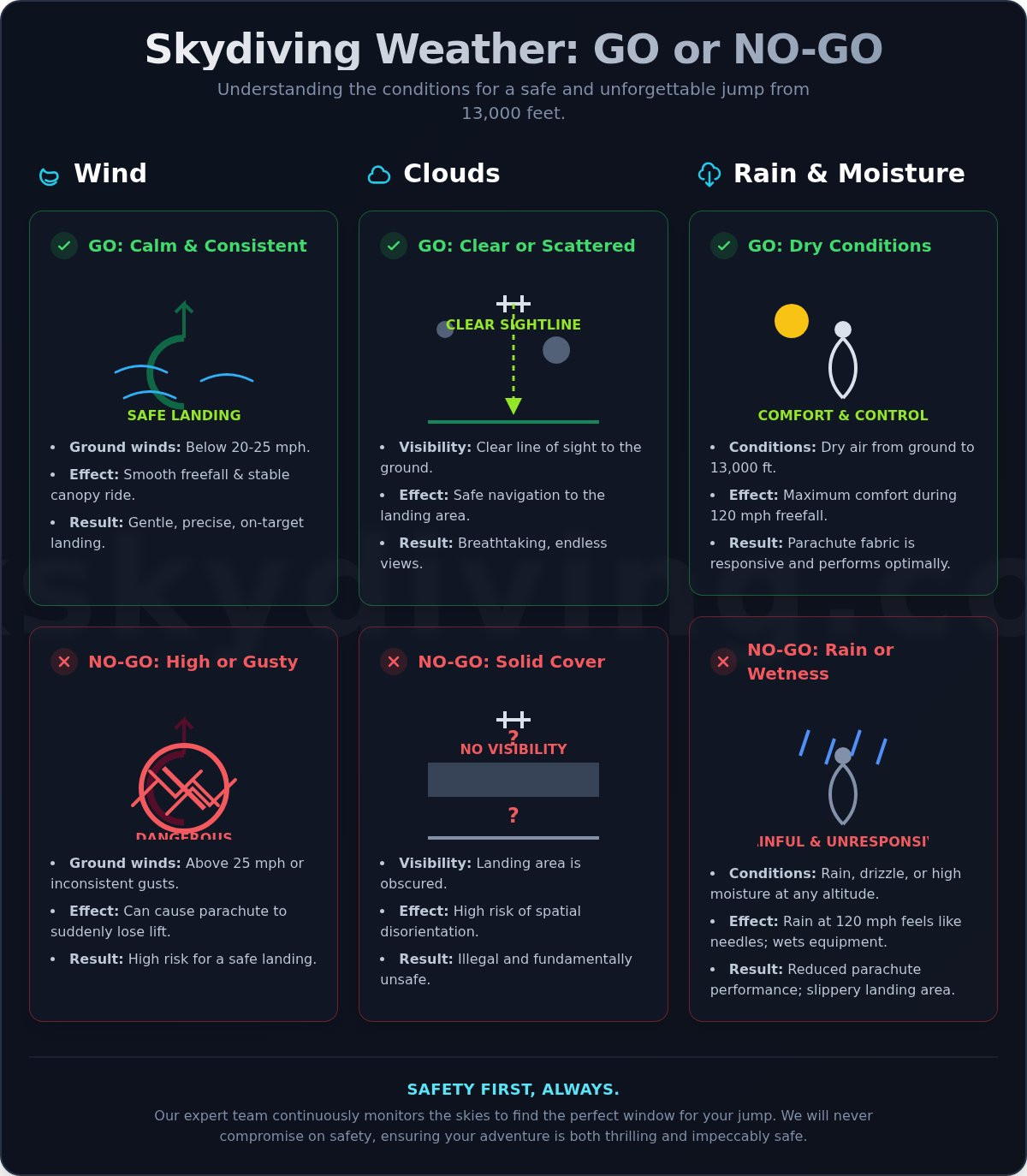
Wind is a huge factor in skydiving, but it behaves differently at 13,000 feet than it does on the ground. While our pilots and instructors account for winds at altitude, it’s the ground wind that is most critical for a soft, safe landing. For tandem students, we typically look for ground winds to be below 20-25 mph. More important than speed is consistency; gusty winds are particularly dangerous as they can cause a parachute to suddenly lose lift close to the ground. This isn’t just our rule; official sources like the FAA weather guidelines highlight the risks. Rest assured, our highly experienced instructors are masters of reading the wind and will only proceed when conditions are ideal for your landing.
Cloud Cover: Why We Need to See the Ground
A beautiful blue sky is the perfect backdrop for your jump, but cloud cover is about more than just pretty pictures. Legally and for safety, we cannot jump through a solid layer of clouds. We need a clear line of sight to the ground to effectively navigate back to the designated landing area. Jumping through thick clouds can cause serious spatial disorientation for both the instructor and student. Think of it this way: you would never drive a car blindfolded, and we won’t fly you through the sky without being able to see where we are going!
Rain and Moisture: More Than Just Getting Wet
What might feel like a light drizzle on the ground feels very different when you’re falling at 120 mph-it’s more like being hit by thousands of tiny needles! Beyond the discomfort, rain poses a significant safety risk. Moisture makes the parachute material heavier and less responsive, affecting its handling and performance. Furthermore, a wet landing area can be slippery and unsafe. Even if it’s not raining on the ground, moisture or light rain at altitude is enough to postpone the jump. Your comfort and safety are paramount, from the moment you exit the plane to your triumphant landing.
The Anatomy of a Perfect Jump Day
After the patient waiting, the moment the sky clears is pure magic. This is the reward. This is what our highly skilled team looks for when they give the final, exhilarating green light. It’s not just about safety; it’s about giving you the most breathtaking, unforgettable experience possible. When the skydiving weather is perfect, every part of your adventure is amplified into something truly extraordinary.
Clear Skies and Endless Views
Imagine ascending to 13,000 feet with nothing but crisp, clear air around you. The view is simply intoxicating. On a perfect day, you’ll see the stunning patchwork of Cambridgeshire’s fields and countryside stretching out to the horizon. While a solid cloud layer is a no-go, light, scattered clouds are perfectly fine and often make the view even more spectacular. Our instructors adhere to strict visibility standards, similar to the USPA skydiving weather regulations, ensuring you have a safe and awe-inspiring backdrop for your jump. This incredible visibility turns a great skydive into a memory you’ll treasure for a lifetime. Ready for that view? Book your jump!
Calm and Consistent Winds
Ideal skydiving weather includes calm and predictable winds. In the air, this translates to a beautifully smooth and stable freefall, allowing you to fully embrace the mind-blowing sensation of flying at over 120 mph. During the canopy ride, it means a serene and controlled flight back to earth. Our expert instructors use these conditions to guide the parachute with precision, setting you up for a gentle, on-target landing right in our dropzone. A light breeze is often perfect, helping to create a soft, stand-up landing.
Comfortable Temperatures on the Ground and in the Air
It’s true that it gets colder the higher you go-the temperature typically drops by about 3°C for every 1,000 feet of altitude. But don’t worry about feeling the chill during your freefall! The sheer adrenaline rush of the experience is a powerful internal furnace that will keep you warm. We always advise dressing in comfortable layers for your day with us. This allows you to stay comfortable on the ground and be perfectly prepared for the temperature at altitude, ensuring nothing distracts you from the ultimate high.
Behind the Scenes: How We Make the Weather Call
We know you’re buzzing with anticipation, and the big question is always about the weather. Will your jump go ahead? While we can’t control the clouds, we can guarantee a professional, meticulous process for making the call. Your safety is the launchpad for your adventure, and our expert team makes the final decision with one goal in mind: giving you the ultimate, safest thrill possible. This is how we do it.
Constant Monitoring, Multiple Sources
Forget the standard weather app on your phone. Our team operates on a different level. We use advanced, professional-grade aviation weather forecasts to get the real picture. Your jump day comes onto our radar 48-72 hours in advance, and we begin our detailed analysis using a range of specialist tools:
- The Met Office: Detailed aviation-specific forecasts for the UK.
- Windy.com: Advanced modelling for wind speeds at different altitudes.
- Live Airfield Data: Real-time information from local and regional airports.
This constant monitoring gives us a deep understanding of developing weather patterns, long before you even pack your bag.
The Morning of Your Jump
The day begins early at the dropzone. First thing, our Chief Instructor-one of the most experienced skydivers in the country-makes an initial assessment. They analyse live satellite and radar imagery, cross-referencing it with data from our very own on-site weather station. If the conditions are clearly unsuitable for the entire day (for example, persistent high winds or heavy rain), we promise to contact you as early as we possibly can to reschedule your extraordinary experience.
On-Site, Real-Time Assessment
Weather can be incredibly localised. It might be pouring with rain 20 miles away while our airfield is bathed in sunshine! That’s why the final decision on the day’s skydiving weather is always made right here, in real-time. Throughout the day, we’re constantly assessing the sky. We may send up pilot balloons to check the upper-level winds or even have an experienced instructor perform a test jump. This hands-on approach means that even if we start on a ‘weather hold’, things can change fast. Patience is key, as a brief pause often leads to a perfect window for your jump!
Making the right call on the conditions is our most critical responsibility. You can be confident that our highly skilled team is using the best information and decades of experience to ensure your jump is nothing short of breathtaking. When you jump with UK Parachuting, you’re in the safest hands.
What Happens if Your Skydive is Postponed? (The Good News)
We get it. You’ve been counting down the days, your adrenaline is pumping, and the last thing you want to hear is that your jump is on hold. But here’s the good news: a postponement isn’t a cancellation. It’s a promise. It’s our commitment to ensuring your first flight is not just safe, but absolutely spectacular. We would rather reschedule you for a day with blue skies and breathtaking views than send you up in anything less than perfect conditions.
Our Promise: You WILL Get to Jump
Let’s be crystal clear: a weather delay is a raincheck, not a rejection. Your adventure is waiting for you, and we guarantee you’ll experience it. If we make the call to postpone due to poor skydiving weather, you can reschedule for a new date completely free of charge. Your payment is 100% safe and will simply be applied to your new booking. We are as excited as you are for you to take this leap, and we will make sure it happens on a day you’ll remember for a lifetime.
The Simple Rescheduling Process
We make rearranging your jump as easy and stress-free as possible. There are no hoops to jump through, just a simple, clear process to get you back in the calendar for your extraordinary experience.
- We Contact You: If we need to postpone jumps, our team will contact you directly via phone or text with as much notice as possible.
- Easy Rebooking: You can reschedule your jump in minutes by calling our friendly team or rebooking yourself online.
- Peace of Mind: Your voucher or booking will remain valid for a full 12 months, giving you plenty of time to find another perfect day to fly.
Making the Most of a ‘Weather Hold’
Sometimes, the forecast is marginal, and we may go on a temporary ‘weather hold’. This doesn’t mean the day is a write-off! Conditions can change in an instant. We often encourage jumpers to come to the dropzone, as a cloudy morning can break into a perfect afternoon. While you wait, you can soak up the electric atmosphere, watch our experienced teams in action, and meet the instructors who will be guiding your journey. The buzz of the dropzone is an experience in itself! Have questions? Contact our team anytime!
Ready for Blue Skies and the Ultimate Thrill?
Now you see why weather is the ultimate boss in our world! Mastering the essentials of skydiving weather isn’t about being a meteorologist; it’s about respecting the sky to guarantee your jump is nothing short of extraordinary. The key takeaway is simple: your safety is our absolute priority. While we aim for those perfect, crystal-clear days, a weather hold is never a ‘no’-it’s just a ‘not yet’. It’s our commitment to giving you the breathtaking, intoxicating experience you deserve, under the safest possible conditions.
Our expert instructors make the final, trusted call, so you can focus on the excitement. And if the clouds do roll in? Don’t worry. We offer free and easy rescheduling for all weather cancellations, ensuring your adventure is always waiting for you. The ultimate high is just a clear sky away, and we’ll be here to make it happen.
Ready for the ultimate thrill? Book your skydive with confidence!
Frequently Asked Questions About Skydiving Weather
What’s the best time of year to skydive in the UK?
The peak season for the ultimate thrill in the UK is from late spring to early autumn. The summer months of June, July, and August offer the longest days and the best chance of clear skies for that breathtaking view. However, crisp, beautiful jump days are also common in April, May, and September. It’s all about finding that perfect window to experience the ultimate high, and the warmer months give us the most opportunities to fly!
Can you skydive in the winter? Is it too cold?
Absolutely! Winter skydiving is an extraordinary and crisp experience. While it’s certainly colder at altitude, we’ll make sure you’re properly kitted out with a jumpsuit and gloves to wear over your warm layers. The views can be stunningly clear on a bright winter’s day. Don’t let the season stop your adventure; if the conditions are safe for jumping, we are ready to fly. It’s a different kind of thrill, and it’s spectacular!
Why do commercial planes fly when you can’t skydive?
This is a fantastic question that highlights our commitment to your safety. Commercial airliners fly high above the clouds, often at 35,000 feet, using complex instruments to navigate. We fly much lower, right in the heart of the action! For a safe and breathtaking skydive, our highly experienced pilots and instructors must have clear visual contact with the ground and the landing area at all times. Your safety is our ultimate priority.
Should I call the dropzone before I leave home on my jump day?
Yes, we always recommend it! The British weather can be unpredictable, and conditions at the dropzone can change rapidly. Giving our team a quick call before you set off is the best way to get the latest, most accurate forecast for the airfield. This simple check can save you a journey and ensures you’re fully prepared for your day of adventure. We’re here to help make your experience as smooth as possible from start to finish.
What is a ‘weather hold’ and how long does it usually last?
A ‘weather hold’ is a temporary pause in our jump operations for safety reasons, such as high winds or low clouds. Our highly skilled staff are constantly monitoring the conditions, waiting for a safe window to get you in the air. A hold can last anywhere from thirty minutes to a few hours. We know the wait can be tough, but it’s our guarantee that when you do jump, the conditions are right for an amazing and safe experience.
If the weather is bad, can I get a full refund instead of rescheduling?
Because we cannot control the skydiving weather, our standard policy is to reschedule your adventure for another day that suits you, ensuring you don’t miss out on this life-changing thrill. Deposits are typically non-refundable as they secure your slot and cover administrative costs, but the value of your jump will be waiting for you. Please check our full terms and conditions or speak with our team for specific details about your booking.
Does fog affect skydiving in the same way as clouds?
Yes, it absolutely does. Think of fog as a cloud that’s sitting right on the ground! Just like low clouds, fog severely restricts the visibility our pilots and instructors need to operate safely. For you to have that breathtaking, intoxicating experience of a lifetime, we must have a clear view of the landing area from jump altitude. If we can’t see the ground from the plane, we simply won’t fly. Your safety is always paramount.
Categorised in: Uncategorized