
Latest News
-
 Skydiving as a Confidence Booster: How One Jump Can Change Your Life September 20, 2026
 -
 How to Convince Your Parents to Let You Skydive September 19, 2026
 -
 How to Land a Parachute Safely: A Beginner’s Guide September 18, 2026
 -
 Static Line vs AFF: Choosing Your Path to Solo Skydiving in 2026 September 17, 2026
 -
 Skydiving A License: Your Passport to the Skies September 16, 2026
Skydiving Parachute Failure: What Really Happens & Why It’s So Rare
February 6, 2026 12:00 amLet’s talk about the elephant in the room. The one thought that might be holding you back from the adrenaline rush of a lifetime: what happens if the parachute doesn’t open? The fear of a skydiving parachute failure is completely normal, often amplified by dramatic movie scenes that have little to do with reality. But here’s the secret the films don’t show you: modern skydiving is an extraordinarily safe adventure, meticulously engineered with multiple layers of protection.
We’re here to tackle that fear head-on. This isn’t about ignoring the risk; it’s about understanding it. In this guide, we’ll demystify what a “failure” really means, reveal the incredible backup systems built into every single parachute rig, and show you why our highly skilled instructors are absolute experts at managing these extremely rare events. It’s time to replace fear with facts, so you can feel confident, prepared, and ready to experience the ultimate high!
Key Takeaways
- Forget the Hollywood drama! Discover what a parachute ‘malfunction’ truly is and why it’s a calm, manageable situation, not a catastrophe.
- Understand the incredible triple-redundancy safety system built into every single skydiving rig, including a primary and a reserve parachute.
- See how our highly skilled instructors drill for these scenarios, turning a potential problem into a routine, well-rehearsed procedure.
- Get the real statistics on just how rare a skydiving parachute failure is, and let the data put your biggest fears to rest for good.
Demystifying Parachute ‘Failure’: It’s Not Like the Movies
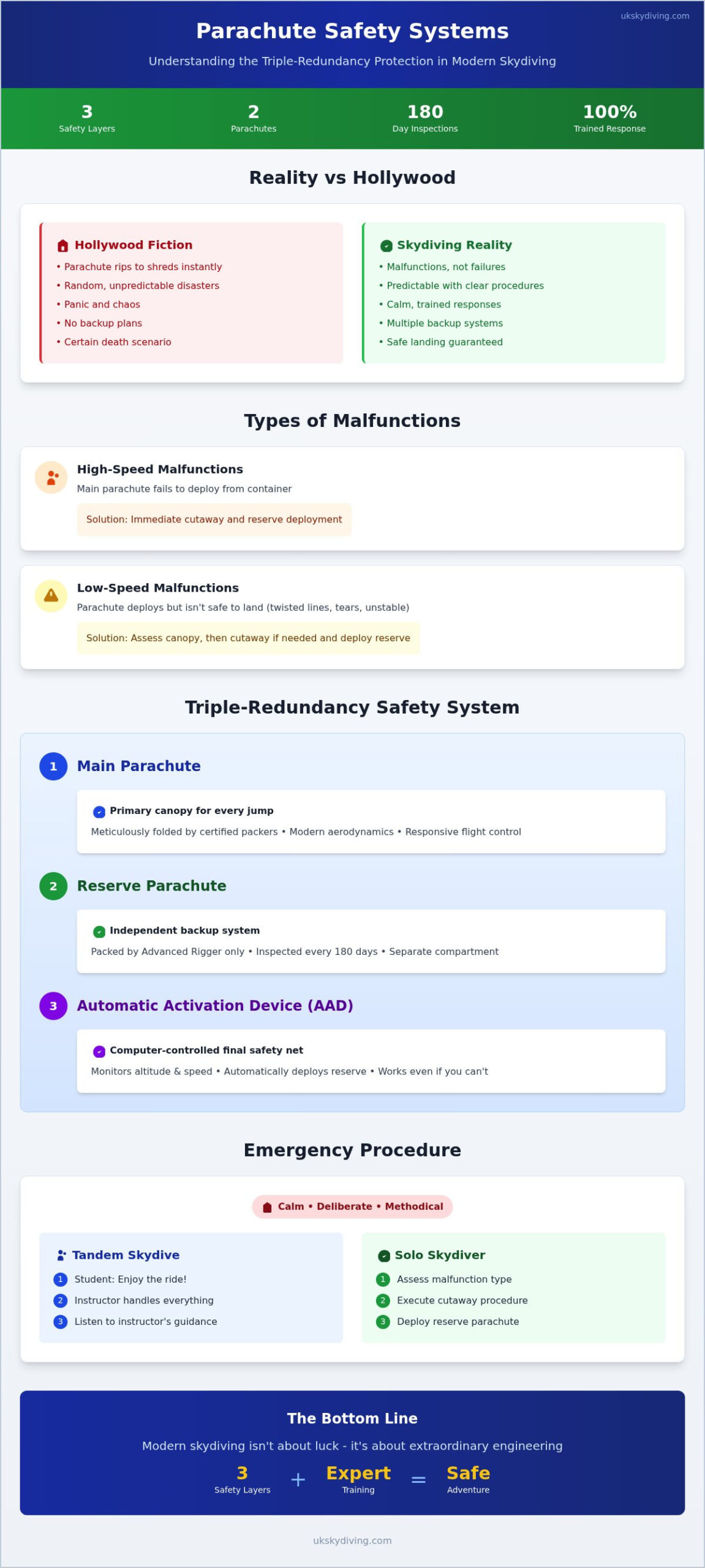
Forget everything you’ve seen in action films. The heart-stopping image of a parachute instantly ripping to shreds mid-air is pure Hollywood fiction, designed for drama, not reality. In the world of skydiving, we don’t talk about catastrophic ‘failure’; we talk about ‘malfunctions’. And there’s a world of difference.
A malfunction isn’t a random, unpredictable disaster. It’s a predictable issue with a clear, rehearsed procedure to solve it. Our highly skilled instructors and every trained skydiver know these procedures inside and out. The goal is always to have a perfect, square, and stable canopy overhead, but the backup plan isn’t chaos-it’s deploying a canopy that is ‘good enough’ to land safely. The perceived drama of a skydiving parachute failure is replaced by calm, decisive action.
Every skydiver is equipped with two parachutes-a main and a reserve. Malfunctions are broadly categorised into two types, each with its own immediate solution.
High-Speed Malfunctions
This is the most critical type, but also the most straightforward to resolve. A high-speed malfunction occurs when the main parachute fails to deploy from its container at all. Think of it like a stuck zipper on a bag-the contents are fine, but you can’t get them out. This is precisely what our emergency procedures are designed for. The solution is immediate and decisive: cut away the main and deploy the reserve parachute.
Low-Speed Malfunctions
Here, the main parachute has deployed from the container but isn’t safe to land. It could have severe line twists, a tear in the fabric, or an unstable shape that prevents you from steering. While this might sound alarming, it’s not a panic situation; it’s a decision situation. The skydiver assesses the canopy, and if it’s not controllable, they follow the same procedure: cut away the faulty main and fly the reserve. There are several types of parachute malfunction in this category, all of which are covered extensively in training.
The Triple-Redundancy Safety System in Every Rig
Forget everything you’ve seen in the movies. Modern skydiving isn’t about luck; it’s about extraordinary engineering and meticulous preparation. Every single skydiving rig is a masterpiece of safety, built with not one, not two, but three layers of protection. This triple-redundancy system is the cornerstone of our sport, transforming a potential skydiving parachute failure from a crisis into a manageable, trained-for procedure. This relentless focus on safety is precisely why skydiving safety statistics consistently show how safe the sport has become.
This system is your guarantee, allowing you to let go and embrace the pure, intoxicating thrill of freefall. Let’s break down your three guardian angels.
Safety Layer 1: The Main Parachute
This is your primary canopy, the workhorse of every single jump. It’s not just thrown into a bag; it is meticulously folded and packed by a certified British Skydiving packer or rigger. These parachutes are marvels of modern aerodynamics, designed for comfortable, soft openings and incredibly responsive flight, allowing you to soar through the sky with grace and control before a gentle landing. It’s your ticket to an unforgettable ride.
Safety Layer 2: The Reserve Parachute
Tucked away in a separate compartment of your rig is your backup plan: a second, completely independent parachute. This isn’t just a spare; it’s a life-saving device packed under the most stringent conditions. Only a highly-certified Advanced Rigger is permitted to pack a reserve, and it must be inspected and repacked every 180 days by law-even if it has never been used. It’s always ready, always reliable, and waiting in the wings just in case.
Safety Layer 3: The Automatic Activation Device (AAD)
This is the ultimate safety net and a true game-changer in skydiving safety. The AAD is a small, incredibly sophisticated computer that acts as your personal guardian angel. It constantly monitors your altitude and descent speed. If it detects that you are still in freefall at an unsafe altitude-meaning you haven’t deployed a parachute-it will automatically fire and deploy your reserve parachute for you. It’s a final, decisive layer of protection that works even if you can’t.
The Procedure: What Happens During a Malfunction?
Forget the Hollywood-style panic. In the world of modern skydiving, a parachute malfunction is not a surprise; it’s a scenario we train for relentlessly. The thought of a skydiving parachute failure can be daunting, but the response is anything but chaotic. It’s a calm, deliberate, and methodical process drilled into every instructor and solo jumper until it becomes second nature. The number one priority is simple: create a clean slate by getting rid of the malfunctioning main canopy to make way for the backup.
On a Tandem Skydive: Your Instructor is in Control
Your job during a tandem jump is to enjoy the breathtaking rush! If an issue arises, your only task is to listen to your instructor. These highly-skilled professionals are trained to identify and react to any situation in seconds. They will talk you through it calmly as they perform a ‘cutaway’-a procedure to release the malfunctioning main parachute. With a clear airspace, they then deploy the clean, reliable reserve parachute for a safe landing.
For Solo Skydivers: A Drilled Emergency Response
For those flying solo, the power is in your hands because the training is in your bones. Solo jumpers spend hours on the ground practising emergency procedures before they ever jump alone. The process is a simple mantra: ‘cutaway and pull’. This involves releasing the main canopy and immediately deploying the reserve. This entire sequence is a core part of modern skydiving equipment safety, and the training builds critical muscle memory to ensure the response is fast, correct, and automatic.
The Role of Repetitive Training
Confidence in the sky comes from competence on the ground. Our instructors undergo constant, rigorous training and testing on all emergency procedures. This relentless repetition ensures their response to any potential skydiving parachute failure is automatic, not panicked. It’s this dedication to preparation that transforms a potential problem into a manageable situation. It’s an extraordinary level of preparedness that guarantees you are in the safest hands possible for your ultimate adventure, making a true skydiving parachute failure incredibly rare.
How Common Are Parachute Failures, Really? The Data
You know the backup plan, you understand the procedure, but the big question remains: how often does any of this actually happen? Let’s cut through the Hollywood drama and look at the hard numbers. You’re about to discover that the perceived risk of a skydiving parachute failure is worlds away from the statistical reality. The truth is, skydiving is an exceptionally well-managed and safe sport.
The Numbers Don’t Lie
The data on skydiving safety is incredibly reassuring. According to global safety statistics from the United States Parachute Association (USPA), tandem skydiving has an outstanding safety record, with an average of just one student fatality per 500,000 jumps over the last decade. To put it another way, you’re far more likely to be struck by lightning than to have a fatal tandem accident.
Even minor malfunctions requiring a reserve parachute are uncommon, happening on roughly 1 in every 1,000 jumps. This number proves two things: firstly, main parachutes are extraordinarily reliable. Secondly, when a malfunction does occur, the backup systems and emergency procedures work exactly as they should.
An Obsession with Safety
This incredible safety record isn’t an accident. It’s the result of a relentless, industry-wide obsession with safety and decades of refinement. Here’s why you’re in such safe hands:
- Cutting-Edge Technology: Modern parachute rigs are marvels of engineering. From the design of the canopies to the life-saving Automatic Activation Device (AAD) that acts as a final failsafe, the equipment is smarter and more reliable than ever.
- Iron-Clad Regulations: In the UK, every single parachute operation is strictly governed by British Skydiving. They enforce rigorous rules for equipment maintenance, packing procedures, and instructor training, ensuring the highest standards are always met.
- A Culture of Caution: From our ground crew to our highly experienced instructors, every person at the dropzone is focused on a safety-first mindset. Every jump is preceded by multiple checks and a thorough briefing.
Putting Risk in Perspective
Let’s be blunt: the most dangerous part of your skydiving day will likely be the drive to our airfield. Everyday activities like driving, cycling, or even walking carry a higher statistical risk than a tandem skydive. The extreme thrill of freefall creates a powerful feeling of risk, but the reality is that you are participating in a highly regulated and controlled adventure. The goal is to feel the adrenaline, not to take a foolish chance. Making the decision to jump is about understanding that the systems in place are designed to give you the ultimate thrill with the ultimate peace of mind.
Ready to face the thrill with confidence? Book your jump!
Trust the Tech, Embrace the Ultimate Thrill
The fear of the unknown is powerful, but the facts are undeniable. Hollywood’s dramatic depiction of a skydiving parachute failure is pure fiction. The reality? An extraordinary system of safety built on triple redundancy. With a main canopy, a reserve, and an Automatic Activation Device (AAD) in every single rig, you are protected by layers of proven technology and procedure. Our instructors don’t just know these systems; they master them.
At our official British Skydiving affiliated dropzone, your safety is our guarantee. You’ll be harnessed to a highly experienced instructor with thousands of jumps on their record, using only state-of-the-art equipment. The fear is gone. All that’s left is the breathtaking, intoxicating rush of flight. This isn’t just a jump; it’s a memory for life.
The sky is waiting. Are you ready to answer the call? Your adventure is waiting. Book your tandem skydive today!
Frequently Asked Questions About Parachute Safety
Can both the main and reserve parachutes fail?
This is the ultimate ‘what if’, but a total malfunction is extraordinarily rare. The main and reserve parachutes are two completely independent systems. They are packed and deployed separately, meaning a problem with one has no impact on the other. Our rigorous British Skydiving safety standards and meticulous equipment checks are designed to make this scenario as close to impossible as it gets. Your safety is always our first priority!
Who is allowed to pack the parachutes?
Only the best of the best! Every main parachute is packed by a certified British Skydiving parachute packer or the jumper themselves. The reserve parachute, however, is held to an even higher standard. It can only be inspected and packed by a British Skydiving Advanced Rigger. Furthermore, it is legally required to be repacked every six months, whether it has been used or not, guaranteeing it’s always in pristine condition for your jump.
How often are reserve parachutes actually used at your dropzone?
While every instructor is trained to perfection for the procedure, it’s not a common sight! A true skydiving parachute failure requiring a reserve is very infrequent, occurring in less than 1 in every 1,000 jumps on average. This incredible safety record is a testament to the quality of modern gear and our highly skilled staff. We prepare for every possibility so you can focus on the ultimate thrill of the jump!
Is the reserve parachute smaller or less safe than the main one?
Absolutely not! The reserve parachute is your ultimate guarantee, designed for one thing: pure reliability. It’s not necessarily smaller and is built to open quickly and fly stably in any situation. In fact, it undergoes even more stringent testing and packing procedures than the main canopy. Think of it as the elite special forces of parachutes-always ready and guaranteed to perform flawlessly when called upon for your adventure.
What does the ‘cutaway’ procedure feel like for a tandem student?
For you, it feels like a seamless and controlled part of the skydive. Your highly experienced instructor handles the entire procedure with calm precision. You’ll feel a momentary sensation of release as the main parachute is cut away, followed almost instantly by the firm, reassuring tug of the reserve opening above you. It’s a smooth transition that happens in seconds, allowing you to continue enjoying the breathtaking flight back to earth.
Does the AAD ever make a mistake?
The Automatic Activation Device (AAD) is a brilliant piece of life-saving technology with an outstanding safety record. These small computers are incredibly reliable and perform constant self-checks. While no technology is 100% infallible, the chances of an AAD error are astronomically low. In any discussion about a potential skydiving parachute failure, the AAD stands out as one of the most trusted and effective safety innovations in the sport’s history.
Categorised in: Uncategorized