
Latest News
-
 4 ways to make your first skydive feel more manageable November 10, 2026
-
 What’s the Scariest Part of Skydiving? How Freefall Feels November 9, 2026
-
 Parental Consent for Skydiving and Young Jumpers November 8, 2026
-
 How to Position Your Body and Breathe During Freefall November 7, 2026
-
 Pressure Changes During Skydiving: Why Your Ears Hurt November 6, 2026
Skydiving logbook records and digital proof for jumpers
October 31, 2026 12:00 amDigital proof is only as useful as the jump record behind it. Keep a clear entry for every jump, with digital files organised as supporting records alongside your main logbook. Here’s skydiving logbook explained: what to record and how to think about digital proof.
It’s natural to wonder whether a digital record is enough when you need to show your jump history. USPA guidance is one part of the picture, but the purpose of the record matters too.
Read on to learn what to record after each jump, how USPA guidance treats digital proof, and how a standalone logbook can keep your jump history clear and organised.
Key Takeaways
- Build a useful record by noting the key details of each jump, from freefall through canopy flight and landing.
- Understand how USPA guidance approaches digital proof and why keeping clear, organised records matters.
- Use a standalone logbook to bring your jump history together and make entries easier to review.
- See how logged jump totals relate to UK licences and ratings, and what to consider as you progress.
Recording freefall, canopy flight and landing
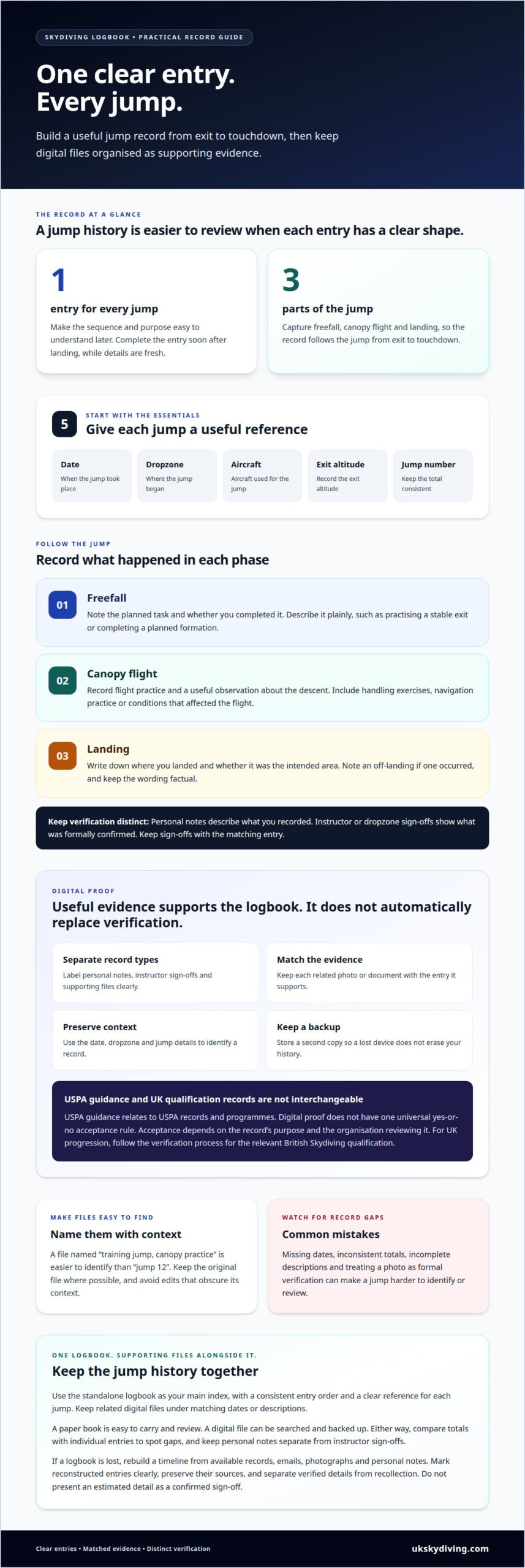
For skydiving logbook explained in practical terms, follow one jump from exit to touchdown. Record the date, dropzone, aircraft, exit altitude and jump number. Then describe the freefall activity, canopy flight and landing outcome. Each entry should make the jump’s sequence and purpose easy to understand later.
For British Skydiving progression, recording and verification depend on the qualification. Keep your personal notes distinct from any formal verification or sign-off. That way, it’s clear which details you wrote and which were confirmed through training.
Complete your entry soon after landing, while the sequence remains fresh. Describe the freefall task in plain language, such as practising a stable exit or completing a planned formation. For canopy flight, note handling exercises, navigation practice or conditions that affected your flight. Finish with the landing area and outcome, including an off-landing if one occurred. A skydiving logbook explained through a completed entry shows how these details fit together.
- Freefall: Record the exit altitude, planned task and whether you completed it.
- Canopy: Note the flight practice and a useful observation about the descent.
- Landing: Write down where you landed and whether it was the intended area.
- Verification: Keep instructor or dropzone sign-offs with the matching entry.
For example, describe a stable exit, formation practice, canopy navigation and a landing away from the intended area. Keep the wording factual. A brief note about what changed during the jump adds useful context beyond a bare total.
Some dropzones encourage carrying a phone as an additional safety measure in case of an off-landing or emergency. Keep phone notes and images separate from the core logbook entry. They can support your recollection, while the logbook brings the jump details together in a format you can review.
USPA logging guidance and digital proof
USPA stands for the United States Parachute Association. Its guidance relates to USPA records and programmes, and does not automatically determine verification for UK qualifications. Keep digital evidence organised, while distinguishing personal records from entries formally verified through the relevant process.
There isn’t one universal yes-or-no answer to whether USPA accepts digital proof. Acceptance depends on the record’s purpose and the organisation reviewing it. A digital log can preserve jump details, but don’t assume a screenshot or app entry replaces required verification.
For a useful digital record, keep each jump entry complete and easy to match with its supporting evidence. Save files using the jump date and a clear description. For example, “training jump, canopy practice” is easier to identify than “jump 12”. Keep the original file where possible, and avoid editing images in ways that obscure their context.
- Separate record types: Mark personal notes, instructor sign-offs and other supporting files clearly.
- Match the evidence: Keep a photo or document with the entry it relates to.
- Preserve context: Include the date, dropzone and jump details in the record.
- Keep a backup: Store a second copy so one lost device doesn’t erase your history.
Common mistakes include missing dates, inconsistent jump totals, incomplete descriptions and treating a photo as formal verification. These gaps can make it harder to identify a jump or establish whether its record meets a qualification’s requirements. Correct errors transparently: keep the original information visible and add a dated note explaining the correction.
For UK progression, follow the verification process for your British Skydiving qualification. Keep digital files as supporting evidence, not as a substitute for required sign-offs. This makes your records easier to review, whether you’re tracking progress or presenting your jump history for a specific purpose.
Standalone skydiving logbook use
A standalone logbook gives your jump history a dedicated home, separate from phone notes and image folders. Choose a layout that lets you record the date, dropzone, jump details and verification together. A paper book is easy to carry and review; a digital file can be searched and backed up. Either way, use the same entry order each time.
A UK logbook’s price depends on its format, materials and features, and is given after a quote request. Compare those factors with how you’ll use the book, such as writing entries at the dropzone or reviewing them digitally.
Make the logbook your main index, not the only place you keep evidence. Give each entry a clear reference, then store related digital files using matching dates or descriptions. For example, an image named “canopy practice” is easier to connect to its entry than a file called “photo”. Keep personal notes separate from instructor sign-offs.
- Keep entries consistent: Use the same fields and order for every jump.
- Make details searchable: Add clear dates and dropzone names to digital files.
- Protect the record: Back up digital copies and store a paper book safely.
- Review regularly: Compare totals with individual entries to spot gaps.
If your logbook is lost, start rebuilding a timeline from digital records, emails, photographs and personal notes. Contact the relevant dropzones or instructors for copies of records they retain. Clearly mark reconstructed entries, preserve their sources, and separate verified details from your recollection. Never present an estimated detail as a confirmed sign-off.
Once you’ve gathered the evidence, compare each recovered entry with any remaining records. Note missing dates or details instead of filling gaps with guesses. Keep the reconstructed record and its supporting files together, then use one consistent entry format for future jumps. A standalone logbook makes that ongoing history easier to follow.
How many logged jumps are needed for UK skydiving licences and ratings?
There isn’t one jump total that applies to every UK skydiving licence and rating. The number depends on the qualification you’re pursuing and its specific progression criteria. A total alone can’t show whether your record meets those criteria.
For UK progression, distinguish British Skydiving requirements from USPA guidance. They relate to different organisations, so don’t assume a USPA number automatically applies to a British Skydiving qualification. Identify the exact licence or rating first, then use its current criteria as your reference.
Read the requirements as a checklist, not just a target total. Some progression stages may involve specific skills, completed tasks or verification alongside logged jumps. Your logbook should make it easy to connect each relevant entry with the skill or sign-off it supports.
- Name the goal: Write down the precise licence or rating you’re working towards.
- Match the criteria: Separate jump totals from any skill or verification requirements.
- Track progress: Mark completed entries against the relevant progression steps.
- Keep evidence together: Store supporting records beside the jumps they relate to.
For example, a higher jump count doesn’t prove that every requirement is complete. If a rating requires a specific skill, the record needs to show that skill clearly, not simply another jump. This helps you identify what remains before presenting your logbook for review.
As you build experience, review the criteria after each training milestone. Record the jump while its details are fresh, then note which progression item it supports. If you’re at the very start, a Tandem Skydive Experience offers a first taste of skydiving before you choose a training route.
UK Skydiving: Tandem Skydive Experience
UK Skydiving’s Tandem Skydive Experience gives beginners a thrilling first taste of skydiving. You’re securely harnessed to a professional instructor for a jump from up to 13,000 feet. It’s an experience to enjoy, rather than a substitute for checking the requirements of a licence or rating.
If you’re curious about the sensation of freefall before choosing a training path, a tandem skydive can be a memorable first step. Video and Photo Packages can help capture the experience, too.
Ready to take the leap? Explore UK Skydiving’s Tandem Skydive Experience on the website, or get in touch.
Take your next step towards the sky
A clear record can do more than track progress. It can help you see what you’ve learned and decide what kind of experience you want next. With the skydiving logbook explained in practical terms, you can choose a path that matches your interests, whether you’re curious about a first jump or keen to explore training.
UK Skydiving offers a Tandem Skydive Experience for beginners, an Accelerated Freefall (AFF) Course for those looking to progress towards solo skydiving, and Charity Jumps for people taking on a fundraising challenge. Each offers a different way to make your next step personal.
If you’re ready to explore those options, contact UK Skydiving to discuss your jumps. Bring your questions and your sense of adventure. Your next skydiving chapter starts with a decision, and it can be an exhilarating one.
Frequently Asked Questions
Do governing bodies like USPA accept digital proof of jump numbers?
Digital proof may be useful, but acceptance depends on the organisation and purpose of the record. Keep a clear export or backup of your digital log alongside any supporting verification. For example, a saved entry can show jump details, while a separate signed record may show formal approval. USPA guidance concerns its own programmes, so don’t assume it automatically sets UK qualification requirements.
What is a skydiving logbook and what is it used for?
A skydiving logbook is a chronological record of your jumps and progression. It helps you review your experience, recall training milestones and organise evidence when working towards a qualification. Think of it as a flight history for your skydives, not a collection of photographs. For example, you can use it to find when you practised a particular skill and what feedback you received.
What information is recorded in a skydiving logbook?
Include enough information to identify the jump and explain its purpose. Useful fields include the date, dropzone, aircraft, exit altitude, jump type, planned task and instructor feedback. Add any verification details relevant to your training. For example, note whether a jump was a training exercise or a formation jump. Consistent entries make it easier to compare progress across different stages.
How do you fill out a skydiving logbook after a jump?
Complete the entry after landing, while details are fresh. Write the date and dropzone first, then describe the jump’s aim, what happened and any feedback. Leave space for the appropriate verification if your training process requires it. Keep the wording factual. For example, write “practised stable exit, instructor noted improvement” rather than relying on a brief label such as “good jump”.
Are digital skydiving logbooks accepted, or is a paper logbook required?
There isn’t one universal format rule for every organisation or qualification. A digital log can be practical for searching and backing up entries, while paper provides a physical record. The key distinction is between keeping a record and meeting a specific verification process. Keep entries legible and easy to retrieve, and retain any separate sign-offs required for the purpose you’re presenting them.
What details should a beginner record for AFF training jumps?
For an AFF training jump, record the training level or task, the actions you practised and the instructor’s feedback. Add the jump date and dropzone so the entry connects to your wider progression. Note specific observations, such as a stable exit or a task that needs more practice. Keep formal sign-offs distinct from your personal notes so each entry’s status is clear.
Categorised in: Blog