
Latest News
-
 4 ways to make your first skydive feel more manageable November 10, 2026
-
 What’s the Scariest Part of Skydiving? How Freefall Feels November 9, 2026
-
 Parental Consent for Skydiving and Young Jumpers November 8, 2026
-
 How to Position Your Body and Breathe During Freefall November 7, 2026
-
 Pressure Changes During Skydiving: Why Your Ears Hurt November 6, 2026
Invite Your Spouse to Skydive Without Pressure
October 19, 2026 12:00 amWhat if the best invitation to skydive is one that leaves room for “no”? Sharing an extraordinary adventure could bring you closer, but worries about heights, safety or the unknown deserve to be heard. Convincing your spouse to skydive shouldn’t mean wearing them down. It should mean having an honest conversation and making space for their choice.
You can be excited about the idea and still respect a hesitant response. A first tandem jump is designed for beginners: your spouse would be securely harnessed to a professional instructor for a jump from up to 13,000 feet. Knowing what to expect may help answer questions, but it doesn’t mean they have to say yes.
This guide will help you talk about skydiving without pressure, understand what might be behind your spouse’s concerns and choose a next step that feels right for both of you. We’ll cover how to listen before offering information, explain what a tandem experience involves and respond to a “no” or “not yet” with care. The goal isn’t to secure a yes. It’s to protect trust while exploring whether this adventure belongs on your shared horizon.
Key Takeaways
- Start by asking what your spouse thinks and listening without trying to change their answer.
- When convincing your spouse to skydive, separate clear, factual information from personal reassurance.
- Make the first step a relaxed conversation, not a booking, surprise or expectation of a yes.
- Choose a next step together, whether that means learning more, revisiting the idea later or trying another adventure.
- Keep a tandem skydive an invitation, not a test of courage or commitment to your relationship.
Why a Skydiving Invitation Can Feel Different Between Spouses
You might picture the two of you sharing an unforgettable rush and celebrating a bold new experience side by side. Your spouse may picture the height, the uncertainty or the moment of stepping out of an aircraft. Both reactions are real. Your excitement about inviting them doesn’t mean they’ll feel excited straight away.
Spouses don’t have to share the same appetite for risk or unfamiliar activities. One person may enjoy trying something new, while the other prefers to know what to expect before deciding. That difference isn’t a flaw in the relationship. It’s a reason to make room for a conversation, rather than treating hesitation as a problem to solve.
Why your spouse may respond differently than you expect
A pause or a “maybe” can mean several things. Your spouse might be uncomfortable with heights, concerned about losing control or unsure what a tandem skydive involves. They might like the idea in principle but not feel ready now, or not want this particular activity to be a shared milestone. Ask rather than assume.
Try an open question: “What part of the idea gives you pause?” Then give them time to answer. Don’t label their reaction as fear, tease them for being cautious or jump straight into reassurance. Find out whether they’re unsure about skydiving itself, the timing or doing it together. These are different concerns, and each deserves to be heard on its own terms.
If safety questions come up, separate what you can learn from how your spouse feels. The United States Parachute Association (USPA) offers a starting point for understanding the organisation of skydiving in the United States. A reference can support an informed discussion, but it can’t decide what feels right for your spouse.
Shared adventure works best when both people choose it
A shared milestone can be thrilling when both partners genuinely want to be there. The anticipation, the jump and the story you tell afterwards can become part of a memory you chose together. The value isn’t just in doing something dramatic. It’s in knowing you both felt comfortable saying yes.
A reluctant yes may leave one person focused on getting through the experience, while the other worries they pushed too hard. That’s unlikely to create the joyful memory either of you hoped for. There’s no need to turn an invitation into a test of courage or commitment.
A respectful invitation makes space for an honest yes, a no or a not-yet without changing the warmth between you. Declining a skydive doesn’t mean your spouse is rejecting you or the relationship. It means this particular experience may not be right for them. You can still share excitement, talk openly and choose adventures you both enjoy. Convincing your spouse to skydive shouldn’t mean getting agreement at any cost. It should mean understanding each other well enough to decide what comes next together.
Answer Safety Concerns With Facts, Not Reassurance You Cannot Prove
“You’ll be fine” may come from love, but it doesn’t answer a safety question. Your own confidence doesn’t either. If your spouse is worried, excitement can’t replace clear information, and reassurance shouldn’t promise an outcome no one can guarantee. First understand what concerns them, then share what you can verify and leave room for them to decide how they feel.
Ask what part of skydiving worries them most
Start with a question, not a pitch. Is it the height, the moment of the jump or not knowing what the experience involves? They may not have a neat answer straight away. Listen without correcting them, making light of the concern or comparing their reaction with someone else’s.
Then ask whether they’d like practical information or would rather talk through the feeling first. A spouse who wants to be heard may feel dismissed if you respond with facts before they’re ready. Someone who wants details may find general encouragement frustrating. Let them guide the conversation, and don’t treat a question as a commitment to jump.
Explain what a first tandem skydive involves
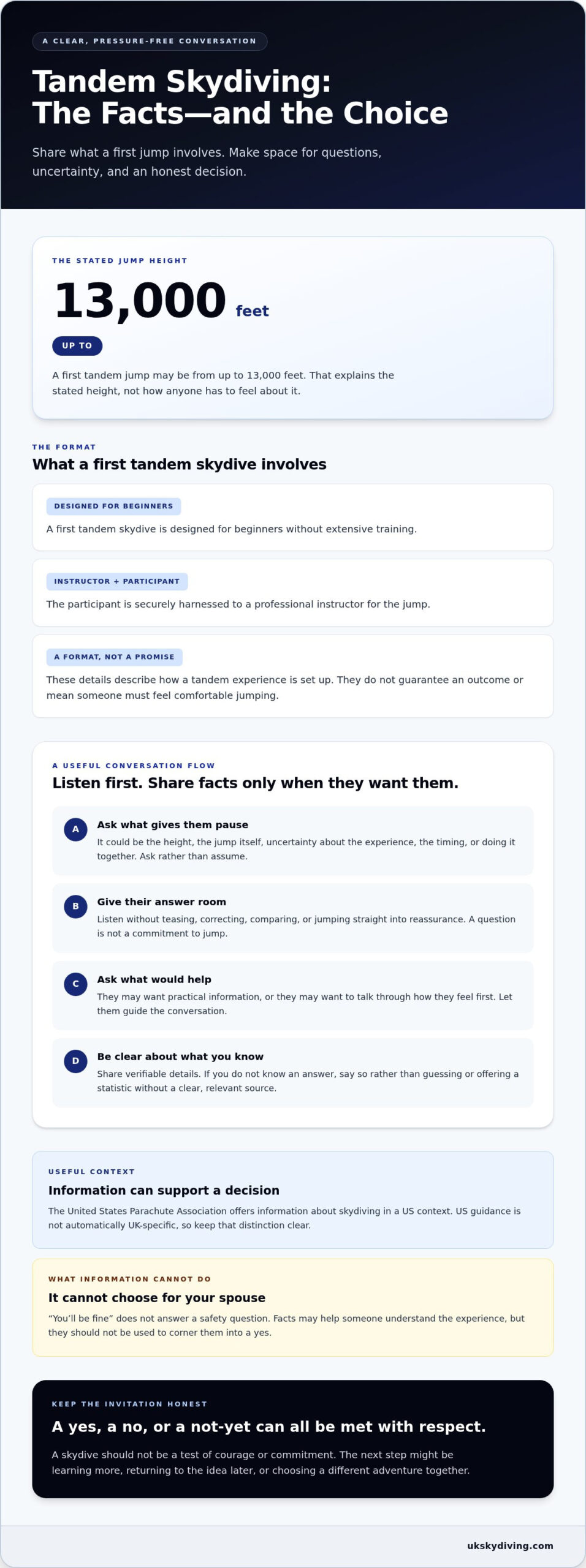
Once they’re open to information, stick to the details you know. A tandem skydive is designed for beginners without extensive training. The participant is securely harnessed to a professional instructor, and the jump is from up to 13,000 feet. Those facts explain the format. They don’t mean your spouse has to feel comfortable with it.
A first tandem skydive pairs a beginner with a professional instructor, with both securely harnessed together for a jump from up to 13,000 feet.
For broader background, the United States Parachute Association publishes skydiving information for a US context. Keep that distinction clear if you share its resources. US guidance isn’t automatically UK-specific, so don’t use it to make claims about local procedures or settle a concern it doesn’t address.
Be honest about what you don’t know. If your spouse asks a question you can’t answer reliably, don’t guess or reach for a statistic without a clear, relevant source. Acknowledge that you don’t know and offer to look for trustworthy information together, without expecting the answer to change their decision. That’s a stronger foundation for convincing your spouse to skydive than talking them past a concern.
If they’d prefer to explore the topic privately, UK Skydiving’s honest guide to skydiving safety offers a place to read at their own pace. They can take from it what’s useful, ask more questions or decide the jump isn’t for them. Facts can inform a choice. They shouldn’t be used to corner someone into making it.
How to Talk About Skydiving Without Turning It Into Pressure
A good conversation starts before anyone looks at dates or makes plans. The aim isn’t to build the perfect pitch. It’s to share why the idea excites you, hear how your spouse feels and let them choose whether they want to explore it further. A booking, surprise or public announcement can make it harder for them to answer honestly.
Choose a calm moment and make one clear invitation
Bring it up when you’re both relaxed, not rushing out of the house or in the middle of an argument. Keep your invitation simple and personal: “I’ve been thinking about trying a tandem skydive. It sounds like an incredible experience, and I’d love to share it with you. Would you be interested in hearing more?”
This expresses your excitement without suggesting your spouse is expected to jump. Ask whether they want details before launching into them. If they say yes, explain what interests you and answer their questions plainly. If they don’t, pause. Their first response isn’t an opening to make a stronger case.
Treat the first conversation as an invitation to talk, not a decision deadline. Avoid buying a voucher, choosing a date or telling friends you’ll jump together before you’ve heard a clear yes. Even a well-meant surprise can create pressure if your spouse feels they have to agree to avoid disappointing you.
Respond to no, maybe, and questions with respect
Different answers call for different responses. A clear “no” is enough. Don’t bargain, shame them or return to the subject repeatedly in the hope they’ll give in. A “maybe” means they’re unsure, not that you have permission to book. Ask whether they’d like time, information or for the conversation to end there.
If they have questions, answer what you can without exaggerating or treating every concern as an obstacle to overcome. It’s fine to say you don’t know. Give them time to think, and let them decide whether to bring the idea up again. Repeated requests can turn enthusiasm into an obligation, even if you don’t mean them that way.
Respectful information-sharing leaves room for your spouse to consider the idea at their pace. Unwanted persuasion keeps pressing after they’ve answered. Guilt can be direct, like saying, “If you loved me, you’d do it,” or subtle, like acting hurt when they hesitate. Neither approach builds the trust you’d want for a shared adventure.
A good invitation makes declining safe and straightforward, without requiring an excuse or risking hurt feelings. That’s a better starting point than focusing on convincing your spouse to skydive. If you both become curious, explore UK Skydiving’s tandem skydive experience together. If not, keep the conversation kind and find another way to share an adventure.
Find a Comfortable Next Step, Even If They Are Not Ready
A conversation doesn’t have to end with a shared booking. It can end with a question answered, an idea set aside or a different plan you’re both genuinely excited about. Choosing a next step together keeps the focus on what works for your relationship, not on finding another way to secure a yes.
If they are curious, explore the experience together
If your spouse wants to know more, agree on a small, no-strings next step. You could read about the first jump together, write down questions or talk through what they’d like to understand before deciding. UK Skydiving’s tandem skydiving first-jump guide can help explain the experience in practical terms.
A tandem skydive is designed for beginners, with the participant securely harnessed to a professional instructor. Learning about that format may make the idea clearer, but curiosity isn’t a promise to take part. Keep checking in: “Would you like to read more, or have you had enough information for now?” Let their answer set the pace.
Keep this step free from hidden commitments. Don’t turn reading a guide into a plan to pick a date, and don’t treat a question as a soft yes. Vouchers, bookings and surprise arrangements shouldn’t be used to change someone’s answer. Make plans only when both people have freely decided they want to jump.
If they are not ready, keep the relationship bigger than the activity
If your spouse says they aren’t ready, accept that without asking them to set a deadline. You can ask whether they’d like to revisit the idea someday, but leave it open only if they want that. Otherwise, let the subject rest. A shared memory doesn’t have to involve a plane, a big rush or a test of anyone’s nerve.
Choose an adventure you both enjoy, whether that’s a day out somewhere new, a challenging walk or another experience you’re both keen to try. The point is to have fun together, not to find a substitute that secretly leads back to skydiving. A different plan can still become a story you’ll remember fondly.
You can also decide that skydiving is something you’d like to pursue on your own. Be honest with yourself about whether you can do that without resentment or keeping score. Your spouse’s choice doesn’t need to diminish your excitement, and your interest doesn’t need to become an obligation for them.
If skydiving remains a personal goal, explore UK Skydiving’s tandem skydive experience for yourself. Let the next step fit the answer you’ve actually received. That’s a more trusting path than trying to find another way of convincing your spouse to skydive.
Make a Tandem Skydive an Invitation, Not a Relationship Test
A skydive can be a remarkable shared experience, but it isn’t a measure of how much you love, trust or believe in each other. Your spouse doesn’t need to prove their courage by agreeing, and you don’t need to give up your own interest if they decide it isn’t for them. The strongest outcome is a choice you can both feel good about, even if you make different choices.
That’s the heart of convincing your spouse to skydive without damaging trust: share what excites you, make room for their honest response and let the decision belong to them. If you both become interested, explore what a first jump involves. If not, the invitation can still be caring because it came with no hidden test attached.
What a willing first-time tandem jump offers
UK Skydiving’s tandem experience is designed for beginners, so extensive skydiving training isn’t needed. The participant is securely harnessed to a professional instructor. That instructor-led format makes a first jump an option to learn about, not a challenge your spouse has to accept to prove they’re adventurous.
If your spouse is curious about the experience, you can read what skydiving feels like together. Use it to picture the experience and prompt questions, not to suggest that reading about it settles their concerns. They may feel intrigued, remain uncertain or decide it’s not for them. Each response is valid.
A willing first jump may become a vivid memory you share, but its value lies in choosing it freely. Make sure you’re both comfortable with the decision before moving from conversation to plans. Excitement is wonderful. Consent matters more than matching each other’s enthusiasm.
Explore the experience when you are both ready
If you’ve reached a genuine yes together, take the next step at a pace that suits you both. Talk through any remaining questions and decide whether you’d like to explore the tandem experience further. There’s no need to rush into a date or turn the decision into a grand gesture. Keep checking that you’re both still happy with the plan.
If your spouse isn’t ready, let that be the answer for now. You can enjoy other adventures together, or pursue skydiving independently if that feels right for you. A relationship can hold different comfort levels without either person needing to apologise for them.
If you’re both ready to find out more, explore the tandem skydive experience. Make it an invitation you can both say yes to freely, with the thrill of the adventure matched by the trust you bring to it.
Let Your Next Step Reflect a Shared Yes
The best outcome isn’t necessarily making the jump together. It’s knowing you can talk about an exciting idea honestly, respect each other’s boundaries and choose what comes next as a team. If your spouse says “not now” or “not for me”, that answer can sit alongside your own enthusiasm without becoming a measure of your relationship.
If the conversation leads to a genuine shared yes, let curiosity guide the next step. UK Skydiving’s base in Cambridgeshire serves North London and beyond, offering a place to explore the experience when the time feels right for both of you. There’s no need to rush. A thoughtful invitation can begin an adventure, or simply create a moment of understanding between you.
Ready to explore the possibility at your own pace? Explore a tandem skydive with UK Skydiving. Keep the choice mutual, and let the excitement grow naturally if you’re both ready.
Frequently Asked Questions
How do I convince my spouse to skydive without pressuring them?
Make one clear invitation, then let your spouse choose whether to discuss it further. You could say, “I’m excited by the idea of a tandem skydive. Would you like to hear what interests me about it?” Listen without turning every concern into a reason to agree. If they decline, accept their answer kindly. A good conversation protects trust, even when you don’t reach the same decision.
Is tandem skydiving suitable for someone who is nervous?
A tandem skydive is designed for beginners, and the participant is securely harnessed to a professional instructor. That format may help someone understand what a first jump involves, but it can’t predict how they’ll feel about taking part. Nervousness can mean someone wants more information, or it can mean they’d rather not jump. Let them decide whether learning about the experience feels useful, without treating curiosity as a commitment.
What should I say if my spouse is afraid of heights?
Ask what about the height worries them, then listen without correcting or comparing their feelings with someone else’s. Their concern might be about being high up, the jump itself or not knowing what to expect. You could ask, “Would it help to look at some information together, or would you rather leave it there?” Share details only if they welcome them, and don’t imply that information should make the fear disappear.
Can my spouse change their mind about skydiving?
Yes. Your spouse can change their mind, and their choice deserves respect whether they were curious before or had previously agreed. Don’t treat an earlier conversation as permanent permission to make plans. If they reconsider, listen and talk through what they want now. Avoid guessing about booking or cancellation arrangements, since those depend on the relevant terms. Keep the conversation focused on their decision, not on persuading them to stick with an earlier answer.
What happens during a first tandem skydive?
In a first tandem skydive, a beginner is securely harnessed to a professional instructor for a jump from up to 13,000 feet. It’s an instructor-led experience intended for people without extensive skydiving training. If your spouse wants more detail, help them find practical information and make a list of questions they’d like answered. Knowing the basic format can support an informed choice, but it doesn’t mean they have to take part.
Should I surprise my spouse with a skydive booking?
It’s better to discuss the idea first. A surprise booking can make your spouse feel they must accept to avoid disappointing you, especially if other people already know about the plan. Instead, share why a jump appeals to you and ask if they’d like to explore it together. Make plans only after you’ve both clearly chosen to take part. That keeps the decision shared rather than turning it into an unexpected obligation.
What if my spouse says no to skydiving?
Accept their no without bargaining, teasing or bringing it up repeatedly. A decision not to skydive isn’t a rejection of you, and it doesn’t need to change how you enjoy time together. Suggest choosing another activity you’re both genuinely interested in, such as a day out or a different adventure. If you decide to skydive on your own, do so without resentment or expecting your spouse to change their mind.
Categorised in: Blog