Latest News
-
 Skydiving as a Confidence Booster: How One Jump Can Change Your Life September 20, 2026
 -
 How to Convince Your Parents to Let You Skydive September 19, 2026
 -
 How to Land a Parachute Safely: A Beginner’s Guide September 18, 2026
 -
 Static Line vs AFF: Choosing Your Path to Solo Skydiving in 2026 September 17, 2026
 -
 Skydiving A License: Your Passport to the Skies September 16, 2026
How to Prevent Nausea During a Skydive: Tips for a Smooth Flight
June 17, 2026 12:00 amYour heart is pounding as the plane door opens, but your biggest fear isn’t the 15,000-foot drop, it’s whether your breakfast will stay where it belongs! It’s a common worry for many first-timers, but the freefall is pure magic and you don’t have to let motion sickness ruin a single second of it. If you’re wondering how to prevent nausea during skydive jumps, you’re already taking the right step toward a legendary experience. It’s perfectly normal to feel a bit of “stomach flip” anxiety, but with professional preparation, you can keep your focus on the horizon rather than your digestion.
We understand that the fear of feeling ill can be just as intense as the fear of the height itself. That’s why we’re sharing expert-backed strategies to keep your stomach settled so you can focus entirely on the thrill of your first jump. You’ll gain the confidence to board that plane without a shred of doubt. This guide breaks down exactly what to eat on the morning of your flight, how to breathe through the nerves, and why the canopy ride is actually the most important part to prepare for. Get ready to turn that nervous energy into pure, unadulterated joy.
Key Takeaways
- Understand the science of sensory conflict and why you won’t experience that dreaded “stomach drop” feeling during your exit.
- Learn exactly how to prevent nausea during skydive jumps by fueling your body with the right food and hydration on the morning of your flight.
- Discover why the canopy ride is the primary trigger for motion sickness and how to communicate with your instructor for a smoother descent.
- Master effective breathing techniques that calm your nervous system and help you manage adrenaline-induced butterflies with ease.
- Gain the professional insights needed to transform your anxiety into pure excitement for a truly life-altering adventure.
Understanding the Science of Skydiving Nausea
You’re about to embark on the most incredible adventure of your life. It’s perfectly natural to wonder about your stomach’s reaction to the sky. Skydiving nausea isn’t a given, it’s actually a temporary sensory conflict that you can master with ease. Learning how to prevent nausea during skydive attempts starts with understanding why your body reacts the way it does. It’s not about the fall itself, but rather about the signals your brain receives during the transition from the cabin to the open air. Most people find that the reality is far more comfortable than their imagination suggests.
The Myth of the Stomach Drop
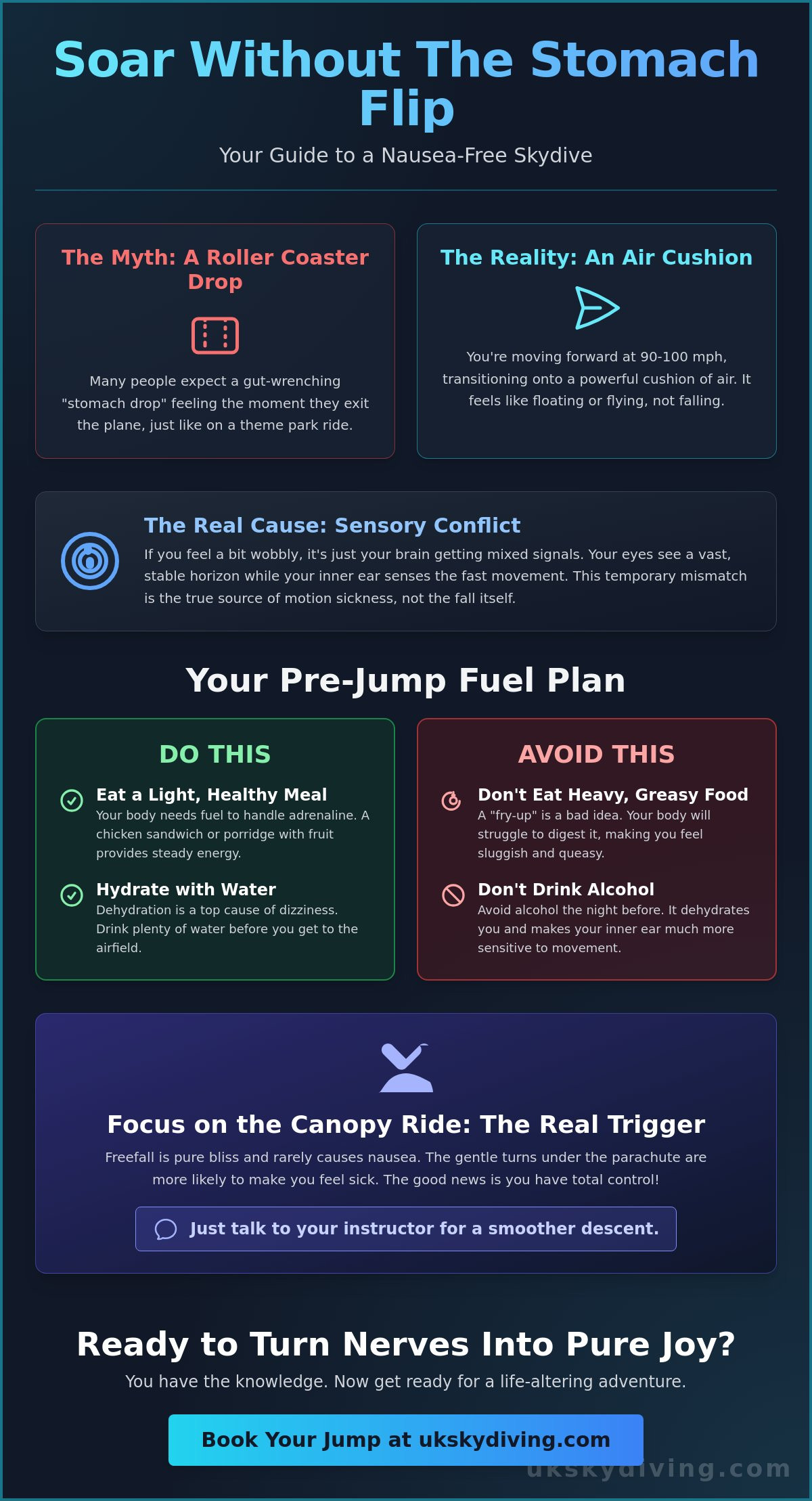
Everyone knows that sinking feeling on a roller coaster. You might expect that same gut-wrenching drop when you leave the plane, but here is the truth: it simply doesn’t happen. When you jump from a moving aircraft, you aren’t starting from a standstill. The plane is moving forward at a significant speed, usually around 90 to 100 miles per hour. Instead of a vertical plummet, you transition into what skydivers call “the hill.” This forward momentum creates a powerful cushion of air that supports you instantly. You can read more about what skydiving feel like to get a better sense of that incredible transition. It’s much more like floating on a high-speed mattress than falling through a trapdoor.
Sensory Conflict at High Altitude
If you do feel a bit of a wobble, it’s usually because of your inner ear and eyes working in different ways. This is known as sensory conflict. Your eyes see a vast, beautiful horizon that looks almost stationary because you’re so high up. Meanwhile, your inner ear, or vestibular system, detects the rapid movement and changes in orientation. This mismatch can lead to a mild version of motion sickness. Understanding Airsickness is helpful here because it explains how these conflicting signals can momentarily confuse the brain. At 15,000 feet, the ground is so far away that your brain doesn’t have a close reference point to gauge your actual speed. This lack of ground proximity can be disorienting for a moment as your brain tries to make sense of the rush. Add in the rapid pressure changes as you descend through the atmosphere, and your body might need a second to catch up. However, knowing how to prevent nausea during skydive experiences means you can use simple mental grounding techniques to tell your brain exactly where you are in space. Your instructor is a seasoned pro who knows exactly how to make this process feel smooth and safe. You are in expert hands, and the view is going to be worth every single second.
Pre-Jump Preparation: Fueling Your Body the Right Way
Skipping breakfast is the single biggest mistake you can make before a jump. Your body needs fuel to process the massive adrenaline rush you’re about to experience. When your blood sugar levels crash, your stomach starts to do backflips before you even board the plane. Mastering how to prevent nausea during skydive trips starts in your kitchen. Adrenaline naturally triggers your “fight or flight” response, which diverts blood away from your digestive system. If your stomach is completely empty, this physiological shift feels much more aggressive and can lead to that shaky, lightheaded feeling. Eat a normal, healthy meal. Your body will thank you when you’re soaring through the clouds.
Alcohol is another major trigger you must avoid. Having a few drinks the night before might seem like a way to calm your nerves, but it’s a recipe for disaster. Alcohol severely dehydrates your brain and makes your inner ear much more sensitive to movement. A hangover at 15,000 feet is an experience you definitely want to skip. It ruins the magic. Stay sharp. Stay hydrated. You want to remember every incredible second of this life-altering event with total clarity.
What to Eat and What to Avoid
Stick to light, slow-release carbohydrates that provide steady energy. Porridge with fruit or a simple chicken sandwich are perfect choices. You should stay far away from the classic “greasy spoon” fry-up. Heavy, fatty foods sit in your stomach like lead and take a long time to digest. You want your body focused on the thrill of the jump, not struggling to break down a mountain of bacon and sausages. If you’re feeling a bit peckish while waiting at the airfield, a banana or a handful of nuts can keep your energy levels stable without making you feel weighed down. Balance is everything.
Hydration and Temperature Control
Drink plenty of water while you wait for your flight. Dehydration is a leading cause of queasiness and dizziness. In Cambridgeshire, the weather can be quite unpredictable. Airfields are often wide-open spaces where you’re exposed to the elements. If you get too cold while waiting, your body tenses up, which can lead to physical discomfort and nausea once you’re in the air. On the flip side, sitting in the baking sun for hours without water will make your head spin. Wear sensible layers that you can easily add or remove. Being comfortable on the ground is the first step to feeling amazing in the sky. If you’re feeling prepared and ready for the rush, you can explore our tandem skydiving experiences to find the perfect date for your adventure. Stay cool, stay hydrated, and get ready for the best view of your life.
Managing the Canopy Ride: The Real Nausea Trigger
Most people assume the 120mph freefall is the part that tests your stomach. In reality, the most common time for motion sickness is actually after the parachute opens. The transition from the high-octane roar of the wind to the serene silence of the canopy ride is a massive shift for your senses. It’s an incredible moment, but the physical mechanics of spiraling turns can sometimes catch your inner ear off guard. Understanding how to prevent nausea during skydive jumps means focusing on this specific phase of the flight. The spiraling motion creates centrifugal force that can lead to dizziness if you aren’t prepared. If you know you’re prone to motion sickness in cars or on boats, consider taking a mild over-the-counter medication early in the morning. This gives the medicine plenty of time to enter your system before you board the aircraft. Anxiety often plays a massive role in how your body processes these sensations. When you’re stressed, your muscles tense up and your digestion slows down. Take a moment to read about is skydiving safe to put your mind at ease. A calm mind leads to a settled stomach, allowing you to enjoy the spectacular views of the countryside below.
Communication with Your Tandem Instructor
Your tandem instructor is your ultimate guide and your best friend in the sky. Don’t be shy about your feelings! Tell them immediately if you start to feel even slightly queasy during the descent. They have total control over how the parachute flies and can adjust their style in an instant. While some adrenaline junkies love high-energy “acrobatic” spirals that pull significant G-forces, you can simply ask for a “scenic” canopy ride instead. This means your instructor will perform gentle, wide turns and maintain a smooth, straight-in approach to the landing area. They are highly trained experts who want you to have the time of your life. They can fly the wing very gently to ensure your experience is nothing but pure joy.
The Horizon Gaze Technique
When the parachute is turning, your brain might struggle to process the rapid change in direction against the vastness of the sky. The best way to stay steady is to keep your eyes firmly on the horizon. Avoid looking straight down at your dangling feet or focusing on the ground directly beneath you while the wing is in motion. By looking at a fixed distant point, like a far-off forest or the edge of the coastline, you give your brain a stable reference to recalibrate your vestibular system. This simple trick provides instant stability and helps your body stay in sync with the movement of the parachute. It works like magic to keep those butterflies under control so you can focus on the breathtaking scenery around you.
Breathing and Mental Grounding Techniques
Anxiety isn’t just a mental state, it’s a physical catalyst that can turn a few butterflies into full-blown queasiness. When you’re standing on the edge of a legendary adventure, your body’s survival instincts kick in. This releases a flood of hormones that can mess with your digestion. If you want to know how to prevent nausea during skydive flights, you have to master the connection between your mind and your lungs. By controlling your breathing, you can actually override the chemical signals that cause stomach distress. It is about taking charge of your physiology to ensure you can enjoy every second of the rush. You aren’t just a passenger, you are the master of your own experience.
Deep Breathing in the Aircraft
The ascent is your time to shine. As the plane climbs above the beautiful landscape, focus on slow, purposeful breaths. Many first-time jumpers accidentally hold their breath or take shallow “chest breaths” when they feel nervous. This deprives the brain of oxygen and leads to lightheadedness, which your body often misinterprets as nausea. Try box breathing: four seconds in, four seconds hold, and four seconds out. This simple rhythm keeps your heart rate stable and your stomach calm. When it’s time to jump, let out a massive, legendary shout! Shouting forces you to exhale all that stale air, ensuring your first breath in freefall is deep, fresh, and invigorating. It’s a total game-changer for your physical comfort and helps you stay present in the moment.
The Power of Positive Visualisation
Your imagination is a powerful tool for physical stability. Instead of dwelling on the “what-ifs” of motion sickness, visualise the perfect landing. See yourself gliding gracefully toward the ground and high-fiving your instructor. This isn’t just wishful thinking, it’s chemical management. By focusing on the reward, you swap cortisol for dopamine and serotonin. These “feel-good” chemicals are natural nausea suppressants that help settle your stomach and boost your mood. Remind yourself that any physical tension is just your body’s way of preparing for a peak life event. You are not sick, you are excited! You are about to accomplish something most people only dream of. Embrace that energy and let it carry you through the clouds with total ease.
Put your mental game to the test and experience the ultimate adrenaline high. Book your Tandem Skydive Experience with our expert team and discover how amazing you’ll feel when you conquer the sky with total confidence.
Ready for the Thrill? Book with UK Skydiving
Now that you are armed with expert knowledge on how to prevent nausea during skydive adventures, there is nothing holding you back. You have the breathing techniques. You know exactly what to eat. You understand the science of the “hill” and the horizon gaze. It is time to stop dreaming and start flying! Our professional team at our Cambridgeshire base in March is ready to guide you through every exhilarating second. We specialise in turning first-time nerves into total triumph. Whether you want to tick a major goal off your bucket list or start a brand-new hobby, we are here to make it happen. This is your moment to shine.
We offer a variety of ways to experience the magic of the sky. Most people start with a tandem skydiving experience where you are securely harnessed to one of our world-class instructors. For those who want to take it to the next level and master the air themselves, you can learn to skydive solo through our Accelerated Freefall (AFF) Course. We also take immense pride in supporting our charity jumpers. If you are jumping to raise money for a cause close to your heart, our team provides a supportive environment to ensure your fundraiser is a massive success. We handle the logistics so you can focus on the jump.
Why Choose UK Skydiving?
Our instructors are not just technical experts. They are masters of the human experience. They know exactly how to settle your stomach and your mind before the door opens. From the moment you arrive at our facilities in March, you will feel the energy and the professionalism that sets us apart. We provide a supportive, inclusive environment from the ground training all the way to the soft landing. Plus, our dropzone features a fantastic viewing area. Your friends and family can watch your legendary descent and celebrate your achievement the moment your feet touch the grass. It is a day out that your entire group will remember forever.
Next Steps for Your Adventure
The sky is calling and the horizon has never looked better. Do not let another weekend pass by without experiencing the ultimate rush of freefall. Check our availability for the upcoming weeks and find a slot that works for you. You can choose between a standard thrill-seeking jump or signing up for one of our impactful charity fundraisers. The process is simple, fast, and the first step toward a memory that will stay with you for a lifetime. Book your tandem skydive now and prepare to see the world from a whole new perspective. It is time to fly!
Take the Leap and Conquer the Sky
You are now equipped with the ultimate toolkit to make your first jump a total success. By focusing on smart pre-flight nutrition and mastering the horizon gaze technique, you have learned how to prevent nausea during skydive attempts with professional ease. Remember that your body is simply reacting to an extraordinary event, and you have the power to stay calm and settled through every second of the rush. Trust in your preparation and get ready for the most transformative memory of your life.
Our team brings over 30 years of skydiving excellence to every flight, ensuring you are in the safest hands possible. With highly qualified BPA instructors guiding you, all you need to do is breathe and enjoy the stunning views over the Cambridgeshire countryside. Don’t let a moment of hesitation hold you back from this peak life event. The view from 15,000 feet is waiting for you! Book your life-changing tandem skydive experience today and join the ranks of those who have truly touched the sky. You were born for this adventure.
Frequently Asked Questions
Can I take motion sickness medication before skydiving?
Yes, taking over-the-counter motion sickness medication is a brilliant idea if you are prone to travel sickness. Make sure to take it at least an hour before your flight so it is fully active in your system. This is an effective way how to prevent nausea during skydive experiences. Always check the label to ensure it doesn’t cause excessive drowsiness, as you’ll want to be wide awake for those incredible views!
Is it better to skydive on an empty stomach?
No, you should never jump on an empty stomach. Low blood sugar combined with a massive adrenaline rush is a recipe for feeling faint or queasy. Having a light snack or a balanced meal keeps your energy levels stable and your stomach settled. It gives your body the fuel it needs to process the excitement of the jump without any physical hiccups. Stay fuelled and stay focused on the fun!
What should I eat on the morning of my skydive?
Stick to slow-release carbohydrates and light proteins for the best results. Porridge, a banana, or a simple chicken sandwich are all excellent choices for the morning of your jump. Stay away from heavy, greasy foods or a massive “full English” breakfast. You want to feel light and energised rather than weighed down by a heavy meal when you are soaring through the sky at 120mph!
What happens if I actually vomit during the jump?
Don’t worry, our instructors are seasoned professionals who have seen everything. If you feel ill, tell your instructor immediately so they can adjust the canopy flight for a much gentler descent. It is a very rare occurrence, and your safety and comfort are always our top priorities. We will get you down safely and make sure you are looked after the moment your feet touch the ground.
Will I get that roller coaster stomach drop feeling?
You won’t feel that dreaded stomach drop at all! Unlike a roller coaster that starts from a standstill, the plane is moving forward at a high speed. When you exit, you transition onto a powerful cushion of air. It feels more like floating or being supported by a giant fan rather than falling through a trapdoor. It is an incredibly smooth and exhilarating sensation that most people find surprisingly comfortable.
Does the altitude affect how sick I might feel?
Altitude itself isn’t the trigger, but the rapid descent through different air pressures can sometimes feel unusual. This is why deep, purposeful breathing is so important during your flight. If you are looking for how to prevent nausea during skydive maneuvers, remember that oxygen is your best friend. Keeping your lungs full ensures your brain stays clear and your body feels fantastic from the exit all the way to the landing.
How long does the nauseous feeling usually last after landing?
Any feelings of dizziness or queasiness typically vanish within 15 to 20 minutes of landing. Once you are back on solid ground and have had a few sips of water, your body recalibrates very quickly. Walking around the airfield and taking in the fresh Cambridgeshire air helps your inner ear settle down. Most jumpers are so buzzing with adrenaline that they forget all about their stomach the moment they land!
Can I still skydive if I get car sick very easily?
Yes, you definitely can! Many people who suffer from car or sea sickness find that skydiving doesn’t trigger the same reaction. The air in freefall is incredibly fresh, and you don’t have the “closed-in” feeling of a moving vehicle. Just follow our preparation tips and let your instructor know about your concerns. We will make sure your flight is as smooth and scenic as possible for your ultimate comfort.
Categorised in: Blog