Latest News
-
 4 ways to make your first skydive feel more manageable November 10, 2026
-
 What’s the Scariest Part of Skydiving? How Freefall Feels November 9, 2026
-
 Parental Consent for Skydiving and Young Jumpers November 8, 2026
-
 How to Position Your Body and Breathe During Freefall November 7, 2026
-
 Pressure Changes During Skydiving: Why Your Ears Hurt November 6, 2026
How Many Jumps to Get an A License and Meet the Requirements
October 30, 2026 12:00 amEarning an A licence involves completing the required training and demonstrating the skills needed to jump independently. If you’re asking how many jumps it takes to get an A licence, that’s the key number, but it’s only one part of the qualification.
It’s natural to focus on the jump count when picturing your first solo skydive. But earning a licence also means completing training and demonstrating the skills needed to jump independently. Understanding how these requirements fit together makes the goal clearer.
Here, you’ll learn what the British Skydiving A licence allows, how AFF training and consolidation jumps count towards it, and how the licence fits into the wider progression. You’ll see how training takes you from your first jump towards greater independence in the sky.
Key Takeaways
- An AFF student in the UK needs at least 25 jumps to earn an A licence, but the jump count is only part of the qualification.
- Understand how training, consolidation jumps and demonstrated proficiency work together on the path to independent skydiving.
- Compare AFF and Static Line routes to see how each approach shapes your training progression.
- Learn how a tandem skydive can offer a first experience of freefall, while AFF is the route to training for solo jumps.
What Types Of Skydiving Licenses Are There?
In the UK, the British Skydiving A licence is the first qualification for independent solo skydiving. It marks the move from supervised training towards greater independence in the sport.
A Licence Jump Minimums
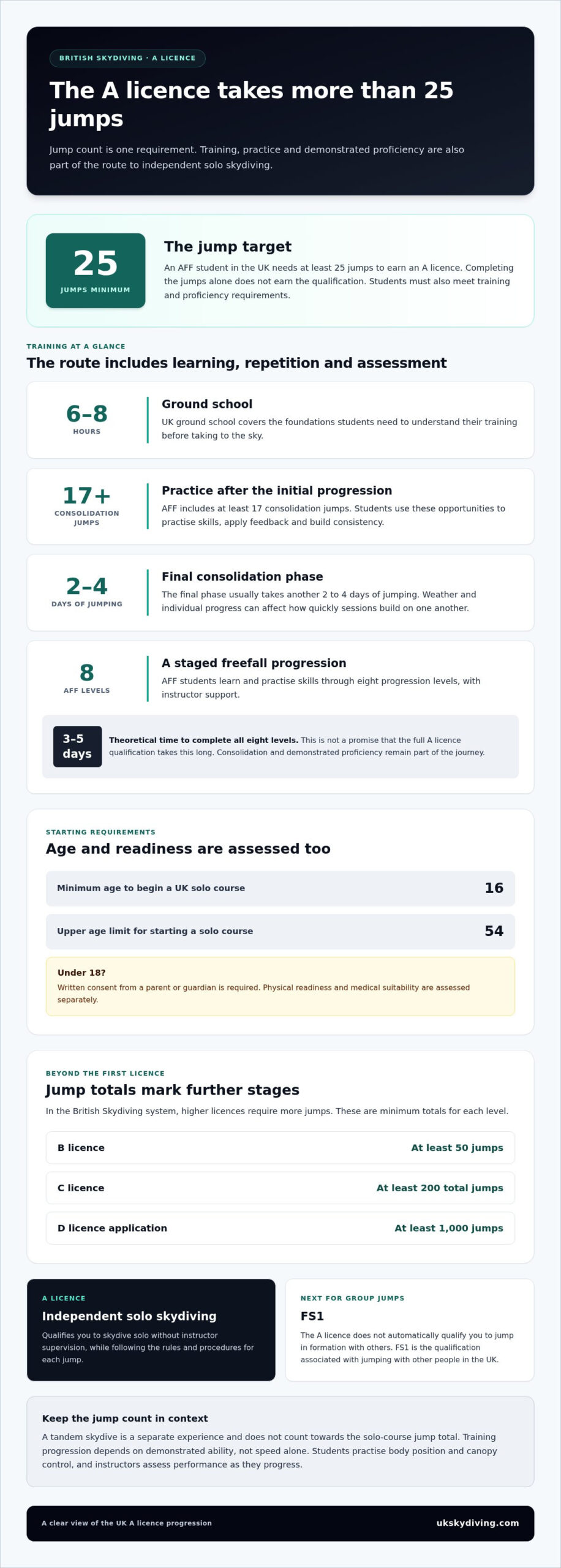
An AFF student in the UK needs at least 25 jumps to earn an A licence. That minimum gives you a clear target, but completing the jumps alone does not earn the qualification. You also need to meet the training and proficiency requirements. A tandem skydive, where you’re securely harnessed to an instructor, is a separate experience and does not count towards the solo-course jump total.
Privileges for Unsupervised Skydiving
The British Skydiving A licence qualifies you to skydive solo without instructor supervision. That means you can progress beyond student training, while still following the rules and procedures that apply to each jump. The licence doesn’t automatically qualify you to jump in formation with others. FS1 is the next qualification for jumping with other people, so it matters if group skydives are your goal.
Licences mark stages of progression. In the British Skydiving system, the B licence requires at least 50 jumps, while the C licence requires at least 200 total jumps. A D licence application requires at least 1,000 jumps. These higher levels reflect growing experience and qualifications, rather than replacing the A licence’s role as the first independent-skydiving credential.
Other countries use their own licensing systems. The USPA A licence also requires at least 25 jumps, plus five skydives with one or more other people. The jump totals look similar, but requirements and privileges are set by each organisation, so a UK Category A licence isn’t automatically interchangeable with an overseas licence.
Training also develops knowledge, not just freefall and canopy skills. Written skydiving exams assess understanding of procedures and rules, while practical progression tests how you apply that knowledge. Group formation skydives involve flying and maintaining position with other skydivers. In the UK, FS1 is the qualification associated with jumping with others.
Pay attention to safety and insurance throughout your training. Follow instructor supervision and established procedures, and understand what your insurance covers during training and solo jumps. A tandem jump is a different experience from licence training: an AFF course is for people working towards solo skydiving.
A licence training and proficiency requirements
UK solo skydiving courses have age requirements as well as training standards. Students must be at least 16 to begin, and the upper age limit for starting a solo course is 54. Anyone under 18 needs written consent from a parent or guardian. Age alone doesn’t establish fitness or medical suitability. Physical readiness and health considerations are assessed separately before training.
Ground school builds the knowledge needed before a student takes to the sky. In the UK, it takes 6 to 8 hours and covers the foundations students need to understand their training. That time is part of learning, not simply a wait before jumping. Careful attention on the ground helps students connect instructions with the practical skills they develop during their progression.
AFF training includes at least 17 consolidation jumps. These follow the initial progression and give students repeated opportunities to practise and strengthen their skills. The final consolidation phase usually takes another 2 to 4 days of jumping. This period is where repetition matters: each jump lets a student apply feedback, build consistency and demonstrate the proficiency needed to advance.
Proficiency means more than reaching a jump total. Students must show they can apply their training in the air and manage the practical demands of a skydive. Body position and canopy control, for example, are skills to practise and refine over successive jumps. Instructors assess performance as students progress, rather than treating each completed jump as an automatic pass.
Training days and calendar time aren’t the same thing. The final consolidation phase takes 2 to 4 days of jumping, while weather and the student’s progress can affect how quickly sessions build on one another. A student who needs more practice can focus on improving specific skills before progressing. That measured approach keeps the focus on demonstrated ability, not speed alone.
If you’d like to experience freefall before committing to solo training, a Tandem Skydive Experience is a separate route, with you securely harnessed to a professional instructor.
In the British Skydiving progression, becoming an Accelerated Free Fall Instructor requires at least a D Licence and ten hours of free fall. A USPA D licence requires at least 500 jumps.
AFF and Category Systems training routes
In the UK, AFF and Static Line are two routes into solo skydiving, each with a different training structure. AFF follows eight progression levels, while the Category system records progress through training and consolidation. The route shapes how you learn, but both require practical development before you qualify.
With Accelerated Freefall, students progress through eight levels, learning and practising skills in stages. They can theoretically complete all eight levels in 3 to 5 days. That is the progression-level estimate, not a promise that the complete A licence qualification takes only that long. Further consolidation and demonstrated proficiency remain part of the journey.
The AFF format puts a student into freefall with instructors as they learn. AFF introduces students to freefall with instructor support. Each level builds on the previous one, so the student can focus on applying skills before moving ahead. Completing the levels is a major milestone, followed by the additional work needed to consolidate those skills.
Static Line offers a different start. Students usually begin their jumps at around 3,500 feet, with the parachute deployment initiated through the static-line system. The route typically takes several months to complete. Its pace gives students a staged progression, rather than the concentrated sequence of AFF levels.
How long does it take to qualify for a Category A licence in the UK? AFF students may move through all eight levels in 3 to 5 days, but that doesn’t represent the full qualification. Consolidation and proficiency requirements add to the progression, while the Static Line route typically takes several months.
Choose a route based on the training structure and pace that suit your learning. AFF follows a defined sequence of eight levels, while Static Line typically unfolds over several months. Neither route is simply a matter of completing stages: students must consolidate what they learn and demonstrate the skills needed for independent skydiving.
Minimum jumps for an A licence
For an AFF student in the UK, the minimum is 25 jumps to earn an A licence. That is the headline answer for anyone asking how many jumps it takes to get an A licence, but it describes a minimum total, not a guaranteed pass. Students must also complete the training and demonstrate the required proficiency.
Keep two figures in perspective. The 25-jump minimum is the overall jump target, while AFF training includes at least 17 consolidation jumps. Consolidation gives students opportunities to practise and strengthen their skills during training. These figures describe different parts of the qualification, so don’t simply add them together and treat the result as the required total.
Reaching jump 25 doesn’t automatically mean you have earned the licence. Jumping is only one measure of progress. Students also need to complete the course requirements and show that they can apply their training in practice. If a skill needs more work, further practice may be needed before they can meet the proficiency standard.
It helps to think of the process as three milestones:
- Jump count: reach the minimum total of 25 jumps.
- Training: complete the required course progression, including consolidation.
- Proficiency: demonstrate the skills required for the A licence.
The distinction matters when planning your progression. A schedule based only on completing 25 jumps can overlook the time needed for training and skill development. AFF students may complete all eight progression levels in 3 to 5 days, but that estimate covers those levels, not the full licence process. The final consolidation phase usually takes another 2 to 4 days of jumping.
Use 25 jumps as the minimum target, then measure progress by training completion and demonstrated ability. That gives you a more useful picture than counting jumps alone, and helps explain why the path to an A licence can extend beyond reaching the stated minimum.
UK Skydiving: Tandem Skydive Experience
UK Skydiving’s Tandem Skydive Experience lets you experience a real skydive while securely harnessed to a professional instructor. It’s different from earning an A licence, so it suits you if you want to experience skydiving before deciding whether to pursue solo training.
For a first jump, you’ll exit from up to 13,000 feet with your instructor. If you’re ready to work towards solo skydiving, the Accelerated Freefall (AFF) Course is the training route to explore. Charity Jumps offer another way to take part, while Video and Photo Packages can capture the experience.
Contact UK Skydiving to discuss which skydiving experience suits what you’re looking for.
Choose the skydiving experience that fits your next step
Knowing how many jumps it takes to get an A licence can help you understand the commitment, but your next step depends on what you want from skydiving. If you want to learn and progress towards solo jumps, explore the Accelerated Freefall (AFF) Course. If you’d rather experience a skydive without beginning a solo qualification, a Tandem Skydive Experience offers another way to try the sport.
You don’t need to think of the whole journey as one giant leap. Decide whether you want the thrill of a first jump, structured training, or the chance to take part through a Charity Jump. That gives you a practical starting point and helps you choose an experience that feels right for you.
Visit UK Skydiving’s website to explore the options and take your next step towards the sky. Make it your own adventure.
Frequently Asked Questions
What skills must a skydiver demonstrate for Category A sign-off?
For Category A sign-off, a student must demonstrate the practical proficiency required by their training, not just complete the required jumps. The assessment considers whether they can apply what they’ve learned during a skydive and progress safely through the course. The required skills are assessed as part of training, so focus on understanding feedback and demonstrating the required performance consistently.
What safety risks and insurance considerations apply while training for a skydiving licence?
Follow instructor supervision and established procedures throughout training and solo jumps. Check what your insurance covers for both.
Categorised in: Blog