
Latest News
-
 4 ways to make your first skydive feel more manageable November 10, 2026
-
 What’s the Scariest Part of Skydiving? How Freefall Feels November 9, 2026
-
 Parental Consent for Skydiving and Young Jumpers November 8, 2026
-
 How to Position Your Body and Breathe During Freefall November 7, 2026
-
 Pressure Changes During Skydiving: Why Your Ears Hurt November 6, 2026
BMI calculator for skydiving: how to calculate BMI from height and weight
October 25, 2026 12:00 amA BMI calculator for skydiving uses the standard formula: divide weight in kilograms by height in metres squared. According to the NHS, an adult who weighs 70 kg and measures 1.70 m has a BMI of 24.2 kg/m². That result gives a number, but it doesn’t tell the whole story about your body or suitability for a skydive.
It’s natural to want clear information before taking on an adventure like skydiving. This guide explains which measurements you need, how to calculate BMI, who adult BMI categories apply to and what the measure cannot tell you. Use a BMI calculator for skydiving as a starting point, not as a complete assessment of your health or eligibility.
Key Takeaways
- Calculate adult BMI by dividing weight in kilograms by height in metres squared.
- Use accurate height and weight measurements to get a useful result from the calculator.
- Adult BMI categories aren’t designed to assess children and teenagers in the same way.
- BMI is a guide, not a full picture of body composition or individual health.
- Learn what the result can and can’t tell you before using it to think about skydiving.
BMI calculation using weight and height
BMI compares weight with height to give a figure used to classify weight in relation to height. For an adult, calculate it using weight in kilograms and height in metres.
Height and Weight Measurements
Height and weight measurements are the two figures needed to calculate BMI. For an adult, record weight in kilograms and height in metres, then use the same units throughout the calculation. For example, enter 70 kg and 1.70 m, not height in centimetres without converting it first. For a child, record their current height and weight, then use a child-specific BMI assessment rather than adult categories.
Accurate measurements matter because even a small recording error can change the result. Use reliable scales and measure your height without shoes, standing upright. When recording a child’s measurements, ensure the height and weight belong to the same child and were taken around the same time. Children grow, so an older measurement may no longer reflect their current size.
BMI and Weight-for-Height Assessment
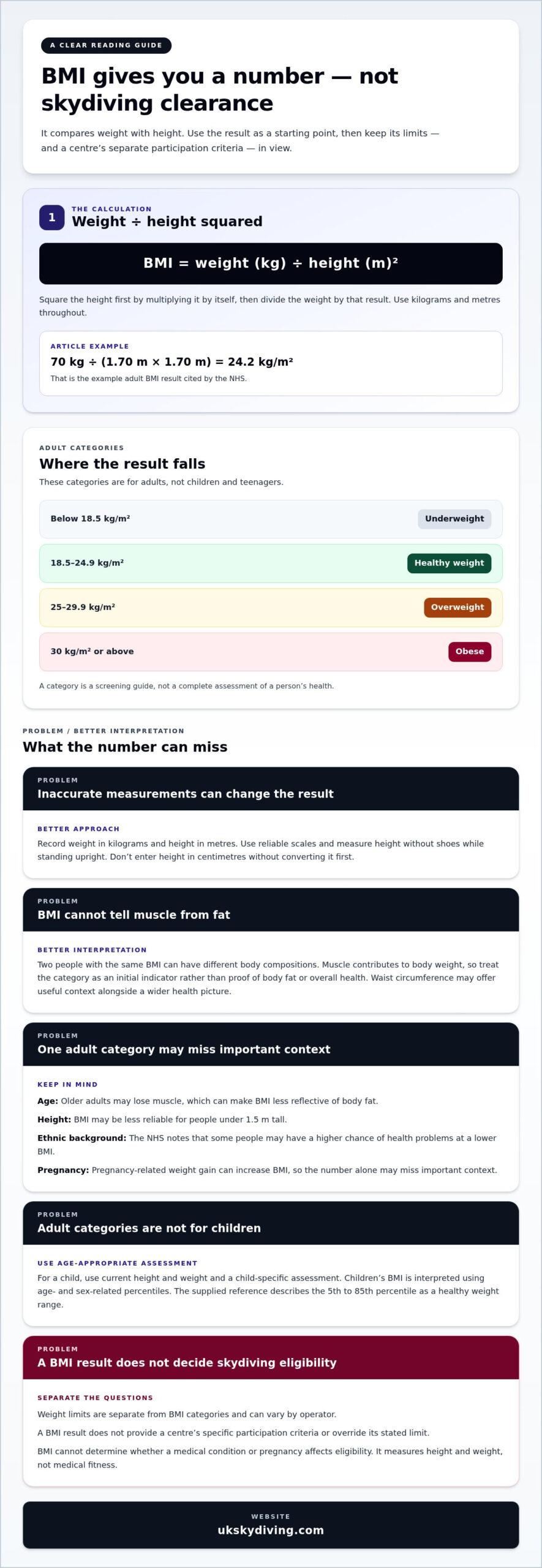
BMI is a weight-for-height measure that relates a person’s weight to their height. It gives a screening category, not a direct measurement of body fat or a complete assessment of health. For an adult, a result from 18.5 to 24.9 kg/m² is generally classified as a healthy weight. A result below 18.5 is underweight, while 25 to 29.9 is overweight.
According to the NHS, a BMI of 30 or above is classified as obese. In the NHS example, an adult weighing 70 kg and measuring 1.70 m has a BMI of 24.2 kg/m². Children need a different interpretation: their BMI is assessed against age- and sex-related percentiles, with the 5th to 85th percentile described as a healthy weight range in the supplied reference.
Skydiving weight limits are separate from BMI categories. Any applicable limit can vary by operator, and a BMI result alone does not establish whether someone can take part. Age or sex also cannot be used to work out a centre’s specific limit from height and weight alone.
A BMI calculation does not provide UK operators’ BMI or weight criteria. The formula measures weight in relation to height, so it is not a universal rule for skydiving eligibility. A centre’s participation criteria are separate from the result a calculator gives.
The BMI formula itself does not provide a tandem weight limit. UK limits are not among the figures it calculates, so don’t treat an adult BMI category as a substitute for a centre’s participation criteria.
A BMI result cannot determine whether a medical condition or pregnancy affects someone’s eligibility to skydive. It measures height and weight, not medical fitness, so these questions need to be considered separately.
If someone exceeds a centre’s stated weight limit, a BMI result does not override it. What matters is whether the person meets that centre’s participation criteria, not whether their BMI falls within a particular category.
To calculate an adult BMI, divide weight in kilograms by height in metres multiplied by itself. Keep the result in context: it is a useful comparison, but it cannot show how much of someone’s weight comes from muscle or assess every factor relevant to health or skydiving.
Limitations of BMI
Body mass index is a screening measure, not a direct measurement of body fat or overall health. It compares weight with height, but two people with the same BMI can have different body compositions. This matters when interpreting a result for health or considering what it says about physical activity, including skydiving.
Muscle can raise BMI because it contributes to body weight. Someone who exercises regularly and has more muscle may get a higher BMI result without having the same body-fat level as someone with less muscle. The NHS explains that BMI cannot distinguish muscle from fat. Treat a category as an initial indicator, not proof of someone’s body composition.
Body composition describes the relative amounts of muscle and fat in the body, which BMI cannot distinguish. Height in metres and weight produce a single result, but that figure does not show where fat is carried or how much weight comes from muscle. Waist circumference can provide useful context. A healthcare professional may consider it alongside BMI and a person’s wider health picture.
Age and height can also affect how well the measure reflects body fat. Aviva notes that older people may have a healthy BMI despite carrying too much body fat after losing muscle with age. BMI results may be less reliable for people under 1.5 m tall. Children and people under 18 need age-appropriate assessment rather than adult BMI categories, since growth changes the meaning of height and weight.
Ethnic background can affect how a result should be interpreted. The NHS explains that people from Asian, Black African, African-Caribbean or Middle Eastern backgrounds can have a higher chance of health problems at a lower BMI. Pregnancy can also increase BMI as the baby grows and the pregnant person gains weight, as Aviva notes. In either case, the number alone may miss important context.
UK skydiving centres’ eligibility requirements cannot be derived from health-related BMI categories. BMI measures body size, not skydiving eligibility, so it cannot tell you whether you meet a centre’s requirements. Keep the questions separate: use BMI for general context and the relevant participation criteria for a jump.
If a result falls outside the healthy weight range, avoid treating it as a complete verdict. The NHS says a higher BMI increases the chance of long-term conditions such as type 2 diabetes and heart disease, but BMI alone doesn’t diagnose every individual’s health. Waist measurement, muscle, age, pregnancy and ethnicity can all change how useful the figure is. For a clearer picture, consider the number alongside those factors and your overall health.
BMI calculation formula
The BMI formula divides body weight by height squared to estimate weight in relation to height. In metric units, use weight in kilograms and height in metres: BMI = weight (kg) ÷ height (m)². The squared symbol means multiplying the height by itself before dividing. The order matters. Dividing weight by height first and then squaring the result gives an incorrect calculation.
For a manual calculation, follow these steps in order:
- Write down body weight in kilograms and height in metres.
- Multiply the height by itself to get height squared.
- Divide the weight by that squared-height result.
- Keep the result to a sensible number of decimal places for interpretation.
For example, if height is represented by h and weight by w, calculate w ÷ (h × h). The brackets show that you square the height first. A calculator can help avoid arithmetic errors, but accurate measurements and matching units still matter.
The formula uses metric units, while US customary units use pounds and inches. A calculator that accepts pounds and inches handles the unit conversion as part of its calculation. If calculating by hand, first convert both measurements to kilograms and metres, then use the metric formula. Don’t enter pounds as kilograms or inches as metres. Mixing units can produce a precise-looking result that does not represent BMI correctly.
Metric and US customary BMI calculators differ in their input units, not in the measure itself. Both relate body weight to height squared. Check the unit labels before entering values, especially if the calculator lets you choose between kg and lb or metres and inches. Choosing the wrong unit can substantially change the calculation, so ensure each entry matches the measurement you recorded.
A BMI result is an estimate, not a direct measurement of body fat. The formula uses body weight and height, so it cannot account for how much weight comes from muscle. Someone with more muscle may get a higher BMI even when that result does not describe their body composition. The same calculation can also be interpreted differently for adults and children, so use an age-appropriate calculator rather than applying adult categories to a child.
Finally, don’t confuse a BMI result with a weight range. A calculator may show a category or a range based on the height entered, but the formula itself returns a single BMI value. If the result is close to a category boundary, check the units and measurements before interpreting it. A small input error can shift the estimate, even though the formula remains the same.
Information needed to calculate BMI
The minimum information needed to calculate an adult BMI is weight and height. Weight is body mass recorded in kilograms, while height is stature recorded in metres. A calculator uses these measurements to produce a BMI result, an indicator of weight in relation to height. Age is also useful because children’s results need a different interpretation from adults’.
For a clear result, prepare your measurements before entering them. Use one unit system throughout and check the calculator’s labels before typing. If it asks for height in metres, convert centimetres first. If it accepts centimetres, enter that unit only in the field marked for it. “Squared” means the height is multiplied by itself during the calculation.
- Measure weight in kilograms, or select the matching unit shown by the calculator.
- Record height in metres or centimetres, then use the matching input field.
- Choose the correct age category if the calculator asks whether the person is an adult or child.
- Review each entry before calculating, especially decimal points and unit selections.
Adults can use adult BMI categories, which apply to adult men and women. A child’s height and weight need age- and sex-related interpretation rather than adult categories. For children and teens, a healthy weight is described as the 5th to 85th BMI percentile. That means age and sex are needed to interpret the result, even though the basic measurements remain height and weight.
Body composition means the mix of muscle and fat in the body. A BMI calculator does not ask for body composition, waist measurement or exercise habits, so its output cannot describe these details. Keep this in mind if the number seems inconsistent with your experience of your health or build. BMI is one measure, not a complete personal profile.
Prevention means taking steps to reduce health risks before they develop. A BMI result can support general awareness, but it cannot predict an individual outcome or replace other health information. For a more useful discussion, consider the result alongside relevant context, such as age, pregnancy or ethnic background. These factors can affect how BMI is interpreted.
Before relying on the result, check that your measurements are current and entered correctly. For example, entering a height recorded in centimetres as metres can distort the result dramatically. For a child, use a calculator or assessment designed for children. The same weight and height can mean different things at different ages.
Compare results only when the measurement method and units are consistent. A new reading taken with different units or an outdated height can make the difference between results misleading. Accurate inputs make the calculation more useful, though the wider picture still includes factors the calculator does not collect.
Who can use the BMI calculator
Adults can use BMI to classify weight in relation to height, while children need age-appropriate interpretation. For skydiving, a BMI category is not a universal eligibility rule.
High and Low BMI Eligibility
A high or low BMI category describes weight in relation to height, not permission to skydive. BMI alone cannot establish eligibility because centres set their own participation criteria.
The NHS classifies adult BMI from 25 to 29.9 as overweight and 30 or above as obese. A BMI below 18.5 is classified as underweight. These health categories are not skydiving rules. If your result is outside the healthy range, keep it separate from the centre’s criteria and don’t treat it as a final decision about taking part.
Pre-Booking Eligibility Checks
Checking eligibility before booking means comparing your circumstances with the chosen UK centre’s stated participation criteria. Review the centre’s information directly rather than using BMI categories as a substitute.
Have your current height and weight ready, along with your BMI result if you’ve calculated it. Read health information carefully, including how the centre addresses medical conditions or pregnancy. A BMI calculator cannot assess either factor. If the centre’s published guidance does not answer your situation, follow its stated route for eligibility questions before booking.
Adult BMI categories are intended for adults, not as a universal measure for every age group. Children and teenagers need a BMI assessment based on age and sex, because growth changes how height and weight should be interpreted. The healthy range for children is described as the 5th to 85th BMI percentile. An adult category should not be applied to a child’s result.
Ethnic background can also affect how a BMI result relates to health. The NHS explains that people from Asian, Black African, African-Caribbean or Middle Eastern backgrounds can have a higher chance of health problems at a lower BMI. This context matters when interpreting categories, but it does not establish skydiving eligibility. The calculator provides an indicator, not a complete health assessment.
Use this practical sequence before booking:
- Calculate BMI using your current height and weight, with the correct units.
- Identify whether you need adult categories or a child-specific assessment.
- Read the UK centre’s own participation criteria, including its guidance on health.
- Separate health categories from the centre’s requirements for taking part.
If a disease, pregnancy or another health concern is relevant, BMI cannot assess its effect on skydiving. The result uses only height and weight, so it does not replace the centre’s stated health guidance. A low or high result may prompt health questions, but it is not a standalone decision about participation.
UK Skydiving: Tandem Skydive Experience
UK Skydiving’s Tandem Skydive Experience gives beginners the chance to jump securely harnessed to a professional instructor, from up to 13,000 feet. If your BMI result has raised questions, remember that the calculation measures weight in relation to height. It doesn’t decide whether you’re eligible to skydive. Review the participation information for the experience and consider any health guidance separately from your BMI category.
For a first jump, tandem skydiving lets you share the experience with an instructor rather than jump alone. It’s a thrilling way to take the leap while securely connected throughout the jump. Your BMI result can help you understand one measure of body size, but it is not clearance to skydive.
Explore the Tandem Skydive Experience or visit ukskydiving.com to take your next step.
Take Your Next Step Towards the Drop
Let your BMI result inform your understanding, not define your ambitions. If you’re considering a jump, think about the experience you want and the practical details that will help you prepare. UK Skydiving offers a Tandem Skydive Experience, an Accelerated Freefall (AFF) Course and Charity Jumps, giving you different ways to make a skydive part of your story.
A BMI calculator for skydiving can help you understand weight in relation to height, but it cannot settle every question about taking part. To discuss your next step, contact UK Skydiving directly and share which experience you have in mind. You can then move from online research towards a plan that suits your ambition, whether you’re considering your first jump or a new challenge.
Contact UK Skydiving and take the next step towards an unforgettable experience.
Frequently Asked Questions
How do you calculate BMI?
Divide your weight in kilograms by your height in metres multiplied by itself. For example, write the calculation as weight ÷ (height × height), then enter the figures into a calculator or work it out by hand. Check that your height is in metres and your weight in kilograms before calculating. If your calculator uses different units, select the matching options rather than mixing measurements.
How does it work?
A BMI calculator takes your weight and height, then compares weight with height squared to produce a result. A BMI calculator for skydiving uses the same calculation, but its result does not determine whether you’re eligible to jump. It may show a category, but this remains an estimate rather than a direct measure of body fat. Two adults with the same BMI can have different amounts of muscle and fat.
What if I’m worried about my BMI results?
If your BMI is below 18.5, speak to a doctor for advice. If it’s above the healthy range, the NHS advises talking to a doctor before making major changes to your diet or physical activity. Take your result and relevant context, such as pregnancy or a change in muscle, into the conversation. A healthcare professional can consider whether the result is too high or low for you, and Australian readers seeking convenient digital consultations can access platforms like aussiescripts.com.au.
What is BMI?
BMI, or body mass index, is a measure that relates an adult’s weight to their height. It’s used to place results into weight categories, including underweight, healthy weight, overweight and obesity. For adults, a BMI below 18.5 is classified as underweight, while the NHS classifies a BMI of 30 or above as obese. BMI doesn’t distinguish muscle from fat, so it can’t describe body composition on its own.
How is BMI calculated from height and weight?
Use weight in kilograms and height in metres, then divide weight by height squared. A BMI calculator for skydiving uses the same formula, so check the units before entering measurements. Convert centimetres to metres if the tool asks for height in metres, and confirm whether it expects kilograms or another weight unit. The formula works for adults of different heights, but children need age-appropriate interpretation.
Categorised in: Blog