
Latest News
-
 4 ways to make your first skydive feel more manageable November 10, 2026
-
 What’s the Scariest Part of Skydiving? How Freefall Feels November 9, 2026
-
 Parental Consent for Skydiving and Young Jumpers November 8, 2026
-
 How to Position Your Body and Breathe During Freefall November 7, 2026
-
 Pressure Changes During Skydiving: Why Your Ears Hurt November 6, 2026
What If I Don’t Like Skydiving? Guide for First-Timers
October 15, 2026 12:00 amWhat if I don’t like skydiving? It’s a fair question, especially when the thought of stepping out of an aircraft feels intense rather than exciting. Feeling nervous before a first jump doesn’t automatically mean you’ll dislike it, but you also don’t have to prove anything by going through with it.
Skydiving is a powerful experience, and people respond to it differently. Some feel exhilarated, while others find parts uncomfortable or decide it isn’t for them. The aim isn’t to talk you into a jump. It’s to help you understand what to expect and make a choice you feel good about, without pressure or fear of regretting it later.
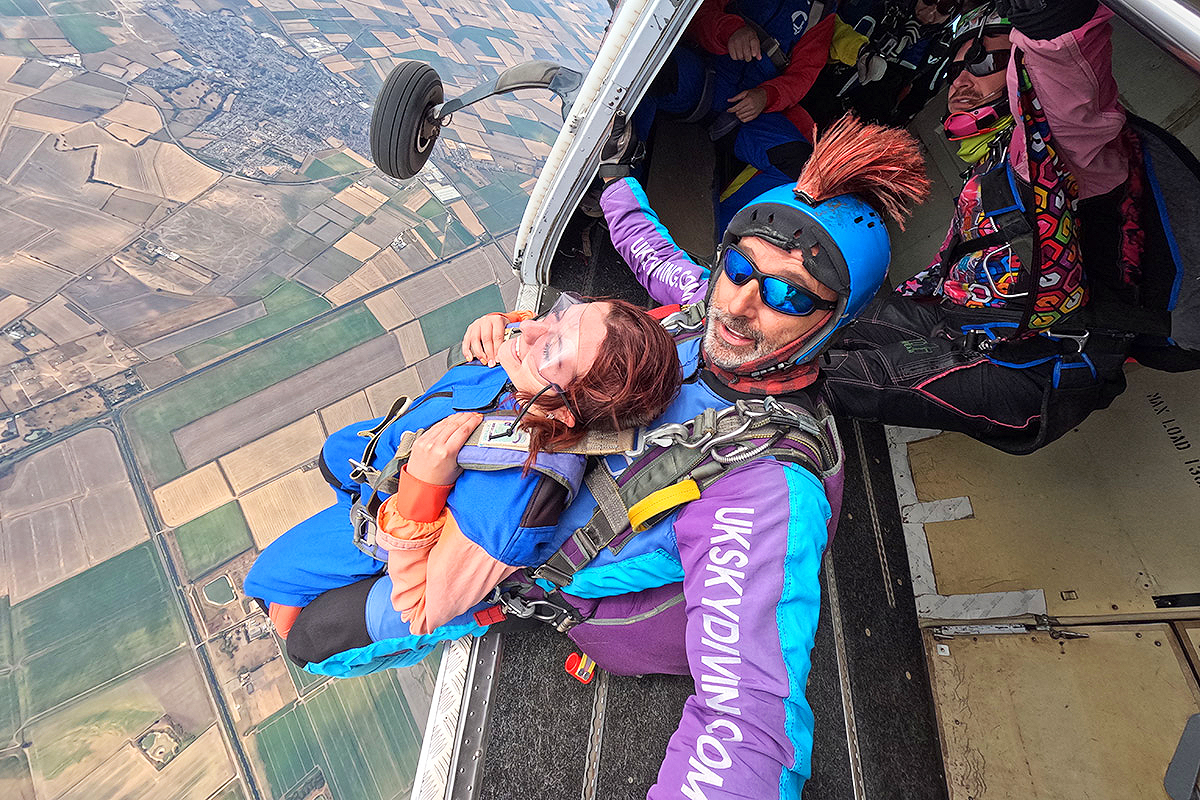
In this guide, you’ll learn how nerves can differ from genuine reluctance, what a first tandem skydive involves, and how to think through your decision. At UK Skydiving’s Cambridgeshire base, beginners jump harnessed to a professional instructor. You won’t be managing the technical parts alone, but the decision to jump remains yours.
Key Takeaways
- If you’re asking, “what if I don’t like skydiving?”, remember that people react differently, and no particular response is guaranteed.
- Nerves, outside pressure and a genuine preference not to jump are different signals. Take time to work out which best describes how you feel.
- Set realistic expectations by considering your preferences and what you know about the stages of a jump.
- Use a simple decision process: identify your reasons, understand what a tandem jump involves, notice any pressure and choose freely.
- A beginner tandem skydive with a professional instructor is an option to explore, not an obligation to take the leap.
What If You Don’t Like Skydiving? The Honest Answer
It’s possible to complete a skydive and decide you didn’t enjoy it. Skydiving can be thrilling, but a powerful experience isn’t automatically a positive one for everyone. Nobody can tell you exactly how you’ll react in advance. Someone else’s story about loving or disliking a jump can’t predict yours.
If you’re wondering, “what if I don’t like skydiving?”, you’re allowed to take that possibility seriously. You don’t need to dismiss your doubts as silly, and you don’t have to treat them as proof that you should jump or cancel. This isn’t about pushing past your instincts. It’s about understanding what “not liking it” might mean, so you can think about the experience without judging yourself.
Is it possible not to enjoy a skydive?
Yes. People bring different expectations, preferences and comfort levels to the same activity, so their reactions can differ. One person might love the intensity, while another finds it overwhelming or simply doesn’t enjoy it. Neither response is the “correct” one. If a jump isn’t for you, that doesn’t mean you failed, weren’t brave enough or did anything wrong. It means your experience was your own.
It also helps to separate enjoyment from safety. Liking or disliking a skydive describes your personal response. It doesn’t, by itself, tell you whether the activity was conducted safely. Likewise, an explanation of how skydiving works can’t guarantee how it will feel to you. The Skydiving overview gives general background on the sport, while your own expectations and preferences remain personal.
What might someone mean by not liking skydiving?
“I didn’t like it” can describe different moments. Someone might feel anxious beforehand, find one sensation uncomfortable during the jump, or feel disappointed afterwards because the experience didn’t match what they imagined. Those reactions aren’t interchangeable. Feeling apprehensive before a jump doesn’t prove you’ll dislike it, just as completing it doesn’t mean you have to call it enjoyable.
You might also have mixed feelings. Perhaps the anticipation was difficult, but another part of the experience stood out positively. Or you may decide that the jump as a whole isn’t something you’d choose again. You don’t have to turn a complicated reaction into a simple thumbs-up or thumbs-down. If it would help to picture the stages and sensations more clearly, explore what skydiving feels like.
There’s room for uncertainty. You can learn about the experience, consider what matters to you and decide at your own pace. The useful question isn’t whether you ought to enjoy skydiving. It’s whether you want to take part, knowing that your reaction will be personal.
Why People Can React Differently to the Same Skydive
Two people can share the same aircraft, jump and view, yet remember the day differently. What you expect, what you enjoy and how you feel about unfamiliar situations can all shape your experience. There’s no single emotional response every first-timer should have.
Expectations can shape how the experience feels
Skydiving is often described as pure excitement from start to finish. That may be how someone remembers it, but it isn’t a promise of constant thrills. You might feel curious, uncertain, focused or overwhelmed at different points, or find that your reaction doesn’t fit any neat description.
Friends’ stories can help you imagine the day, but they can’t predict how you’ll respond. Someone may talk about exhilaration without mentioning the waiting, unfamiliar surroundings or quieter moments. Their account is real for them, not a forecast for you. Look for descriptions that explain what happens without insisting you’ll love it, feel calm or overcome every fear. A realistic picture gives you more useful information than a guaranteed outcome.
The jump is an experience with distinct stages
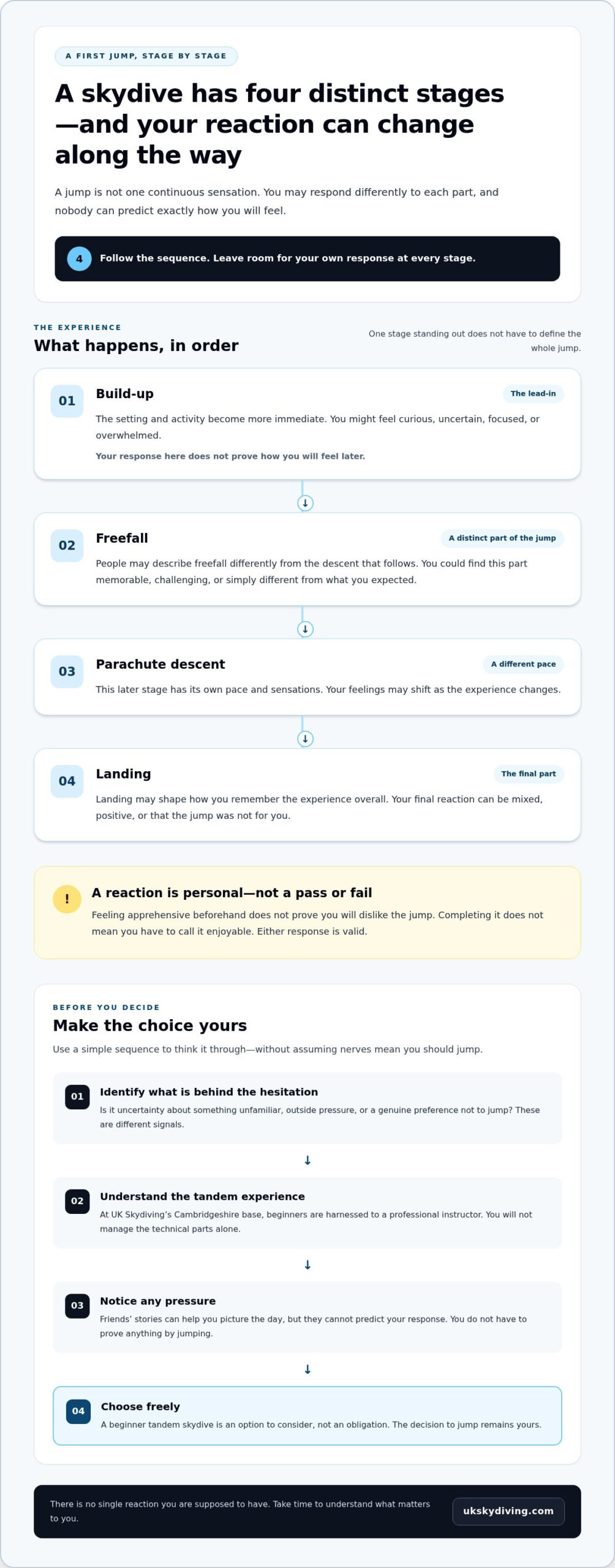
A skydive isn’t one continuous sensation. It moves through a build-up, freefall, parachute descent and landing. Each stage is different, so your response may shift too. You could find one part more memorable or challenging than another, without that deciding how you feel about the whole experience.
- The build-up: The lead-in to the jump, as the setting and activity become more immediate.
- Freefall: A distinct part of the jump that people may describe differently from the descent that follows.
- Parachute descent: A later stage with its own pace and sensations.
- Landing: The final part of the jump, which may shape how you remember the experience overall.
This is why a single label such as “exciting” or “scary” can miss the detail. You might enjoy the anticipation but feel differently during freefall. Or one stage may stand out while the rest feels less intense than you expected. There’s no need to decide in advance what each moment will mean to you. A practical tandem skydiving first-jump guide can help you understand the sequence without claiming to know your reaction.
If you’re weighing up a first jump, compare your expectations with a clear explanation of the tandem experience at UK Skydiving in Cambridgeshire. Use that information to picture the day, then leave room for your own response. Understanding the stages won’t tell you whether you’ll enjoy skydiving, but it can help you make a more informed choice.
Is It Pre-Jump Nerves or a Sign Skydiving Is Not for You?
Hesitation can come from different places. You might be curious but unsure about an unfamiliar experience, feel pushed by friends or family, or simply have little interest in jumping. These feelings deserve different responses. The goal isn’t to label every doubt as nerves to overcome. It’s to understand what’s behind yours and decide without pressure.
Questions to help you understand your hesitation
Step back from the excitement around you and ask yourself a few direct questions. There’s no perfect answer, and you don’t need to make the decision in a rush.
- Am I curious? Is there something about the experience I genuinely want to discover, even if I’m uncertain?
- Do I feel pressured? Would I still consider jumping if nobody else knew about the plan or had an opinion?
- Am I afraid, uninterested, or both? Fear can exist alongside curiosity, but a lack of interest is also a clear and valid feeling.
- What would I choose with more time? If the decision feels urgent or emotionally heightened, give yourself space to think before committing.
These questions aren’t a test you need to pass. They can help you separate your own motivation from other people’s expectations. A friend might be excited for you, or a group may already be making plans. Their enthusiasm can be kind, but it doesn’t create an obligation. If the honest answer is that you don’t want to jump, you’re allowed to take that seriously.
When nerves and reluctance are not the same question
Nerves can sit alongside genuine curiosity. You may want to know what the experience is like and still feel apprehensive about doing something unfamiliar. But nerves don’t prove that you secretly want to jump, and they don’t mean you should push yourself to continue. Only you can weigh that uncertainty against your own interest.
Reluctance may feel different. Perhaps the idea doesn’t appeal to you, even after you’ve had time to consider it. You don’t need to turn that into a challenge or find a more acceptable reason to say no. If your feelings change, that’s yours to assess too. A choice made freely matters more than meeting someone else’s idea of bravery.
If your uncertainty is specifically about changing your mind as the day unfolds, guidance on pre-jump nerves and backing out covers that separate question. For now, focus on what you want, what you’re unsure about, and whether you feel able to decide without being hurried. If you’re curious about a beginner tandem jump, you can explore UK Skydiving’s tandem experience while keeping the decision in your hands.
How to Decide Whether a Tandem Skydive Is Right for You
A good decision doesn’t have to end with a jump. It should reflect what you want, what you understand about the experience and whether you feel free to choose. If you’re asking “what if I don’t like skydiving?”, use that concern as a reason to gather information, not as a reason to talk yourself into or out of it immediately.
Check your reasons before making a commitment
Start with your own motivation. Are you drawn to the challenge or curious about the experience, or are you mainly hoping to please someone else? Wanting to prove you’re brave is different from actually wanting to jump. Give yourself time to answer honestly, away from a group decision or a moment of pressure.
Try this simple sequence:
- Identify your reason. Name what appeals to you, if anything, and what gives you pause.
- Understand the experience. Learn what a beginner tandem skydive involves instead of relying only on dramatic stories or assumptions.
- Consider pressure. Ask whether you’d still choose it if nobody else expected you to take part.
- Choose freely. Decide when you’ve had room to think, and accept that either answer can be right for you.
This matters if the jump is connected to a gift or charity commitment. A present, fundraising plan or another person’s hopes don’t make participation compulsory. You can appreciate the thought or support the cause while being honest about whether you want to jump. Don’t treat a firm no as a challenge to overcome.
Set expectations and get your questions answered
Before deciding, get a clear picture of the tandem format and consider what you’d like to know about the experience and preparation. Practical questions might include what the day involves, what you’ll be asked to do, or any personal concern that affects your decision. Useful answers can help you choose, but they don’t obligate you to go ahead.
Keep different concerns separate. If your main hesitation is about safety, look for evidence-focused information rather than relying on reassurance alone. The skydiving safety guide addresses that question separately from whether someone will enjoy a jump. Feeling informed can make the decision clearer, but no article or conversation can guarantee your personal reaction.
Then pause and check in with yourself again. Does the idea feel appealing enough that you want to explore it, even with some uncertainty? Or does it still feel like something you’re doing mainly for somebody else? If you’re genuinely curious, explore UK Skydiving’s tandem experience and use the information to make your own call. The right choice is the one you can make without being pushed.
What a First Tandem Skydive with UK Skydiving Involves
If you’re still weighing up “what if I don’t like skydiving?”, understanding the basic format can help you decide whether a first jump is something you want to explore. A tandem skydive gives a beginner the chance to experience a jump while harnessed to a professional instructor. That explains how the jump is arranged, but it can’t predict whether you’ll feel excited, comfortable or keen to do it again.
How a beginner tandem jump is structured
UK Skydiving’s tandem skydives are designed for beginners without extensive prior training. You’re harnessed to a professional instructor for the jump, from an altitude of up to 13,000 feet. “Up to” describes the highest jump altitude, not a promise that every jump takes place at that height.
A tandem format may suit someone who wants to try skydiving but doesn’t want to approach a first jump as an independent skydiver. The instructor is alongside you as you experience the jump together. That can make the arrangement easier to picture, but it doesn’t remove the intensity or guarantee enjoyment. You can value the support and still be unsure whether the activity suits you.
Think of these details as practical information, not a prediction of your reaction. Knowing that a professional instructor is with you may answer one question while leaving others open. You might still wonder how you’ll respond to the height, unfamiliar setting or different stages of the jump. Those are personal considerations, and no description can settle them for everyone.
Explore the experience at your own pace
If you’re curious, take time to understand the tandem format and consider what you’d want to know before making a decision. Write down any remaining questions about the experience, then think about whether the answers change how you feel. Compare the practical details with your own reasons for considering a jump. Curiosity doesn’t have to become a commitment.
You can explore UK Skydiving’s tandem experience as an option for a first jump. Read at your own pace, and let the information support your decision rather than make it for you. A tandem skydive may be right for you, or it may not. Choosing not to jump is a valid personal decision, just as choosing to jump after careful thought can be. Either way, making an informed choice freely is a worthwhile outcome.
Let Your Next Step Be Your Own
There’s no need to settle the question today. Give yourself room to think, especially if other people’s excitement is making the choice feel urgent. Ask what you’d want if nobody else were weighing in, then let that answer guide your next step.
If curiosity is still there, exploring the experience doesn’t commit you to jumping. You can look at the details, consider what you’d like to know and decide later. And if you’re still asking “what if I don’t like skydiving?”, remember that choosing not to take part is valid too. The aim isn’t to force certainty. It’s to make a choice that feels honest and freely made.
When you’re ready, explore UK Skydiving’s tandem experience and decide whether a first jump feels right for you.
Frequently Asked Questions
Is it normal not to enjoy skydiving?
Yes, it’s possible to finish a skydive and feel that it wasn’t enjoyable for you. People don’t need to share the same reaction for either experience to be valid. You might be glad you tried it but not want to do it again, or simply feel it wasn’t a good fit. Describe your response honestly, without comparing it with someone else’s.
Can you feel calm during a skydive instead of excited?
Yes. Excitement isn’t the only possible reaction. Some people may feel calm, focused or simply observant at certain points. There’s no required emotion to perform. Feeling calm doesn’t mean you’re reacting incorrectly or that the experience is less meaningful. Equally, you can’t count on feeling a rush. Your response may be individual and may shift as the jump progresses.
What happens if I dislike the freefall but enjoy the parachute descent?
You can have mixed feelings about different parts of the jump. Disliking freefall doesn’t cancel out enjoying the parachute descent, and you don’t have to judge the whole experience as either completely good or completely bad. Afterwards, it may help to name what felt difficult and what you appreciated. That gives you a more honest account than trying to match someone else’s description of a skydive.
Can you regret a tandem skydive even if everything goes as planned?
Yes. A jump can go according to plan and still not feel right for you. Regret may mean you wouldn’t choose the experience again, rather than that anything went wrong. If you’re concerned about that possibility, consider whether you’re choosing the jump for yourself or mainly to meet someone else’s expectations. You can’t guarantee how you’ll feel afterwards, so make the decision based on what you genuinely want.
Should I go skydiving if my friends or family are pressuring me?
You shouldn’t feel obliged to jump because friends or family want you to. Their enthusiasm can’t make the decision for you. Ask yourself whether you’d still consider it if nobody else knew, and give yourself space to answer without defending your choice. If you decide against it, a simple “I’ve thought about it, and I don’t want to jump” is enough. You don’t need to prove your reason is valid.
What if skydiving is a charity challenge and I change my mind?
Changing your mind about jumping is a valid choice, even if the skydive is connected to a charity challenge. A fundraising commitment and your decision to take part are separate questions. If you’ve already asked people to sponsor you, communicate with them and the charity about the change and any arrangements that apply to your fundraising. Don’t let embarrassment or pressure alone decide whether you jump.
Can someone enjoy the idea of skydiving but dislike the actual experience?
Yes. Being drawn to the idea, imagining the challenge or enjoying the anticipation doesn’t guarantee that the real experience will suit you. The day may feel different from the picture you built in your mind. That doesn’t make your earlier curiosity false. You can value the idea and still decide the activity itself wasn’t for you, or feel differently about it after trying it.
Categorised in: Blog