Latest News
-
 4 ways to make your first skydive feel more manageable November 10, 2026
-
 What’s the Scariest Part of Skydiving? How Freefall Feels November 9, 2026
-
 Parental Consent for Skydiving and Young Jumpers November 8, 2026
-
 How to Position Your Body and Breathe During Freefall November 7, 2026
-
 Pressure Changes During Skydiving: Why Your Ears Hurt November 6, 2026
What Does a Skydive Certificate Mean? A Clear Guide
October 7, 2026 10:00 amAfter the rush of a first jump, it’s natural to wonder what does a skydive certificate mean and whether it proves you can jump on your own. The answer depends on who issued it and what achievement the document records. A certificate’s title or design alone won’t tell you what you’re qualified to do.
A tandem skydive certificate may celebrate your experience or record that you took part. It’s a keepsake from a big day, but it isn’t the same as completing training to skydive solo. These are different milestones with different purposes.
This guide explains what details to look for, how a tandem participation record differs from progress through a structured training programme such as Accelerated Freefall (AFF), and how to avoid overstating what a document proves. Whether you’re celebrating your first jump or considering learning to skydive independently, the wording can help you understand what you’ve achieved and what your next step could be.
Key Takeaways
- To understand what does a skydive certificate mean, look beyond the word “certificate” and focus on its issuer and exact wording.
- Identify whether the document records tandem participation, course progress, or a specific qualification.
- Check the named activity, achievement, date, and any formal qualification wording before relying on the certificate as proof.
- Describe your achievement accurately on a profile or application. Don’t imply that a participation certificate qualifies you to skydive solo.
- Choose your next step based on your goal: experience a tandem jump or explore structured AFF training.
What Does a Skydive Certificate Actually Record?
A skydive certificate records the activity or achievement named on it. To understand what does a skydive certificate mean, check its wording, issuer, and context. The word “certificate” by itself doesn’t tell you whether the document marks an experience, a course milestone, or a formal qualification.
A participation certificate records an activity you took part in. A training document records progress or achievement within a course. Neither proves a solo-jumping qualification unless it clearly identifies the relevant qualification.
Why do people receive a skydiving certificate?
After a tandem skydive, a certificate may commemorate your first jump or record that you completed the experience. During a tandem jump, you’re securely harnessed to a professional instructor. Taking part in that jump is different from completing training to jump independently.
Training documents have a different purpose. They may record a course milestone as a student progresses through a structured programme such as Accelerated Freefall (AFF), which includes ground training and instructor-guided jumps. Read the exact wording, as skydiving organisations and centres may use different terms and formats. For broader context on the sport and its forms, see this Skydiving overview.
Does a certificate mean you can skydive solo?
Not necessarily. A certificate showing that you took part in a tandem experience records that participation. It doesn’t, by itself, show that you’ve completed solo training or hold a qualification to jump independently.
Look for a clear distinction between participation, training progress, and formal qualification. If a certificate uses qualification wording, read the full title and note the issuing organisation. Don’t infer solo-jumping privileges from a celebratory document or a phrase that simply sounds official.
For UK qualification terms and requirements, refer to current British Skydiving guidance. Requirements can depend on the specific qualification, so a general certificate label isn’t enough to establish what you’re qualified to do. Describe only the activity or milestone the document actually names.
Tandem, Participation, and AFF Certificates: What Is the Difference?
Skydiving documents can record very different achievements. One may celebrate a jump you took part in, while another records training progress. In practice, what does a skydive certificate mean? Read it in light of the activity and achievement it names, rather than assuming every certificate represents the same level of experience.
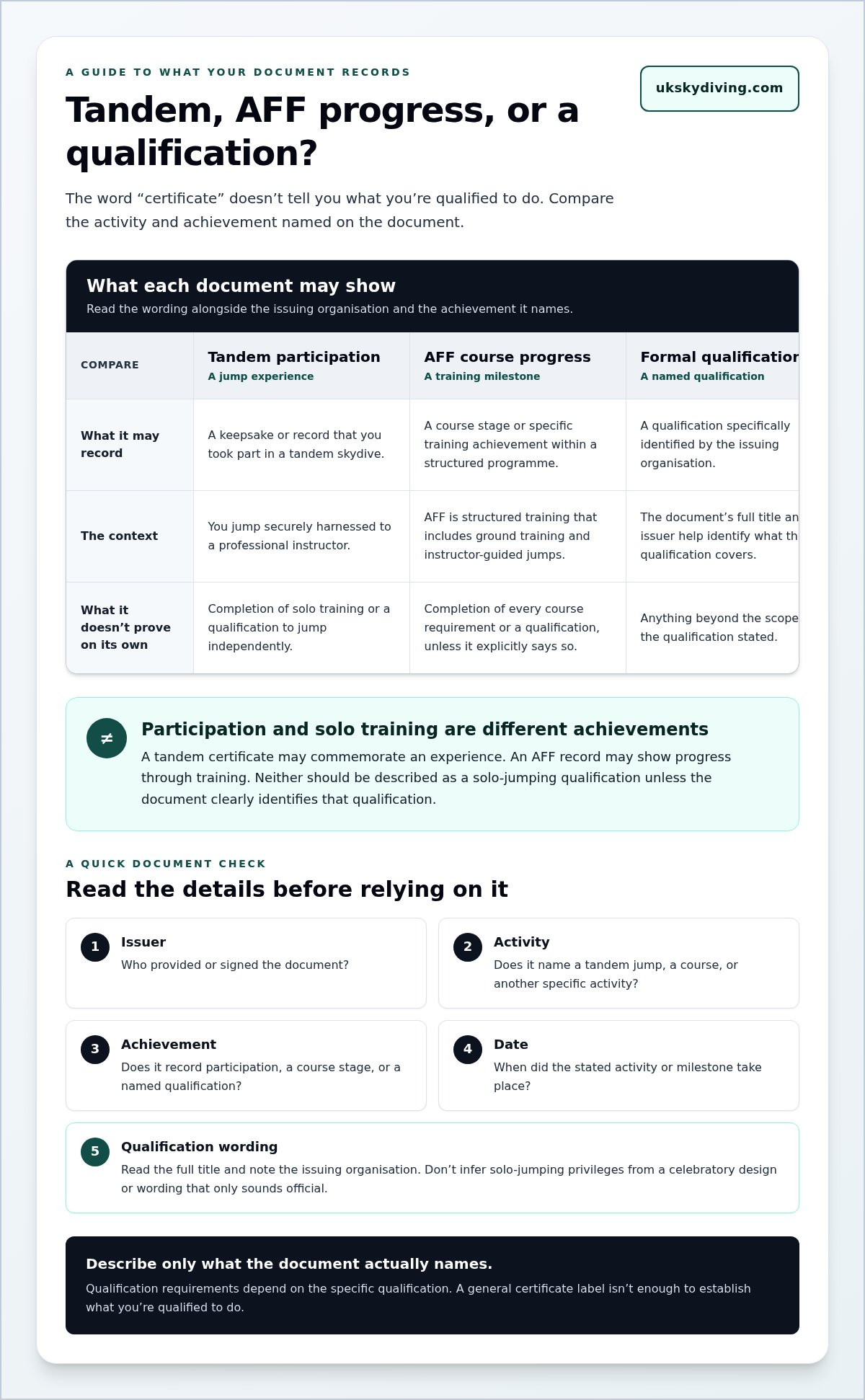
| Document type | Purpose and what it may document | What it doesn’t prove on its own |
|---|---|---|
| Tandem participation record | A keepsake or record of taking part in a tandem skydive | Completion of solo training or a solo-jumping qualification |
| AFF course-progress document | A course milestone or achievement during structured training | Completion of every course requirement or a qualification, unless it explicitly says so |
| Formal qualification document | A qualification specifically identified by its issuing organisation | Anything beyond the scope of the qualification stated |
Tandem participation and solo training are different achievements. In a tandem jump, you experience a skydive while securely harnessed to a professional instructor. AFF is a structured course for people learning to skydive solo, with ground training and instructor-guided jumps.
What might a tandem skydive certificate show?
Depending on its wording, a tandem certificate may recognise or commemorate your jump. It can be a brilliant reminder of the experience, but it doesn’t mean you completed a solo jump. In a tandem, you jump with an instructor rather than independently. If you’re considering your first experience, explore the Tandem Skydiving: The Ultimate Guide to Your First Jump for a closer look at what the experience involves.
How does an AFF training record differ?
An AFF-related document may record a course stage or a specific training achievement. It’s useful evidence of progress, but a record of one milestone shouldn’t be mistaken for proof that the full training pathway is complete. If you’re interested in solo progression, the Learn to Skydive: Your Ultimate Guide to Becoming a Licensed Skydiver can help you understand the training route.
Formal licence systems vary by country. The USPA Skydiving Licenses page explains the United States Parachute Association’s US licensing framework, which is distinct from UK qualification terminology. For any certificate, match the issuer and exact wording to the achievement it describes.
How to Read a Skydive Certificate Without Misreading It
A certificate can look impressive, but its design doesn’t establish what you’ve achieved. To work out what does a skydive certificate mean, read the details and avoid adding claims that aren’t on the document.
Which details should you look for first?
Start with the issuer, then identify the activity and achievement named. A document saying you completed a skydive may record an experience. One referring to a course milestone may show training progress. Check the date and read any qualification wording in full.
- Issuer: Who provided or signed the document?
- Activity: Does it name a tandem jump, a course, or another specific activity?
- Achievement: Does it record participation, completion of a course stage, or a named qualification?
- Date: When did the stated activity or milestone take place?
- Qualification wording: Does it identify a formal qualification, or use broader celebratory language?
Be careful with broad phrases. “Completed a skydive” shouldn’t be stretched into “qualified to skydive solo”. The first describes an activity. The second makes a claim about training or qualification. If the document doesn’t explain what was completed, treat its meaning as unclear rather than filling in the gaps yourself.
When does a certificate count as proof of qualification?
Look for wording that explicitly identifies the relevant formal qualification and its issuer. A statement that you completed a course may show a course achievement, but it doesn’t necessarily prove a separate licence or permission to jump independently. The document’s exact wording and context matter.
For example, “AFF course milestone completed” and “qualified” don’t necessarily mean the same thing. The first describes progress within training. The second suggests a qualification and needs to be supported by clear, relevant documentation. A logo, signature, or official-looking layout alone doesn’t establish formal status.
Check current British Skydiving guidance before making a definitive claim about a UK qualification. Terminology matters, and requirements can depend on the specific qualification. If a certificate uses unfamiliar wording, describe only what it plainly states until you’ve verified the term. This lets you recognise the achievement without overstating what the document proves.
What to Do If Your Skydiving Certificate Is Unclear
An unclear certificate doesn’t take away from the experience or effort it represents. It means you should be precise about what you say it proves. If you’re asking what does a skydive certificate mean, use this four-step check before relying on it:
- Identify the issuer. Look for the organisation or centre that issued the document, along with any named course or programme.
- Read the exact wording. Check the full statement, not just a prominent heading or celebratory phrase.
- Identify the activity. Is it a tandem experience, a course milestone, or another achievement?
- Verify formal terms. If the certificate names a qualification, check the wording against current British Skydiving guidance before describing it as a UK qualification.
This check helps distinguish a record of participation from evidence of training progress or a formal qualification. Don’t present a tandem experience certificate as proof that you’re qualified to skydive solo. A tandem jump is made with a professional instructor, while solo progression involves structured training.
How can you describe your achievement accurately?
Use the wording on the document as your starting point. If it records a tandem jump, describe it as a tandem skydive or tandem participation. If it records an AFF milestone, name only the progress it explicitly confirms. Don’t turn a course-stage record into a claim that you completed the whole course or hold a qualification.
For a personal profile or application, you could write “Completed a tandem skydive” or “Recorded an AFF training milestone”. These descriptions communicate the achievement without implying more than the certificate states. If key details are missing, leave out assumptions rather than making the wording sound more impressive.
What if you want to progress beyond a tandem jump?
If your goal is to learn to skydive solo, UK Skydiving offers Accelerated Freefall (AFF), a structured training route that includes ground training and instructor-guided jumps. For a fuller explanation of the progression, read Learn to Skydive: Your Ultimate Guide to Becoming a Licensed Skydiver.
A tandem jump and solo training are different experiences. The right next step depends on what you want from skydiving. Choose a tandem experience if you want to jump with an instructor, or explore AFF if you’re keen to learn through structured training. Explore skydiving experiences with UK Skydiving.
Choose Your Next Skydiving Step: A First Jump or Solo Training
A certificate records the experience or milestone named on it. It doesn’t decide what you should do next. That depends on whether you want a first taste of the freefall experience or a structured path towards learning to jump solo.
When choosing between the two, focus on your goal rather than the document’s title. A tandem certificate may be a keepsake from an incredible day. An AFF record may show training progress. Neither should be read as more than its wording supports.
Is a tandem skydive right for a first experience?
Tandem skydiving is designed for beginners who want to experience a jump with a professional instructor. You’re securely harnessed to the instructor throughout the tandem experience, with jumps from up to 13,000 feet. It offers the experience of a skydive without being the same as solo training.
Curious about what that first jump might feel like? What Does Skydiving Feel Like? A Journey Through Every Sensation offers more insight into the experience. UK Skydiving operates from March, Cambridgeshire, where you can consider a first jump at its Cambridgeshire base.
When should you explore solo-skydiving training?
If your aim is to learn to skydive solo, Accelerated Freefall (AFF) is the structured training route. It includes ground training and instructor-guided jumps. These are part of a learning programme, not simply a record of experiencing a tandem jump. Read an AFF milestone at the level it specifically records.
You don’t need to decide your whole skydiving future based on one certificate. Match your next step to your interest: choose a tandem experience for a first jump with an instructor, or explore AFF if you want to learn and progress through training. The certificate documents what you’ve done. Your goal shapes what comes next.
To explore either route, Discover your next skydiving adventure.
Make Your Next Skydiving Step Your Own
So, what does a skydive certificate mean? It records the experience or achievement stated on the document. The issuer and exact wording help show whether it marks tandem participation, training progress, or a named qualification. A tandem certificate isn’t, by itself, proof that you’re qualified to jump solo.
Let your goal guide what comes next. UK Skydiving offers tandem skydives for beginners, securely harnessed to a professional instructor. For those who want to learn to skydive solo, its structured Accelerated Freefall (AFF) course includes ground training and instructor-guided jumps. UK Skydiving operates from March in Cambridgeshire.
Ready to explore the experience that feels right for you? Explore your next skydiving experience. Whether you’re taking your first leap or starting a training journey, your next milestone can be an adventure worth remembering.
Frequently Asked Questions
Does a skydive certificate mean you are qualified to jump solo?
Not necessarily. What does a skydive certificate mean depends on its wording and issuer. A certificate records a solo-jump qualification only if it explicitly identifies the relevant qualification. A document marking a tandem jump records participation in an instructor-led experience, not independent training. Check formal UK qualification wording against current British Skydiving guidance before describing yourself as qualified to jump solo.
What does a tandem skydive certificate prove?
Depending on its wording, a tandem skydive certificate may record or commemorate your participation in a tandem jump. During the jump, you’re securely harnessed to a professional instructor. The certificate can support an accurate description of that experience, but it doesn’t, by itself, prove you completed solo training or hold a qualification to jump independently. Read the document to see exactly what it recognises.
Is an AFF certificate the same as a skydiving licence?
No, not automatically. An AFF document may record a course milestone or training achievement, while a licence is a formal qualification. The wording should make clear whether it describes progress through training or identifies a qualification. Don’t assume that a certificate for one part of a course means you hold a licence. For UK qualification terms, refer to current British Skydiving guidance.
What information should a skydiving certificate include?
There isn’t one universal format to assume. Look for the issuer, named activity or course, recorded achievement, date, and any explicit qualification wording. The document may also identify the participant. Check whether it describes taking part in a jump, reaching a training milestone, or earning a named qualification. If the details are missing or vague, avoid conclusions the certificate doesn’t support.
Can I use a tandem skydive certificate as proof of experience?
You can use it to describe the tandem experience it records, such as participation in a tandem skydive. Whether it meets the requirements of a particular application depends on what that organisation needs and what the certificate states. Be precise: a tandem jump with an instructor isn’t the same as a solo jump or evidence of solo training. Don’t present the certificate as proof of a solo-jumping qualification.
What should I do if my skydive certificate is unclear?
Identify who issued it, read the full wording, and note the activity and achievement it names. Look for explicit qualification terms rather than relying on the design or a broad phrase like “completed a skydive”. If it refers to a formal UK qualification, check the terminology against current British Skydiving guidance. Until its meaning is clear, describe only the experience or milestone it plainly records.
Categorised in: Blog