Latest News
-
 4 ways to make your first skydive feel more manageable November 10, 2026
-
 What’s the Scariest Part of Skydiving? How Freefall Feels November 9, 2026
-
 Parental Consent for Skydiving and Young Jumpers November 8, 2026
-
 How to Position Your Body and Breathe During Freefall November 7, 2026
-
 Pressure Changes During Skydiving: Why Your Ears Hurt November 6, 2026
Managing a Corporate Skydiving Event for Your Team
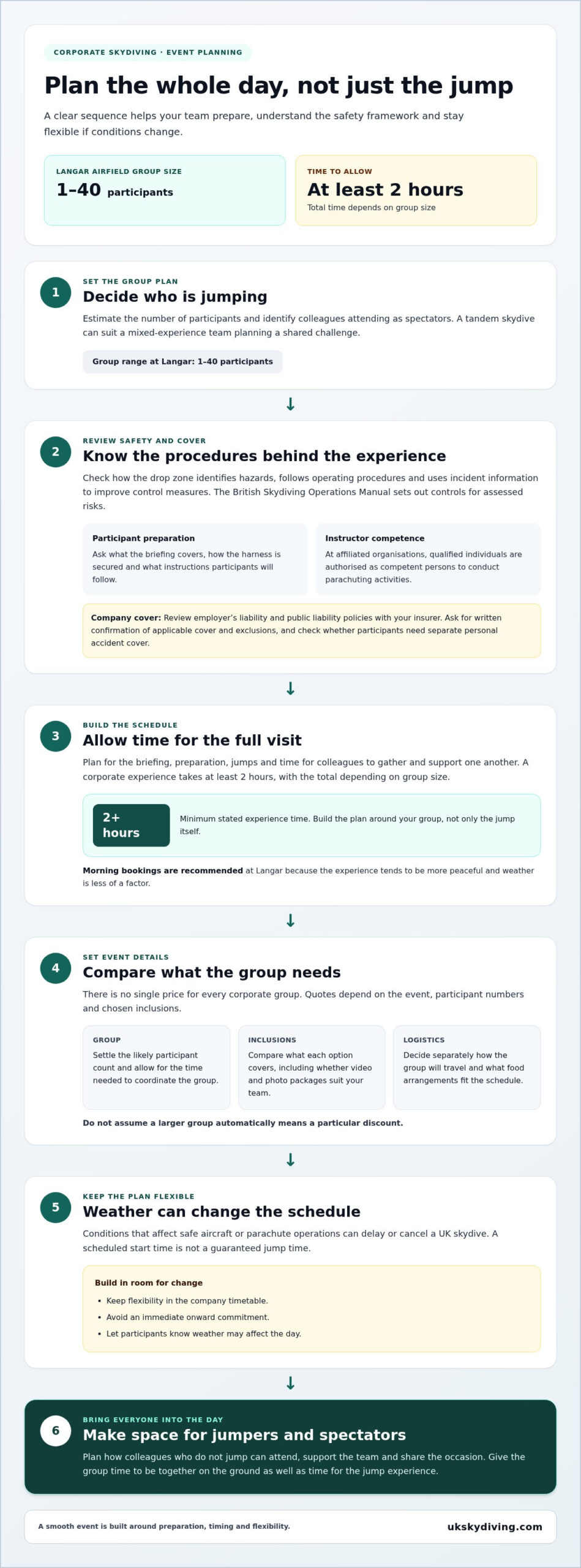
October 23, 2026 12:00 amThe jump is the headline, but the plan makes the day work. At UK Skydiving in March, Cambridgeshire, a corporate team-building skydive can include 1 to 40 participants and takes at least 2 hours, depending on group size. Managing a corporate skydiving event means allowing time for the briefing, preparation, jumps and colleagues to support one another from the ground.
It’s natural to focus on the jump, but a smooth corporate day also needs clear safety procedures, realistic timings and a plan for colleagues who don’t jump. British Skydiving’s Operations Manual sets out control measures for risks identified and assessed in sport parachuting.
This guide explains how a corporate tandem skydive works, what to consider when reviewing safety and instructor training, and how to plan arrival and timing. It also covers weather delays and ways to include non-jumping guests, so your team knows what to expect before the day.
Key Takeaways
- Review the drop zone’s operating procedures and how it uses incident information to strengthen safety measures.
- Plan the day around the full tandem experience, including preparation, briefing and the time needed to coordinate a group.
- At Langar Airfield, first jumps start at 9am and skydiving finishes at 8pm or sunset, whichever comes first.
- Make the event welcoming for non-jumpers by giving them ways to support colleagues and share the occasion.
- Choose an experience that suits your team’s aims, whether that’s a first tandem jump, a charity event or learning to skydive solo.
Checking drop-zone safety and instructor training
A tandem skydive involves a briefing, a secure harness connection and an instructor who guides the jump. Sport parachuting cannot be entirely risk-free, so each participant must voluntarily accept some risk.
When planning your corporate event, consider how the drop zone identifies hazards, follows operating procedures and learns from incidents. These practical checks help you understand the safety framework behind the experience.
Safety Management and Risk Assessment
British Skydiving supports affiliated parachute training organisations and registered display teams in managing sport parachuting risks to an acceptable level. Its approach combines regulation through the Operations Manual with a positive safety culture. When managing a corporate skydiving event, look for clear information about how risks are assessed and addressed in operating procedures.
Safety management also means learning from events. British Skydiving shares safety information and collects incident reports and data for analysis and action, helping improve control measures where needed. Ask how the drop zone communicates relevant safety information to staff and participants, and puts updated procedures into practice.
Operations Manual and Safety Controls
The British Skydiving Operations Manual sets out control measures for risks identified and assessed in sport parachuting, as well as standards for operating. At affiliated training organisations and registered display teams, parachuting activities follow the procedures in the manual.
Check that the safety information explains the procedures participants will follow, including the briefing and instructions before the jump. The manual does not guarantee that every risk can be removed. It provides an operating framework for identified risks and controls. For parachute dropping from civil registered aircraft over the UK, the UK Civil Aviation Authority says operations are regulated and must comply with the Air Navigation Order.
Instructor competence is another important consideration. At British Skydiving-affiliated parachute training organisations and registered display teams, only qualified individuals are authorised as competent persons to conduct parachuting activities. The British Skydiving Council regulates their training and qualifications through its Safety and Training Committee, assisted by competent technical staff.
For a tandem jump, the instructor guides the participant through preparation and the jump. The participant is securely harnessed to a professional instructor. Before the event, give colleagues a clear outline of the briefing, the instructor’s role and the need to follow instructions. This helps first-time jumpers know what to expect without suggesting that training removes every risk.
Employers should review their employer’s liability and public liability policies with their insurer, explaining that employees will take part in a parachute jump. Ask for written confirmation of applicable cover and exclusions, and establish whether participants need separate personal accident cover. Make these arrangements before inviting staff to commit, so the company and each participant understand their cover.
How does a corporate skydiving experience work?
At Langar Airfield in Nottinghamshire, a corporate team-building skydive can include 1 to 40 participants and takes at least 2 hours, depending on group size. Plan the booking around your team’s numbers, preferred timing and the experience you want to create.
Booking the Corporate Experience
Start by estimating how many colleagues want to jump and who will attend as a spectator. At Langar Airfield, the stated group range is 1 to 40 participants. A tandem skydive is a common first step into the sport, so it can suit a mixed-experience team planning a shared challenge.
Build the schedule around the full visit, not just the jump itself. A corporate experience takes at least 2 hours, with the total depending on group size. Morning bookings are recommended because the experience tends to be more peaceful and weather is less of a factor. Include time for colleagues to gather and support each other.
Group Bookings and Pricing Tiers
For a larger booking, settle the likely participant count before comparing package details. Group size affects the time needed to coordinate the day, so a team near the 40-person upper limit should allow for a longer visit than a smaller group. Make a list of jumpers, spectators and anyone still deciding.
There’s no single price that applies to every corporate group. The quote depends on the event, with factors such as participant numbers and chosen inclusions shaping the cost. Compare what each option covers, including whether video and photo packages suit your team. Don’t assume a larger group automatically means a particular discount.
Weather-Related Delays and Cancellations
Weather that affects safe aircraft or parachute operations can delay or cancel a UK skydive. Whether operations can proceed depends on the conditions, not just the planned schedule. Don’t treat a scheduled start time as a guaranteed jump time.
Build flexibility into your company timetable and avoid scheduling an immediate onward commitment. Let participants know the day may run differently if weather affects operations. A morning booking is recommended at Langar Airfield because weather is less of a factor, but delays are still possible.
Catering, Photography, and Transport
A corporate day can include catering, photography and transport as part of the wider event plan. Treat each as a separate logistical decision: decide how the group will travel, what food arrangements suit the schedule and whether your team wants a visual record of the day.
Photography can help colleagues share the experience afterwards. Video and photo packages are available to capture the jump, while transport and catering should fit the group’s arrival plans and time on site. For a practical plan, assign one organiser to coordinate travel and food, and keep the jump schedule flexible enough for the full group experience.
Use the tandem skydiving experience as the starting point when shaping a first-jump event for your team.
Arrival times and daily jump schedule
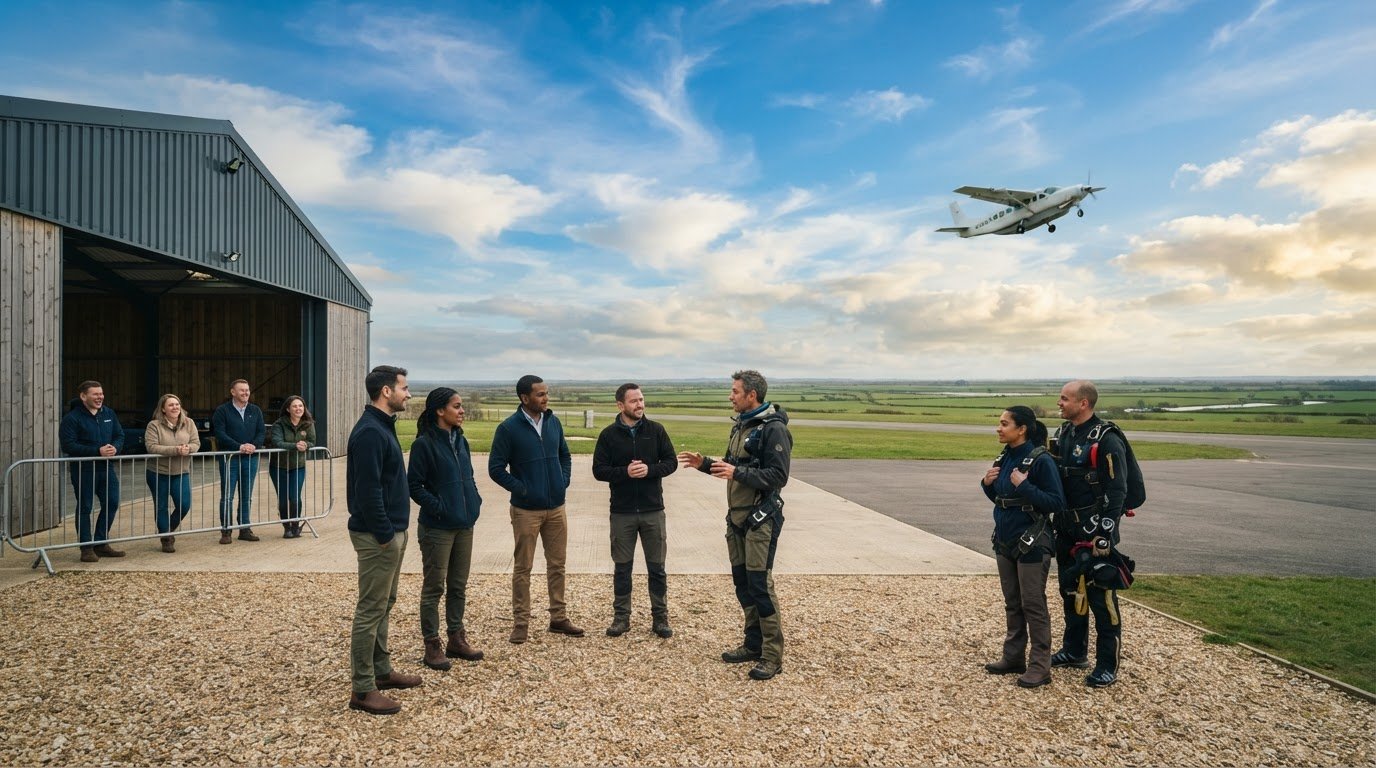
At Langar Airfield, first jumps start at 9am, and skydiving finishes at 8pm or sunset, whichever comes first. Use those limits to plan your team’s arrival, travel and end-of-day arrangements. The published jump window is a useful planning guide, not a promise that every group member will jump at a particular time.
Before event day, share arrival instructions with every participant and spectator. Ask the group to arrive together where possible, then leave time for check-in and the pre-jump briefing. Don’t arrange a meeting or onward journey around an assumed jump time. Weather and the pace of the day can affect when each person jumps.
Build your run sheet around stages rather than fixed time slots. Start with arrival and gathering, then allow for the briefing, preparation, waiting and jumps. After each jump, leave time for colleagues to reconnect with the group. This gives the organiser a clear sequence while keeping the timetable flexible enough to match the pace of operations.
The aircraft flight to exit altitude at Langar Airfield takes about 15 minutes. Tandem skydivers reach an exit altitude of 14,000 feet, then experience around 50 seconds of freefall and approximately 5 minutes under the parachute. These figures help colleagues picture the jump itself, but they don’t represent the full time each participant spends at the drop zone.
For a group, plan around individual turns and shared moments. Keep a participant list, note who has completed the briefing, and make sure the organiser can reach everyone if the running order changes. If your team includes jumpers and spectators, give non-jumpers a clear role, such as welcoming colleagues after landing.
Travel planning matters too. Choose a meeting point, share directions to Langar Airfield and agree how the group will handle late arrivals. Set an internal deadline for gathering before the scheduled start, without presenting it as an official arrival time. A named organiser can track attendance and update colleagues if the day’s sequence changes.
Because the finishing time is 8pm or sunset, whichever comes first, avoid placing the last jump close to a fixed evening commitment. The actual schedule depends on the operation’s progress and conditions. Keep transport arrangements adaptable, and tell colleagues that the day may take longer than the jump itself.
On the day, follow the drop zone’s instructions and keep participants available until their turns are complete. A calm, visible coordinator can answer team questions, direct people to the right gathering point and share schedule updates. That simple role helps the group stay together from the 9am start through the final planned activity.
Options for non-jumping spectators
Colleagues don’t need to jump to make a corporate skydive a team event. Give non-jumpers clear roles in advance, such as welcoming the group, keeping colleagues informed and celebrating with jumpers afterwards. A named organiser can coordinate these tasks and help spectators feel included rather than left waiting without a plan.
Agree a simple support plan with your team. One colleague could track who has arrived, while another gathers messages of encouragement for participants. Spectators can also help the group reconnect after each jump. Keep responsibilities practical, and make sure everyone knows who is coordinating updates if the schedule changes.
Make the event inclusive by offering different ways to join in:
- Invite colleagues to cheer on participants and share encouragement.
- Ask a volunteer to coordinate team messages and post-jump congratulations.
- Give spectators an organising role, such as keeping the group together.
- Plan a shared follow-up so jumpers and non-jumpers can look back on the day.
At a charity skydive, spectators can support jumpers and help promote the cause. An organiser can share event details through a corporate newsletter or staff noticeboard. A press release should explain who is taking part, why the event is happening, what it involves, where it takes place and when it is scheduled.
Plan publicity in advance. Email a charity skydive press release to local news desks at least two weeks before the event. This gives the organiser a clear deadline to gather details and prepare the announcement. Focus the message on the participants, the cause and the event, rather than assuming every colleague will want to jump.
Fundraising can involve colleagues who stay on the ground. Whether your team is backing first responder and disaster recovery efforts through Blue Line Relief or championing a local cause, ask the charity whether it prefers a particular online fundraising site or already has one set up. Employees can also ask their HR department or the managing director’s assistant about additional employer fundraising support. Some employers may match the amount an employee raises, so it’s worth raising this with the team organiser.
After the jump, share photographs and video footage so spectators and participants can revisit the day together. For a charity event, images can also help thank supporters and keep the fundraising story going. Decide in advance who will collect and share the material, and include non-jumpers in the recap rather than focusing only on those who jumped.
Finish with a shared team moment, such as gathering everyone for congratulations and an update. This recognises the spectators’ support, the organisers’ work and the jumpers’ achievement. It gives the whole team a common memory, even if only some colleagues chose to take to the sky.
Qualifications and competent personnel
Qualified personnel matter because a tandem jump depends on trained people carrying out defined roles. At British Skydiving-affiliated parachute training organisations and registered display teams, only qualified individuals are authorised as competent persons to conduct parachuting activities.
British Skydiving’s Council regulates the training and qualification of competent persons through its Safety and Training Committee, assisted by competent technical staff. This oversight links instructor competence to the procedures used at affiliated organisations. For a corporate organiser, the practical point is to understand who leads the participant briefing and who conducts the parachuting activities.
Ask how participants are prepared for the jump. A tandem skydive includes a briefing and instructions from the instructor, who guides the participant through the experience. Participants need to understand and follow those instructions. A clear division of roles helps colleagues know what to expect before putting on the harness.
Age and weight limits, health conditions and mobility can affect eligibility for a tandem jump. These criteria form part of the drop zone’s participant assessment, so don’t assume one person’s circumstances represent the whole team. Ask each colleague to consider their own health and ability to take part before organising the event.
Competence is also part of an organisation’s operating framework. At British Skydiving-affiliated training organisations and registered display teams, parachuting activities follow the procedures in the British Skydiving Operations Manual. The British Skydiving Council regulates the manual’s content through its Safety and Training Committee, supported by competent technical staff.
There is also a formal application route for organisations. Parachute Training Organisations and Parachute Display Teams apply through the recommendation of an Approved Person, such as British Skydiving. This recommendation process is part of how these organisations enter the framework for training and operational procedures.
For your event, use a short organiser’s checklist:
- Identify who gives participants their briefing and jump instructions.
- Make sure colleagues understand that instructions must be followed.
- Give participants a clear route for raising health or mobility concerns.
- Keep the group together so everyone receives the relevant information.
These steps help your team understand the people and processes behind the jump, without treating qualifications as a promise that risk disappears. Ready to plan a team experience? Explore tandem skydiving for your group.
UK Skydiving: Tandem Skydive Experience
UK Skydiving’s Tandem Skydive Experience gives your team a shared first-jump option, with each beginner securely harnessed to a professional instructor. It suits colleagues who want to take on the challenge together without first learning to skydive solo.
Shape the event around your team’s purpose. Choose tandem jumps for a memorable team day, Charity Jumps to fundraise, or Video and Photo Packages to capture the occasion. Colleagues who want to progress towards solo skydiving can explore the Accelerated Freefall (AFF) Course as a separate route.
With your plans and questions ready, contact UK Skydiving to discuss a Tandem Skydive Experience for your team, or visit ukskydiving.com.
Turn the team’s idea into a day to remember
The strongest corporate events give colleagues a shared goal while leaving room for different ways to take part. As you move from managing a corporate skydiving event to planning the experience, decide what matters most to your team: taking on a first jump together, supporting a cause or capturing the moment to revisit later.
UK Skydiving offers a Tandem Skydive Experience for a first jump, Charity Jumps for fundraising and an Accelerated Freefall (AFF) Course for those interested in learning to skydive solo. Choose the option that fits your team’s aims, then start a conversation about planning the day.
Contact UK Skydiving to plan your event and take the next step towards an unforgettable team experience.
Frequently Asked Questions
How much will it cost?
The cost depends on the event, and you’ll receive a quote after making a request. Key factors include the number of people jumping and what the event includes. For example, a team planning tandem jumps with video or photo packages should factor those choices into its budget. Keep catering and transport as separate event-planning costs to distinguish the skydive quote from the wider day budget.
What happens on the day?
Participants arrive, receive instructions, prepare for their jumps and take part when called. Set a meeting point for your team and choose one organiser to keep track of the group. Spectators can welcome colleagues after they land. Allow time for everyone to gather again before leaving, rather than arranging an immediate onward commitment after the final jump.
Why choose skydiving for your next away day?
Skydiving gives colleagues a shared challenge and the chance to create a vivid team memory. There are different ways to take part: some people may jump, while others support the team or help organise the day. A company could, for example, make the event a charity fundraiser. The right fit depends on what your team wants from its away day. For organisations aiming to sustain team energy beyond one-off events, adopting gamified operational systems such as DialGame.AI can provide an ongoing boost to daily workplace engagement.
How do you plan a corporate skydiving event in the UK?
Start by deciding the event’s purpose, estimating how many people want to jump and choosing a date that suits the group. Then plan travel, spectator roles and any fundraising or photo arrangements. Keep the schedule flexible and make participation a personal choice. A clear organiser and shared plan help colleagues understand what to do before travelling.
How much does a corporate group skydive cost in the UK?
There isn’t one fixed price for every corporate group. The quote depends on the number of participants and the experience or extras selected, such as video and photo packages. Request a quote based on your group’s plans, then account separately for travel, food and fundraising. This gives you a more useful event budget than relying on a generic per-person estimate.
What group sizes and booking lead times do UK drop zones require?
At Langar Airfield, a corporate skydiving group can include 1 to 40 participants. Booking lead times depend on the chosen date and the group’s arrangements, so plan early if your event has a fixed date or several colleagues to coordinate. Confirm the participant count as your plans take shape, and leave room in your schedule for the group to complete the experience together.
How should employers assess risks and obtain staff consent for a skydiving event?
Employers should consider the event’s risks, explain the activity clearly and make sure staff can choose freely whether to participate. Sport parachuting cannot be entirely risk-free, so participants must voluntarily accept some risk. Give employees a private way to raise concerns, and don’t make jumping a condition of joining the away day. Plan meaningful spectator roles so colleagues can take part without jumping.
What alternatives are available for employees who cannot or do not want to skydive?
Employees can attend as spectators, support colleagues on the ground, or help with organising and fundraising. At a charity event, they might share the cause through a staff newsletter or coordinate campaign messages. A shared gathering after the jumps also gives everyone a chance to celebrate. Make the non-jumping role part of the plan, not an afterthought.
Categorised in: Blog