Latest News
-
 4 ways to make your first skydive feel more manageable November 10, 2026
-
 What’s the Scariest Part of Skydiving? How Freefall Feels November 9, 2026
-
 Parental Consent for Skydiving and Young Jumpers November 8, 2026
-
 How to Position Your Body and Breathe During Freefall November 7, 2026
-
 Pressure Changes During Skydiving: Why Your Ears Hurt November 6, 2026
Is the Landing or the Jump Scarier? What First-Time Skydivers Can Expect
October 12, 2026 12:00 amIf you’re wondering, “is the landing or the jump scarier?”, you may be picturing the open aircraft door, the rush of freefall or an awkward touchdown. Each stage can bring up different questions, and your reaction will be personal.
Anticipation can make an unfamiliar experience seem vivid before you’ve even boarded the aircraft. For some first-time skydivers, stepping out is the biggest mental hurdle. Others are more focused on the final approach and reaching the ground. Freefall may feel different from the stomach-drop sensation they expect.
In a tandem skydive, you’re securely harnessed to a professional instructor, who manages the technical parts of the jump. That lets you focus on the experience and follow the guidance you’re given. This guide explains what may feel intense about the exit, freefall and landing, and offers practical ways to prepare for each stage. No one can predict exactly how you’ll react, but understanding the sequence can make the unknown feel less daunting.
Key Takeaways
- There’s no universal answer to “is the landing or the jump scarier?” Your reaction may depend on whether you mean the aircraft exit, freefall or the whole skydive.
- Separate the anticipation of leaving the aircraft from the sensations of freefall to identify what is behind each worry.
- Think about the landing as its own stage. Focus on your questions about the approach rather than assuming the worst.
- To feel more prepared, name your concern, learn the stage order, listen to the briefing and follow your instructor’s guidance.
- UK Skydiving’s tandem experience is designed for beginners, with participants securely harnessed to a professional instructor.
Is the landing or the jump scarier? Why first-timers worry about both
There’s no universal winner. If you’re asking, “is the landing or the jump scarier?”, the answer depends on the person and the moment they’re imagining. One first-timer may focus on the open aircraft door. Another may be more concerned about the final approach and touching down. Sometimes the build-up before either moment feels hardest.
It helps to distinguish anticipation from the experience itself. When you don’t know what to expect, your mind can fill in the gaps. The stages then unfold one at a time, and your reaction may change as you move through them. Feeling nervous beforehand doesn’t tell you exactly how you’ll feel in the air, or decide for you whether to consider a tandem skydive.
The exit can bring up worries about the unfamiliar, while landing can prompt questions about the final approach. They’re different concerns, and people don’t all experience them in the same way.
What do people mean by “the jump”?
People often use “the jump” to mean the whole skydive, but it can also refer to the instant you leave the aircraft. For a clearer picture, separate the experience into its stages: exit, freefall, descent under the parachute and landing. They’re connected, but each is a different part of the experience.
Try asking yourself which moment you’re picturing. Is it stepping out, being in freefall or coming down towards the landing area? The Parachuting overview describes the broader sequence and can help put those stages in context. You don’t need to learn every technical detail to identify what’s on your mind.
Why fear can feel different from one person to another
Expectations can shape what feels daunting. If you’ve replayed the aircraft exit in your mind, anticipation may make that moment seem especially significant. If you’re focused on landing, uncertainty about the approach may take up more of your attention. Your comfort, previous experiences and the details you imagine can all influence your response.
There isn’t one stage that is always the scariest, and somebody else’s story can’t predict how you’ll feel. You might be nervous before the exit but respond differently once the skydive is under way. Or landing may remain your main concern. Either way, identifying the specific worry is more useful than trying to decide which stage everyone finds hardest.
Name the moment you’re concerned about: leaving the aircraft, freefall or reaching the ground. That gives you a clearer question to raise during the briefing and a practical starting point for understanding what happens next.
Jumping from the aircraft versus landing: what makes each moment feel intense?
The aircraft exit and the landing can feel intense for different reasons. The exit may be the moment you’ve pictured most in advance. Landing may bring practical questions about the final approach and what to expect as you come down. Neither reaction is universal, and your attention can shift as the skydive progresses.
Why the exit can loom large before the skydive
Before a first jump, the exit can become a vivid mental image. You may find yourself thinking about the open door, the height or the decision to step out, even though you haven’t experienced it yet. Waiting can leave room for uncertainty, especially if you’re trying to imagine every detail beforehand.
Knowing the order of the stages gives that uncertainty some context. The exit is followed by freefall, then descent under the parachute. Freefall is a separate stage from deciding to leave the aircraft. Some people describe the sensation as more like floating on air than the stomach-drop they expect, but experiences vary. A clearer picture won’t dictate how you’ll feel, but it can help you focus on one part at a time.
Why the landing can prompt a different kind of worry
Landing concerns often centre on the final approach: how you’ll come down, what you’ll need to do and how it will feel to reach the ground. If you haven’t experienced a parachute descent before, it’s understandable to have questions. Separate what you know from what you’re imagining instead of assuming the landing will be uncomfortable or effortless.
On a tandem skydive, you’re securely harnessed to a professional instructor and experience the descent alongside them, rather than managing the skydive alone. The briefing and your instructor’s guidance explain what’s expected of you. A tandem format gives you an instructor to guide you through the process, but it can’t predict exactly how you’ll feel during the approach or landing.
The exit may feel daunting because you’ve had time to anticipate it, while landing worries often concern the unfamiliar final approach. One concern may centre on leaving the aircraft, while another is about what happens as you return to the ground.
If you’re considering a first jump, learning about a beginner tandem skydive can help you understand the instructor-led format. You don’t have to dismiss your nerves or decide in advance which stage will feel hardest. Start with the question that matters most to you, then use the briefing to get a clearer picture of what lies ahead.
Jump or landing: how to compare the fears without assuming the worst
Instead of deciding which stage is objectively scarier, work out what your worry is actually about. “The jump” might mean leaving the aircraft, while a concern about landing may be about the final approach or what you’ll be expected to do. Separating those thoughts can make them easier to understand without trying to predict exactly how you’ll react in the air.
A simple framework for identifying your main concern
Picture the moment that comes to mind first. Is it the height, the decision to exit, the unfamiliarity of freefall or the return to the ground? These concerns can overlap, but they aren’t identical. Naming the most vivid one gives you a clearer starting point for questions and turns a general fear of “the whole thing” into something more specific.
Use this comparison as a guide, not a forecast:
- Waiting for the exit: You may be anticipating an unfamiliar decision. Understanding the stage order can put the moment in context.
- Fear of heights: Consider whether it’s the height itself or uncertainty about what happens next that concerns you. Your answer won’t predict the whole experience.
- Freefall: This is a different stage from stepping out. Learning what skydiving feels like may help you form a more grounded picture.
- Landing: Your questions may centre on the approach and what you’ll need to do. The briefing and your instructor’s guidance can explain what to expect.
Asking “is the landing or the jump scarier?” may be less useful than asking, “Which part am I picturing, and what don’t I know about it yet?” Reflection can help you understand your nerves, but it can’t tell you exactly how you’ll feel once the skydive is under way.
What tandem changes and what it cannot promise
A tandem skydive is designed for beginners who want to experience skydiving with a professional instructor, without extensive prior training. You’re securely harnessed to the instructor, who manages the technical aspects of the jump. That’s different from learning to skydive solo, which involves training to take on more responsibility yourself.
The tandem format gives you an instructor to guide you through the experience, but it won’t necessarily make every worry disappear or guarantee a particular reaction. You may still feel nervous about the exit or have questions about landing. Raise those concerns during the briefing so you can hear clear guidance rather than rely on assumptions.
Start with your specific concern, then use the briefing to understand how it fits into the sequence. A beginner tandem skydive lets you experience the stages with a professional instructor alongside you, while leaving room for your own response to unfold.
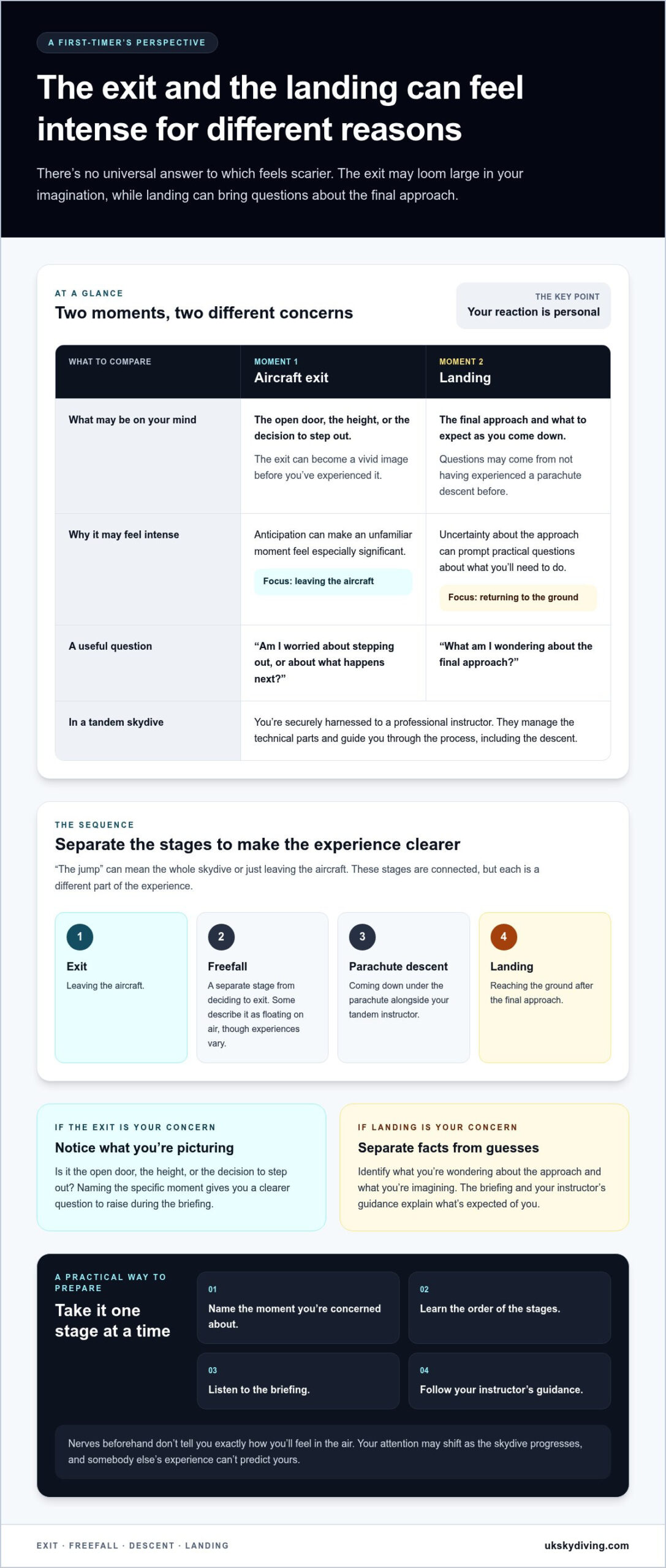
How to feel more prepared for the exit and landing
Preparation isn’t about predicting exactly how you’ll feel. It’s about giving your questions somewhere useful to go. If you’ve been wondering is the landing or the jump scarier, try this sequence: name the concern, understand the order of the stages, listen to the tandem briefing and follow your instructor’s guidance during the experience.
Before the jump: turn a vague fear into a clear question
Write down the moment you’re most concerned about: leaving the aircraft, freefall or landing. Then turn it into a question to raise during the briefing. For example, if landing is your main worry, ask what to expect during the approach and what guidance you’ll receive. A specific question is easier to discuss than a general fear of the whole skydive.
Use the briefing to clarify the sequence and your role. You don’t need to arrive knowing every detail, and you don’t need to hide your nerves. Ask about the part that feels uncertain so you can separate what you’ve imagined from the information your instructor provides. For a broader overview of first-jump preparation, read UK Skydiving’s tandem skydiving guide.
During the experience: listen and follow the instructor
On a tandem skydive, you’re securely harnessed to a professional instructor. Their guidance helps you understand what to do at each stage. Focus on the instruction you’re given as the experience unfolds rather than trying to plan every moment in advance. If a concern comes to mind during the briefing, raise it then so you can get a clear explanation.
Keep your preparation practical: learn the stage order, take in the briefing and follow the instructor’s directions. Don’t treat assumptions or someone else’s account as a guarantee of how your own exit or landing will feel. Individual reactions differ, and preparation can’t promise a particular emotional response.
If you’re looking for a broader, fact-based discussion of risk, UK Skydiving’s article on is skydiving safe can help put that question in context. Keep your focus here on the concern you want explained, whether that’s the exit, the approach or another part of the experience.
You don’t have to work through your nerves without guidance. A tandem jump is designed for beginners, and your instructor is there to guide you through the experience. If you’re ready to explore the next step, find out about a tandem skydive and turn uncertainty into informed questions.
Your first tandem skydive: take the next step with UK Skydiving
So, is the landing or the jump scarier? There’s no single answer. The aircraft exit may feel daunting because you’ve had time to anticipate it, while the landing can bring different questions about the final approach. Recognising that these are separate concerns can help you decide what you’d like to understand before taking the next step.
UK Skydiving offers tandem skydives for beginners from its Cambridgeshire base, serving North London and beyond. A tandem jump lets you experience skydiving alongside a professional instructor, without extensive prior training. You’re securely harnessed to the instructor as you experience the different stages, while your own feelings about the exit, freefall and landing remain personal.
Why tandem skydiving can suit a first-time jumper
A first jump can feel like a big step, especially if you’re unsure what to expect. Tandem skydives are designed for beginners without extensive prior training. You’re securely harnessed to a professional instructor, who manages the technical aspects of the jump. This gives you a way to experience skydiving alongside an instructor rather than learning to make a solo jump.
If you’d like a broader picture before deciding, UK Skydiving’s tandem skydiving guide can help you explore the stages of a first jump. As you read, note which questions matter most to you. You may want to understand the exit, learn more about the descent or know what guidance you’ll receive as the skydive progresses. Arriving with questions is a practical way to make the experience less abstract.
A clear next step when you are curious but nervous
You don’t have to feel completely free of nerves to explore the idea. Take it at your own pace. Revisit the information, identify what you’re still wondering about and raise your concerns with the instructor during the tandem briefing. Clear guidance can give you a better understanding, though nobody can promise exactly how you’ll feel at each stage.
UK Skydiving’s Cambridgeshire base serves people from North London and beyond who are considering a tandem skydive in the UK. Whether your main question is about stepping out or coming down, start by learning about the beginner tandem experience and deciding whether it feels right for you.
Curious about taking that first leap? Explore a tandem skydive with UK Skydiving when you feel ready.
Take your curiosity one step further
You don’t need to know in advance exactly how you’ll react to every part of a skydive. A more useful starting point is noticing what you’re curious about and what you’d like to understand better. If you’re still asking, “is the landing or the jump scarier?”, keep that question in mind as you explore what a first tandem experience involves.
Feeling nervous and excited can sit side by side. Give yourself room to consider the experience without demanding an instant decision. Start by identifying the moment you’d most like explained, then explore the information at your own pace. When you feel ready, learn what a tandem skydive involves and decide whether it’s an adventure you want to pursue.
Explore your tandem skydive with UK Skydiving. Your first step can simply be finding out more. Bring your questions, stay curious and let the next decision be yours.
Frequently Asked Questions
Is the landing or the jump scarier for a first-time skydiver?
There isn’t one answer for everyone. If you’re wondering “is the landing or the jump scarier?”, consider which part you’re picturing: the aircraft exit, freefall or the final approach. Expectations may shape what feels daunting, and your reaction can change during the experience. Rather than treating someone else’s account as a prediction, use it to identify a question to discuss during your briefing.
Does a tandem skydive landing hurt?
A landing isn’t guaranteed to be painless, and people can experience it differently. If discomfort is your main concern, ask what the landing may involve. In a tandem skydive, the instructor guides the experience, but that doesn’t mean every landing feels identical. Share your concern during the briefing and listen to the instructor’s explanation rather than relying on assumptions about how it will feel.
What happens during a tandem skydive landing?
After freefall, the parachute descent brings you towards the landing area, where the instructor guides the final approach and landing. The exact experience can vary, so don’t assume it will feel a particular way. Your instructor will explain what you need to know and provide guidance. If you’re unsure what your part involves, ask during the briefing so you understand what to expect before the jump.
Why does jumping out of a plane feel scary before the skydive?
The exit can feel daunting because it’s unfamiliar and easy to imagine in detail while you’re waiting. You may focus on the open door or the decision to leave without knowing how the next stages will feel. That anticipation doesn’t predict your reaction once the skydive begins. Write down the specific part you’re unsure about, then ask your instructor for an explanation during the briefing.
Can I skydive if I am nervous about landing?
Feeling nervous about landing doesn’t, by itself, tell you whether a tandem skydive is right for you. Identify the part that worries you, such as the approach or what you’ll be asked to do. Raise that concern with your instructor and consider their guidance before making your decision. You don’t have to pretend you’re fearless or predict your exact reaction in advance.
Is freefall scarier than the parachute descent?
It depends on the person. Freefall and the parachute descent are different stages, so one may feel more intense to you than the other. Some people expect a stomach-drop feeling in freefall, while others describe the sensation differently. The descent may bring separate questions about returning to the ground. Descriptions can provide context, but they can’t tell you exactly how either stage will feel for you.
What should I do if I feel scared before my tandem skydive?
Tell your instructor what’s worrying you and ask a specific question. Say whether you’re concerned about leaving the aircraft, freefall or landing, then listen to the briefing and follow the guidance you’re given. You can also consider what information would help you feel more prepared. Acknowledge your nerves rather than relying on guesses about the experience.
Categorised in: Blog